
The best high-quality Bluetooth audio adapter depends on your audio system, preferred sound quality, and whether you need a home or car receiver. The UGREEN Bluetooth 6.0 Receiver with LDAC is best for high-resolution wireless audio, the Auris bluMe HD is suited to stereo owners seeking multiple premium codecs, and the 1Mii B06Pro is a strong fit for home systems that need extended range and several audio connections. For a simpler setup, consider the Esinkin; for car use and calls, consider the COMSOON.
| Product | Best For | Standout Feature |
|---|---|---|
| UGREEN Bluetooth 6.0 Receiver with LDAC | High-resolution home listening | LDAC and dual-device pairing |
| Auris bluMe HD | Hi-fi stereo systems | Multiple codecs and built-in DAC |
| 1Mii B06Pro | Home systems needing range and connection options | Dual antennas and optical, RCA, AUX, and coaxial outputs |
| Esinkin Bluetooth Audio Adapter | Simple home music streaming | One-button pairing and automatic reconnection |
| COMSOON Bluetooth Receiver | Cars and hands-free calls | Noise reduction and up to 16 hours of battery life |
UGREEN Bluetooth 6.0 Receiver With LDAC

Best for: Listeners who want an LDAC-capable receiver for an existing home stereo or wired speakers. It supports LDAC decoding and audio sampling rates up to 24-bit/96 kHz, making codec support its main distinction among the options in this guide.
The Bluetooth 6.0 receiver can connect two phones simultaneously. Only one device can play at a time, so the other phone needs to pause playback before switching sources. Bluetooth 6.0 is described as supporting more stable, lower-latency transmission; the listed product details also note that Bluetooth version mainly affects connection stability and range, not sound quality.
Why it was selected: It is a relevant choice for buyers prioritizing a named high-resolution codec and shared access from two phones. To use LDAC, the transmitting device must support it too.
Consider: Buyers without an LDAC-compatible phone or other source may not benefit from the receiver’s LDAC support.
Auris bluMe HD Hi-Fi Bluetooth Receiver

Best for: Home stereo owners who want broad codec support and a built-in digital-to-analog converter. The bluMe HD supports Bluetooth 5.3 and lists aptX HD, aptX Low Latency, LDAC, and AAC decoding.
Auris describes the unit as a way to stream audio from a phone, tablet, or computer to a home stereo system. Its built-in DAC is specified as a 384 kHz/32-bit upsampling audiophile DAC. That feature set makes this model a better fit for buyers comparing audio-processing specifications and codec choices than for someone seeking only a basic AUX receiver.
Why it was selected: Its combination of several named codecs and a built-in DAC makes it a useful comparison point for high-quality home audio. Codec support depends on the source device and connection; check that your phone or computer supports the codec you intend to use.
Consider: The product information focuses on home stereo use and does not provide a stated wireless range or battery-life figure.
1Mii B06Pro Long-Range Bluetooth Receiver

Best for: Home stereo owners who need several connection choices or want a receiver designed for longer wireless reach. The listed connections include optical, RCA, AUX 3.5 mm, and coaxial, giving buyers more options for matching an existing system.
The B06Pro uses dual antennas and Class 1 Bluetooth technology. Its stated range is up to 197 feet line of sight in open air and 60 to 100 feet indoors without obstacles. Actual range can be affected by obstacles, Wi-Fi routers, or nearby stereo antennas. It also supports aptX HD, aptX Low Latency, and a switchable 3D audio mode.
On-device controls adjust volume, and holding the volume button for two seconds changes tracks. Bluetooth 5.3 is listed in the product description.
Why it was selected: It combines multiple audio outputs, range-focused hardware, and direct controls. Consider: The maximum range is a line-of-sight figure, not a guarantee for every room or setup.
Esinkin Bluetooth Audio Adapter
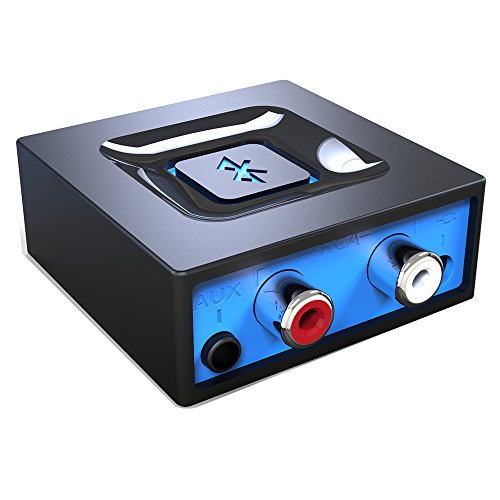
Best for: Buyers who want a straightforward way to stream music from a phone or tablet to computer speakers, a home stereo, or another speaker system. It connects through a 3.5 mm or RCA cable and uses a single central Bluetooth button for pairing and connection control.
The adapter can automatically reconnect to the previously paired device. Its stated indoor wireless range is 30 to 40 feet without obstacles. The button handles connecting or disconnecting with a click and turns the unit on or off when held for three seconds.
Why it was selected: Its simple controls, common analog connections, and automatic reconnection suit buyers who do not need advanced codec features. It is a practical comparison against more feature-rich receivers when ease of setup matters most.
Consider: The product details do not list support for high-resolution codecs such as LDAC or aptX HD. Its stated range is also shorter than the range claimed for the 1Mii B06Pro.
COMSOON Bluetooth Receiver For Car

Best for: Drivers who need to add Bluetooth streaming and hands-free calling to a car stereo with a 3.5 mm AUX input. It can also connect to home stereos, speakers, and wired headphones through its AUX adapter.
The receiver uses a Bluetooth 5.0 chip and lists CVC8.0 noise cancellation and digital signal processing for reducing echo and background noise during calls. Its stated working time is up to 16 hours for calls or music. The included Type-C cable is specified for charging, with a listed full charge time of 2.5 hours. The unit can be used while charging.
Why it was selected: Its battery, call-focused features, and AUX connection make it better suited to portable use and vehicles than the home-focused receivers above.
Consider: It connects through a 3.5 mm AUX input, so check that the intended stereo or speaker has a compatible input. The listed range and supported high-resolution codecs are not specified.
Buying Guide: How To Choose A Bluetooth Audio Adapter
A Bluetooth audio adapter, often called a Bluetooth receiver, adds wireless playback to audio equipment that has a suitable wired input. The phone or computer sends audio over Bluetooth; the receiver passes that audio to a stereo, speaker, or car system. Before choosing a model, check the source device, the receiving system, and the type of listening you plan to do.
Which connection does your stereo or car need?
Start by checking the inputs on the device you want to use. Common analog connections include RCA and 3.5 mm AUX. Some home receivers also accept optical or coaxial connections. The 1Mii B06Pro lists all four of these connection types, while the Esinkin offers RCA and 3.5 mm connections. The COMSOON is designed around a 3.5 mm AUX connection.
Match the receiver’s output to an available input on your stereo. A cable or connector is only useful if it fits both devices. If your equipment has no compatible input, a receiver alone may not be enough to connect it.
Does Bluetooth codec support matter?
Codecs determine how Bluetooth audio is encoded and transmitted. LDAC, aptX HD, aptX Low Latency, and AAC appear in the specifications of some products here. A receiver’s codec list does not guarantee that every phone will use every codec. The transmitting device must also support the codec, and the connection must select it.
For buyers who specifically want LDAC, compare the UGREEN Bluetooth 6.0 home receiver and Auris bluMe HD. For aptX HD and aptX Low Latency, the 1Mii B06Pro and Auris list those options. If you do not need a particular codec, prioritize compatible connections and easy operation instead.
How much wireless range do you need?
Range matters when the phone is not near the stereo. The 1Mii B06Pro lists up to 197 feet in open air and a lower stated range indoors without obstacles. The Esinkin lists 30 to 40 feet indoors without obstacles. These are manufacturer-provided figures, and real-world performance can vary with walls, other wireless equipment, and the placement of the receiver.
For a car or a compact listening setup, the receiver and phone may usually be close together, so an advertised long range may be less important. For a home system across a larger room, compare range claims and consider likely obstructions.
Is the adapter for home listening or car use?
Home stereo buyers may value multiple outputs, support for specific codecs, or a receiver that stays connected to a stereo system. The 1Mii, Auris, UGREEN LDAC receiver, and Esinkin are described for home audio use. For a vehicle, consider whether you need a rechargeable receiver, an AUX input, and call controls.
The COMSOON is portable, lists up to 16 hours of working time, and includes noise-reduction features for calls. A different UGREEN model in the product list also includes a microphone and hands-free calling, but check each model’s connection method and features rather than assuming all receivers share them.
Do you need hands-free calls?
Music playback and phone calls are different requirements. If you want calls routed through car speakers, check for a built-in microphone and call controls. The COMSOON lists CVC8.0 noise cancellation and DSP for calls. A receiver without a listed microphone or call feature may still stream music but should not be assumed to provide hands-free calling.
What else should you compare before buying?
- Controls: Check whether the receiver has buttons for pairing, volume, or track changes. The 1Mii lists volume and track controls; Esinkin uses a central pairing button.
- Power: Confirm whether the intended setup can keep the receiver powered. The COMSOON lists rechargeable battery operation, while product details for other models may not specify battery life.
- Device switching: If more than one person will connect a phone, check whether the receiver supports multiple paired or connected devices. The UGREEN LDAC model lists dual pairing, with one phone paused when the other plays.
- Signal conditions: Walls, nearby wireless equipment, and receiver placement can affect connection reliability. Keep expectations realistic when comparing range specifications.
Frequently Asked Questions
Can a Bluetooth audio adapter make an old stereo wireless?
Yes, if the stereo has an audio input that matches the receiver’s output. Connect the receiver to that input, pair it with a Bluetooth source, and select the appropriate input on the stereo.
Will an LDAC receiver improve sound from every phone?
No. The phone or other transmitting device must support LDAC for that codec to be used. If the source does not support LDAC, the connection uses another available Bluetooth codec.
Does a newer Bluetooth version automatically mean better sound quality?
Not by itself. Bluetooth version can affect connection characteristics such as stability and range, while audio codec support and the source device also matter to sound transmission.
Can I use a home Bluetooth receiver in a car?
Possibly, if the car has a compatible audio input and the receiver’s power requirements suit the setup. For hands-free calls, verify that the specific model lists a microphone and call features.
What is the difference between a Bluetooth transmitter and a receiver?
A receiver takes audio from a Bluetooth source, such as a phone, and sends it to wired audio equipment. A transmitter sends audio from a wired source to Bluetooth headphones or speakers. Check the product’s stated role before buying.