
The best 3-way passive crossover kit depends on your speaker impedance, intended use, and power requirements. The Audiopipe CRX-303 is a straightforward car-audio option rated at 300 watts maximum; the HiQltyla WEAH-3509A is the higher-rated adjustable choice; and the HiQltyla PUV-W3 listings are 200-watt options identified for home HiFi speakers. Compare the ratings and stated application below, then confirm that a crossover’s specifications suit your drivers before connecting it.
| Product | Stated power | Best suited to |
|---|---|---|
| Audiopipe CRX-303 | 300 watts maximum | Car-audio builds |
| 400W adjustable 3-way crossover | 400 watts | Buyers seeking an adjustable option |
| HiQltyla PUV-W3, ASIN B0CCNZDNSN | 200 watts | Home HiFi and bookshelf speakers |
| HiQltyla WEAH-3509A | 350 watts | Car or home audio with adjustable crossover |
| HiQltyla PUV-W3, ASIN B0CCNYG28K | 200 watts | Home HiFi buyers comparing listing options |
Audiopipe CRX-303 3-Way Crossover

The Audiopipe CRX-303 is a 4-ohm, 3-way passive crossover sold as a two-pack. Its listed maximum power is 300 watts. The feature information also identifies high-grade polymer capacitors, ferrite spools, and air-cooled spools.
Best for: Car-audio buyers who want a two-piece crossover set with a stated 4-ohm rating and a 300-watt maximum power figure. It is selected because its product details specifically identify it as a car-audio crossover and name several of its internal components.
Check before buying: The listing describes 300 watts as maximum power, not a continuous power rating. Confirm how that figure compares with your amplifier and speaker setup; do not treat it as a guaranteed operating level.
400W Adjustable 3-Way Crossover Pair

This product is described as a two-piece 3-way crossover rated at 400 watts and intended for speakers rated from 4 to 8 ohms. Its name says it has one high-frequency output and two low-frequency outputs, and identifies the crossover as adjustable.
Best for: Buyers comparing higher stated power handling or looking for an adjustable crossover with a 4–8-ohm range. It is included because the listing presents those points as central specifications.
Check before buying: The supplied product details do not specify adjustment ranges, crossover frequencies, or component materials. Confirm those details with the seller and check the output layout against your drivers before choosing it. Do not assume that “one high & two low” means it matches every three-driver speaker arrangement.
HiQltyla PUV-W3 200W Home Crossover
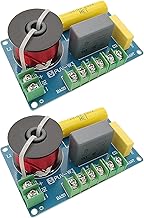
The HiQltyla PUV-W3 is described as a two-pack of passive 3-way crossovers for HiFi home audio. The listing states 200 watts and a 4–8-ohm range, and names bass, midrange, and tweeter speaker duties. Bookshelf speakers are also identified in the product name.
Best for: Home-audio builders seeking a crossover explicitly described for bookshelf speakers and bass, midrange, and tweeter drivers. Its stated impedance range offers a comparison point for systems using 4- to 8-ohm speakers.
Check before buying: The product information supplied here does not state crossover frequencies or explain whether the 200-watt rating is maximum or continuous. Verify both details against your planned speaker design rather than relying on the wattage alone.
HiQltyla WEAH-3509A Adjustable Crossover

The WEAH-3509A is listed as a 350-watt passive 3-way crossover for car and home audio. Its stated impedance range is 4 to 8 ohms, and the product name identifies it as a frequency-adjustable crossover for bass, midrange, and tweeter drivers.
Best for: Buyers who want a crossover presented for both car and home audio, with an adjustable design and a stated 4–8-ohm range. It is a useful middle option when comparing the 300-watt Audiopipe and 400-watt adjustable model.
Check before buying: The supplied details do not explain the adjustment method or provide frequency points. Confirm the available settings and their suitability for your specific drivers before installation. A stated power rating alone does not establish that the crossover is a match for every speaker system.
HiQltyla PUV-W3 200W Crossover Pair

This listing also names the HiQltyla PUV-W3, a two-pack of 200-watt passive 3-way crossovers described for HiFi home audio. Its product details specify 4–8-ohm speakers and bass, midrange, and tweeter applications, including bookshelf speakers.
Best for: Home speaker builders comparing listings for the PUV-W3 model. The described power, impedance range, and intended use match the other PUV-W3 listing in this guide, making this one relevant when checking availability and listing details.
Check before buying: The supplied product information does not establish a technical difference between this listing and the other PUV-W3 listing. Compare the current product details carefully and confirm the exact package and specifications before ordering.
Buying Guide: How To Choose A 3-Way Passive Crossover
What does a 3-way passive crossover do?
A passive crossover divides an audio signal into frequency ranges for different speaker drivers. In a 3-way setup, those ranges are typically intended for a woofer or bass driver, a midrange driver, and a tweeter. The crossover sits between the amplifier and the speaker drivers, so it must be appropriate for the system’s electrical and acoustic design.
Product labels alone are not enough to establish a good match. Crossover frequency points, filter characteristics, driver impedance, and the speaker design all matter. When those specifications are not provided, request them before purchase or consult the speaker manufacturer’s design information.
Should you choose a car-audio or home-audio model?
Start with the system where the crossover will be installed. The Audiopipe CRX-303 is specifically identified as a car-audio product. The PUV-W3 listings name HiFi home audio and bookshelf speakers. The WEAH-3509A is presented for both car and home audio, while the 400-watt model is described more generally as a speaker crossover.
These descriptions indicate intended applications, but they do not guarantee fit with a particular enclosure, amplifier, or driver set. Check the wiring arrangement and speaker specifications for your actual build.
How should you compare power ratings?
The products list different figures: 200, 300, 350, and 400 watts. These numbers are comparison points, not a complete measure of sound quality or system suitability. The supplied details do not define the rating method for every product, and the Audiopipe listing specifically says “maximum power.” Ask whether a figure is peak, maximum, or continuous before treating it as a direct comparison.
Also compare the crossover’s rating with the amplifier and speakers. A higher number does not automatically make a crossover the right choice if its frequency settings, impedance range, or output configuration do not suit the drivers.
Why does impedance matter?
Impedance is an important compatibility check. The Audiopipe product is listed for 4-ohm speakers, while the 400-watt crossover, WEAH-3509A, and PUV-W3 are described for 4–8 ohms. Confirm the nominal impedance of each driver and how the crossover is intended to be connected. Do not assume that a stated range covers every wiring configuration.
What should you check before installation?
- Confirm the crossover’s frequency points and intended driver connections.
- Match the stated impedance range to the drivers and wiring plan.
- Clarify whether the power figure is maximum, peak, or continuous.
- Check the number of crossover units included and the output layout.
- Follow the product’s wiring information and verify polarity before powering the system.
If specifications such as frequency points or adjustment ranges are missing, treat that as an unresolved buying question. The crossover must be selected for the speaker design, not just its advertised wattage or the phrase “3-way.”
Frequently Asked Questions
Can a 3-way passive crossover work with any three speakers?
No. The crossover must match the drivers’ impedance, frequency requirements, power needs, and wiring arrangement. Three drivers alone do not guarantee compatibility.
What does “4–8 ohms” mean on a crossover listing?
It indicates the impedance range stated by the product listing. Check the nominal impedance of each driver and confirm that the crossover supports the intended connection method.
Is a 400-watt crossover always better than a 200-watt crossover?
No. A higher stated rating does not establish better sound or compatibility. Frequency points, impedance, rating method, and driver requirements are also important.
Are the two HiQltyla PUV-W3 listings different products?
The supplied descriptions identify both as PUV-W3, 200-watt, 4–8-ohm, two-pack crossovers for home HiFi use. The information provided does not establish a technical difference, so compare the current listing details before selecting one.
What should I do if crossover frequencies are not listed?
Ask the seller or manufacturer for the frequency points and adjustment details. Without them, you cannot reliably confirm that the crossover will divide frequencies appropriately for your drivers.