
The best 10-inch down-firing subwoofer box depends on your available space, amplifier setup, and how much cargo you need to stack above it. The KICKER Comp is best for a straightforward 4-ohm passive setup, while the KICKER L7T suits buyers seeking a thin, cargo-friendly enclosure. The KICKER TRTP is the powered option, with a built-in amplifier. Compare the options below by design, stated power details, and installation needs.
| Product | Best For | Key Detail |
|---|---|---|
| KICKER Comp 48CDF104 | Cargo-friendly 4-ohm setup | Down-firing loaded enclosure |
| KICKER L7T 49L7TDF102 | Low-profile placement | 2-ohm, 500 watts RMS |
| ORION CDF10 | Buyers choosing a passive sub | Sealed MDF enclosure |
| Alphasonik AS10DF | Tight spaces and 4-ohm systems | 400 watts RMS |
| KICKER TRTP 51PTRTP10 | Buyers wanting an included amplifier | Powered enclosure, 400-watt amplifier |
KICKER Comp 48CDF104 10-Inch Down-Firing Enclosure

The KICKER 48CDF104 is a loaded 10-inch down-firing subwoofer enclosure with a 4-ohm impedance. Its downward-facing design is intended to preserve cargo space, and the manufacturer describes the enclosure as sturdy enough to carry cargo on top. Full-perimeter venting and a UniPlate back plate and pole piece are also listed features.
Best for: Drivers who want a ready-loaded, 4-ohm down-firing enclosure and need to keep the trunk or cargo area usable. It is a practical choice when stacking items above the subwoofer is part of the plan.
Check before buying: This listing describes a subwoofer enclosure, not a powered subwoofer. Confirm that your amplifier can work with a 4-ohm load and that its output is appropriate for the subwoofer. The supplied details do not state an RMS power rating.
KICKER L7T 49L7TDF102 Thin Down-Firing Subwoofer

This KICKER enclosure pairs a thin, square L7T Solo-Baric subwoofer with a custom-tuned down-firing box. The listing specifies a 2-ohm configuration and 500 watts RMS. Its braced enclosure is designed to resist stacking weight and scratches, and the manufacturer says it can fit under a seat or in a trunk or cargo area.
Best for: Buyers who want a low-profile design with a stated RMS rating and need an enclosure that can coexist with cargo. The internal bracing and down-firing layout make it a better fit for people who expect to place items around or above the enclosure.
Check before buying: The 2-ohm impedance matters when matching the enclosure to an amplifier. Verify the amplifier’s supported load and power output before installation. Although the listing describes a thin design, it does not provide exact dimensions in the supplied details, so measure the intended space.
ORION CDF10 Cobalt Passive Down-Firing Subwoofer

The ORION CDF10 is a passive 10-inch down-firing subwoofer enclosure intended for use with an aftermarket amplifier. Its listed construction includes MDF, an airtight seal, and a carpeted finish. ORION describes the sealed enclosure as a way to minimize vibration and provide controlled bass response. The product title states a 1,200-watt maximum rating.
Best for: Buyers who already plan to use an aftermarket amplifier and prefer a sealed, carpeted enclosure. It is a useful comparison for shoppers prioritizing a passive design and stated enclosure materials.
Check before buying: The 1,200-watt figure is listed as maximum power, not RMS power. Do not use it as a substitute for an RMS rating when matching an amplifier. The supplied product details do not give impedance, so confirm that information with the seller or product documentation before choosing an amplifier.
Alphasonik AS10DF 10-Inch Shallow Down-Firing Subwoofer
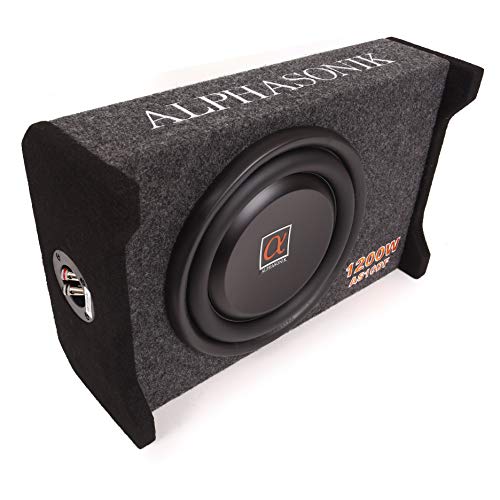
The Alphasonik AS10DF is a shallow, sealed down-firing subwoofer designed for tight spaces in cars and trucks. Its stated power ratings are 400 watts RMS and 1,200 watts maximum, and its final impedance is 4 ohms. Listed components include a spun-aluminum cone, a high-strength EPDM rubber surround, a copper-wound Kapton voice coil, and push-type terminals.
Best for: Buyers who need a shallow enclosure and want a clearly stated 4-ohm impedance and RMS rating. Those details make amplifier matching more straightforward than with products whose supplied information omits impedance or RMS power.
Check before buying: Shallow construction may help with space constraints, but it does not confirm that the enclosure will fit a particular vehicle. Measure the available area and verify the required clearance. Match amplifier output to the 400-watt RMS rating rather than relying only on the maximum figure.
KICKER TRTP 51PTRTP10 Powered Down-Firing Subwoofer

The KICKER 51PTRTP10 is a powered down-firing enclosure with a power-matched 400-watt amplifier built in. The listing describes a KICKER CompRT active thin subwoofer paired with a passive reFLEX subwoofer. The compact enclosure is presented for use in truck cabins, SUV cargo areas, and trunks, and the built-in amplifier removes the need to purchase a separate amplifier for this subwoofer.
Best for: Buyers who want an integrated subwoofer-and-amplifier unit and prefer not to select a separate amplifier. It is the clearest choice in this group for someone comparing powered and passive enclosures.
Check before buying: A built-in amplifier does not remove the need to confirm installation requirements. Check the vehicle’s available space and the product documentation for power, signal, and wiring connections. The supplied details do not provide exact dimensions or a specific factory-system compatibility list.
Buying Guide: How To Choose A 10-Inch Down-Firing Subwoofer Box
A down-firing enclosure points the subwoofer toward the floor beneath it. This orientation can help protect the driver from direct contact with cargo and can leave a flat surface above the box. The actual fit, sound, and installation depend on the enclosure and the vehicle, so compare product specifications instead of assuming every 10-inch model will work the same way.
Do You Need A Powered Or Passive Enclosure?
A powered enclosure includes an amplifier, while a passive enclosure needs a separate amplifier. The KICKER TRTP includes a power-matched 400-watt amplifier. The KICKER Comp, L7T, ORION, and Alphasonik listings describe passive enclosures or do not identify a built-in amplifier.
Choose a powered model if an integrated amplifier is a priority. Choose a passive model if you already own an amplifier or want to select one separately. In either case, check the product documentation for wiring and signal requirements before installation.
How Important Are Impedance And RMS Power?
Impedance affects whether an amplifier can safely power a subwoofer at the intended load. The KICKER Comp is listed at 4 ohms, the KICKER L7T at 2 ohms, and the Alphasonik at 4 ohms. The supplied ORION details do not state impedance, so confirm it before pairing that enclosure with an amplifier.
RMS power is more useful for matching an amplifier than a maximum power figure. The L7T lists 500 watts RMS, the Alphasonik lists 400 watts RMS, and the TRTP has a built-in 400-watt amplifier. The ORION title gives a 1,200-watt maximum rating; its supplied details do not state RMS power. Do not treat maximum and RMS ratings as interchangeable.
Will It Fit Under A Seat Or In A Trunk?
Measure the intended installation area, including height, width, depth, and any space needed for cables or ventilation. A product described as thin or compact is not guaranteed to fit every truck seat or cargo area. The supplied details do not include exact dimensions for these products, so consult the current product specifications before purchasing.
Also consider how the enclosure will affect cargo use. The KICKER Comp and L7T descriptions emphasize designs that can carry cargo above them. Keep the enclosure secure and follow its installation instructions; do not assume every down-firing model is designed for heavy stacking.
What Does The Enclosure Design Tell You?
Some listings identify a sealed enclosure, including the ORION and Alphasonik. The ORION specifies MDF construction, an airtight seal, and carpeted finish. The Alphasonik is described as an airtight sealed enclosure. Other product details emphasize down-firing placement, bracing, or a custom-tuned box.
These descriptions help compare construction and layout, but they do not establish that one enclosure will sound better in every vehicle. Vehicle cabin size, placement, amplifier matching, and installation all influence the result. Use stated specifications and fit requirements as the basis for comparison.
What Should You Check Before Ordering?
- Confirm the enclosure’s dimensions against the available space in your vehicle.
- Match the subwoofer’s impedance to the amplifier’s supported load.
- Compare amplifier output with the subwoofer’s RMS rating when one is provided.
- Check whether the product is passive or includes a built-in amplifier.
- Review wiring, signal-input, and installation requirements in the product documentation.
- Consider whether cargo will sit on or near the enclosure and follow its stated use instructions.
Frequently Asked Questions
What Is A Down-Firing Subwoofer Box?
It is an enclosure that positions the subwoofer driver facing downward. The design can keep the driver less exposed to items in the trunk or cargo area and may leave a usable surface above the box.
Can I Put Cargo On A Down-Firing Subwoofer Box?
Only do so when the manufacturer describes the enclosure as suitable for that use and the installation instructions allow it. The KICKER Comp and L7T listings specifically describe designs intended to resist or accommodate cargo above them.
Is A Powered Subwoofer Easier To Install?
A powered subwoofer has a built-in amplifier, so a separate amplifier is not needed for that unit. It still requires the correct vehicle connections and installation, so review its wiring and signal requirements before buying.
Is A 2-Ohm Or 4-Ohm Subwoofer Better?
Neither impedance is automatically better. The right choice depends on the amplifier’s supported load and intended power output. Check the amplifier specifications and subwoofer documentation to confirm they are compatible.
Is Maximum Wattage The Same As RMS Wattage?
No. Maximum and RMS ratings describe different power figures and should not be treated as equivalent. Use RMS specifications when available for amplifier matching, and seek clarification when a listing provides only a maximum rating.
How Do I Know If A 10-Inch Box Will Fit My Vehicle?
Measure the installation space and compare it with the enclosure’s exact dimensions, including clearance for connections. The 10-inch driver size does not describe the full enclosure size, so verify the product measurements before ordering.