
The best car charger power supply depends on whether you need USB charging, household-style AC outlets, or a replacement 12V cable for a specific device. The PiSFAU 200W inverter is best for travelers who want several outlet types in a compact unit; the BESTEK 300W inverter suits buyers who need more continuous AC power. The 12V cable is better for devices with compatible DC input jacks, while the Lectron station is for home EV charging—not a cigarette-lighter accessory.
| Product | Best for | Power or connection type |
|---|---|---|
| PiSFAU 200W Inverter | Multiple device types | 12V input, AC outlets and USB |
| 12V Car DC Charger Cord | Devices with a matching DC jack | 12V car outlet and interchangeable tips |
| BESTEK 300W Inverter | Higher continuous AC output | 12V input, AC outlets and USB |
| Lectron Level 2 EV Charger | Home charging for J1772 EVs | 240V NEMA 14-50 outlet |
| Pro Chaser 400W Inverter | Road trips and family travel | 12V input, AC outlets and USB |
PiSFAU 200W Car Power Inverter
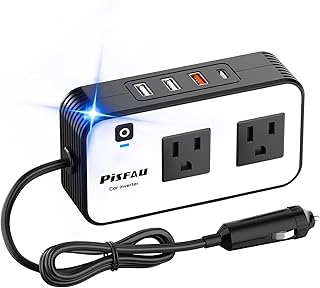
This compact inverter converts a vehicle’s 12V DC power to 110V AC and provides two standard AC outlets plus four USB charging ports. That combination makes it useful when passengers need to charge several kinds of electronics at once, such as phones, tablets, and a laptop.
Best for: Travelers who want a compact power supply with both AC and USB connections. It was selected because its four USB ports and two AC outlets cover more device connection types than a basic USB car charger. The listing describes a lightweight design measuring 2.7 by 1.4 by 5 inches and weighing 8.5 ounces.
The product description also highlights an efficiency-focused circuit design and heat-dissipation technology intended to reduce heat and operating noise.
Limitation: Its listed continuous power is 200W, so it is not the best choice if your intended AC equipment requires more power. Check the device’s power requirements before connecting it.
12V Car DC Charger Cord With Eight Connectors

This 12V car power cord is designed for equipment that accepts DC input through a compatible barrel-style connector. It includes eight connector sizes, including 5.5 x 2.1 mm, 3.5 x 1.35 mm, 4.0 x 1.7 mm, and 5.5 x 2.5 mm. The listing names potential uses such as portable DVD players, GPS devices, speakers, car refrigerators, and air compressors.
Best for: Buyers replacing a missing or unsuitable car power cord for a device with a matching 12V DC input. It was selected because the interchangeable tips offer options for different connector sizes without adding AC outlets or USB ports.
The cord has a replaceable fuse that the product description says will blow to help prevent charging failures. Match the connector dimensions and the device’s voltage and polarity requirements before use; connector fit alone does not prove electrical compatibility.
Limitation: This is not a general-purpose USB charger or AC inverter. It only suits equipment that can safely use the supplied 12V connection and a compatible tip.
BESTEK 300W Car Power Inverter

The BESTEK inverter converts vehicle DC power to 110V AC and offers 300W of continuous output with a stated 700W instantaneous output. It has two AC outlets and two USB ports, each listed at 4.8A. The 32-inch cigarette-lighter plug cord gives some flexibility in where the inverter can sit inside a vehicle.
Best for: Buyers who need more continuous AC output than a 200W model provides, along with USB charging for smaller devices. It was selected for its 300W continuous rating and combination of two AC outlets and two USB ports.
The manufacturer describes the unit as compact and lightweight for vacations, work trips, and camping. Its input range is listed as 11–17V, with the product description also mentioning Tesla compatibility.
Limitation: Its 300W continuous rating still sets a firm ceiling. Confirm the continuous wattage requirements of any AC device, and do not treat the higher instantaneous figure as a continuous operating rating.
Lectron J1772 Level 2 EV Charger

This product is a 240V home EV charging station, not a 12V car accessory or portable power supply for phones and electronics. It uses a NEMA 14-50 plug and provides up to 40A, with a 23-foot cable and a J1772 connector. The listing states that it is compatible with J1772 electric vehicles and that Tesla vehicles require a compatible NACS adapter.
Best for: EV owners seeking a plug-in Level 2 charging station for a suitable NEMA 14-50 outlet. It was included as a distinct option for people whose search for a car power supply actually concerns charging the vehicle itself at home.
The manufacturer states a charging rate of up to 38 miles of range per hour. Actual charging results can vary by vehicle and charging conditions, so use the car’s documentation for a relevant estimate.
Limitation: This charger does not plug into a vehicle’s 12V cigarette-lighter socket. It requires a compatible 240V NEMA 14-50 outlet, making it the wrong category for powering accessories while driving.
Pro Chaser 400W Vehicle Power Inverter

The Pro Chaser inverter converts 12V DC power to 110V AC and lists 400W of steady output with an 800W peak output. It has two AC sockets and two USB ports. The product information gives the USB ports a 3.1A specification and also refers to 4.8A dual USB charging, so check the manufacturer’s details for the exact port configuration before buying.
Best for: Road-trip passengers who need AC outlets and USB charging in one unit, and whose combined equipment stays within the inverter’s rated output. It was selected for its stated 400W continuous capacity, dual AC sockets, and 30-inch cord.
The listing describes it as compact and suitable for travel, outdoor activities, and everyday use on the go. It names laptops, DVD players, breast pumps, and bottle warmers as examples of equipment the AC outlets can handle, subject to their power needs.
Limitation: The listing’s USB current descriptions are not fully consistent. Verify the USB output details and confirm device wattage before relying on it for a particular load.
Buying Guide: How to Choose a Car Charger Power Supply
Start by identifying what you need to power. A USB phone charger, a 110V laptop adapter, a 12V appliance, and an electric vehicle require different equipment. Choosing by product name alone can lead to buying a supply with the wrong plug, output, or voltage.
Do You Need USB, AC, or a 12V DC Connection?
- Choose USB ports for devices that charge through USB. Check the port’s stated output and the device’s charging requirements.
- Choose an inverter with AC outlets when you need to plug in equipment with a standard household-style AC plug. The inverter converts 12V DC from the vehicle into AC power.
- Choose a 12V DC cord when your device accepts 12V DC through a matching input jack. Confirm voltage, polarity, and connector size.
- Choose an EV charging station to charge a compatible electric vehicle from an appropriate home electrical outlet. It is not a substitute for an in-car accessory charger.
How Much Inverter Power Do You Need?
Compare the inverter’s continuous output with the power requirements of every device you plan to use. The products listed here specify 200W, 300W, or 400W continuous output. A stated peak or instantaneous number describes a different rating and should not be used as the continuous capacity.
When charging more than one item, account for their combined load. If a device’s power requirements are not clear, check its label or manufacturer documentation before connecting it. Leave room below the inverter’s rated limit rather than assuming every outlet can deliver the maximum rating simultaneously.
Will the Plug and Connector Fit Your Device?
For a DC cord with interchangeable tips, compare the tip’s outside and inside dimensions with the device’s input jack. Also confirm that the power supply matches the device’s voltage and polarity requirements. A tip that physically fits may still be electrically unsuitable.
For an inverter, check that the device uses an AC plug and that its power needs fit within the inverter’s continuous rating. For an EV charger, check the vehicle connector and the electrical outlet requirements. The Lectron model listed here uses J1772 and a 240V NEMA 14-50 plug.
How Many Ports Do Passengers Need?
Count the devices that may be connected at the same time. The PiSFAU model lists four USB ports and two AC outlets, while the BESTEK and Pro Chaser models each list two USB ports and two AC outlets. More ports can make sharing easier, but port count does not tell you how much power each device receives.
What Safety Details Should You Check?
Read the product instructions and your vehicle manual before using a power inverter or replacement cord. Confirm the supported input voltage, output rating, and fuse information. Keep cables and equipment positioned as directed by the manufacturer, and do not exceed the supply’s stated capacity.
For a vehicle inverter, the cigarette-lighter socket and vehicle electrical system also matter. The product information does not establish that every vehicle socket can support a given inverter at its maximum output. Check vehicle guidance if you plan to run a higher-load device.
Frequently Asked Questions
What Is a Car Charger Power Supply?
It is a broad term for equipment that supplies power in or for a vehicle. It may refer to a USB adapter, a 12V DC cord, a 12V-to-AC inverter, or a home EV charging station. Identify the device you need to power before choosing one.
Can a Car Inverter Charge a Laptop?
An inverter can power a laptop’s AC adapter if the laptop adapter’s requirements are within the inverter’s continuous rating. Check the adapter’s wattage and the inverter’s output before use.
Is a 12V DC Cord the Same as an Inverter?
No. A 12V DC cord supplies DC power through a vehicle outlet and a compatible connector tip. An inverter converts vehicle DC power into AC power for devices with AC plugs.
Can I Use the Lectron EV Charger in a Cigarette-Lighter Socket?
No. The Lectron listing describes a 240V Level 2 charger with a NEMA 14-50 plug for charging an EV. It is not a 12V cigarette-lighter accessory charger.
Does a Higher Peak Wattage Mean an Inverter Can Run That Load Continuously?
No. Peak or instantaneous output is not the same as continuous output. Compare the device’s ongoing power requirement with the inverter’s continuous rating.
How Do I Know Whether a Replacement DC Connector Is Compatible?
Check the connector dimensions, the device’s required voltage, and the polarity. Do not rely on the connector fitting physically as proof that the cord is electrically compatible.