
The best Bluetooth line out adapter depends on the wired equipment you want to connect: choose the COMSOON for a portable car or headphone setup, the Esinkin for a simple home stereo, the KAIY for RCA or 3.5mm connections, the Aokeo for XLR equipment, or the 2-in-1 adapter when you also need Bluetooth transmission. These devices receive Bluetooth audio from a phone or tablet and send it to wired audio equipment through a compatible output. Check the input on your speaker or stereo before choosing.
| Product | Best For | Connection Highlight |
|---|---|---|
| COMSOON Bluetooth Receiver | Cars and portable listening | 3.5mm AUX |
| Esinkin Bluetooth Audio Adapter | Home stereo streaming | Home audio connection |
| KAIY Bluetooth Receiver | Flexible home stereo setups | RCA and 3.5mm |
| Aokeo AK-M1 XLR Receiver | Mixers and DJ equipment | XLR |
| 2-in-1 Bluetooth Adapter | Buyers needing transmit and receive modes | Transmitter and receiver |
COMSOON Bluetooth Receiver

The COMSOON is a portable Bluetooth receiver for sending wireless audio to equipment with a 3.5mm AUX input. Its listed uses include a car stereo, home stereo, and wired headphones. The product name also highlights noise cancelling, hands-free calling, and a stated 16-hour battery life.
Best for: Drivers and listeners who need a compact receiver for an AUX-equipped audio system, or who want to use wired headphones with a Bluetooth source. It is a practical choice when portability and call functions matter alongside music streaming.
Choose this if your audio device accepts a 3.5mm connection and you want a battery-powered receiver. Limitation: the listed connection is 3.5mm AUX, so it is not the right choice if your equipment requires RCA or XLR line-level outputs. Check the input type before ordering.
Esinkin Bluetooth Audio Adapter

The Esinkin adapter is described as a Bluetooth receiver for home stereo systems. It streams music wirelessly from smartphones and tablets to a compatible sound system, making it an option for adding Bluetooth playback to existing wired audio equipment.
Best for: People who want a straightforward home music-streaming adapter and do not need the additional features emphasized by other models. It was selected because its intended use directly matches a common line-out-adapter task: sending audio from a Bluetooth device to a home stereo.
Better for a basic home setup than a buyer seeking a car-specific unit, XLR connections, or multiple playback modes. The provided product information does not specify its exact output connectors or power arrangement. Confirm that its included connection method matches the stereo before purchasing.
KAIY RCA And 3.5mm Bluetooth Receiver

The KAIY receiver is designed to add wireless music streaming to wired speakers and stereo equipment. Its listed connections include RCA and 3.5mm jacks. It also supports TF card music playback, according to the provided product details, and includes NFC for quick connection with an NFC-enabled phone or tablet.
Best for: Buyers who need connector flexibility for a home stereo, older receiver, or compatible speaker system. RCA and 3.5mm support make it a better fit than a single-connector adapter when the user needs to match one of those common audio inputs. NFC pairing and TF card playback provide additional ways to start or play audio.
Choose this if your system has RCA or 3.5mm inputs and you value the listed NFC feature. Limitation: NFC quick connection requires an NFC-enabled source device. The product description’s broad compatibility claim should not replace checking the specific input and signal requirements of your equipment.
Aokeo AK-M1 XLR Bluetooth Receiver

The Aokeo AK-M1 is an XLR Bluetooth receiver aimed at speakers, mixers, and DJ equipment. The product name also lists a claimed 100-foot stable connection and stereo audio, with suggested use at weddings and parties. Its XLR format differentiates it from receivers made primarily for AUX or home stereo connections.
Best for: Users whose audio gear has a suitable XLR input and who want to receive wireless audio from a Bluetooth source. It was selected because it addresses the needs of event and audio setups that use mixers or other XLR-equipped equipment rather than only consumer stereo inputs.
Choose this if XLR is the connection you need. Limitation: the listed connection type makes it a poor match for systems that only accept 3.5mm or RCA. The 100-foot figure is a product claim; actual wireless range can depend on the environment and placement.
2-in-1 Bluetooth 6.0 Transmitter Receiver
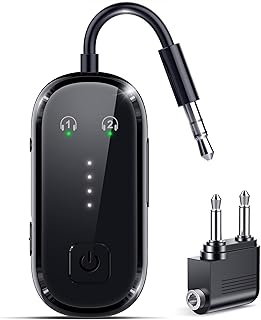
This adapter is presented as both a Bluetooth transmitter and receiver. Its listed uses include a TV, airplane, gym, car, and home. The product name also advertises dual-link support for two headphones and low-latency, stable performance. Because it has a receiving mode, it may suit buyers who want Bluetooth audio sent to a wired source, as well as buyers who need to transmit from a device to wireless headphones.
Best for: Travelers or households seeking one adapter for more than one Bluetooth task. It offers more stated operating flexibility than a receiver-only model, and dual-link support may matter when two headphones are part of the intended setup.
Limitation: the product details provided do not identify specific output connectors. Verify that the adapter’s physical connections match your line-in or line-out equipment before buying. Avoid choosing it solely for a wired stereo installation until its required cable and mode are confirmed.
Buying Guide: How To Choose A Bluetooth Line Out Adapter
What does a Bluetooth line out adapter do?
A Bluetooth receiver accepts wireless audio from a phone, tablet, or other compatible source and delivers that audio to a wired sound system. The connection from the receiver to the stereo is the important part of a line-out setup. A transmitter works in the opposite direction: it takes audio from a wired source and sends it to Bluetooth headphones or speakers. Some devices offer both modes, so confirm which mode you need.
Which output connector should you match?
Start by checking the input ports on the equipment that will play the sound. A 3.5mm AUX input is common on car stereos and smaller audio devices. RCA inputs are often found on home stereo equipment. XLR connections are used with some mixers and audio systems. Match the adapter’s output and cable to the destination input; similar-looking devices are not automatically interchangeable.
- Choose 3.5mm AUX for an AUX-equipped car stereo, headphones, or compatible home audio input.
- Choose RCA when the stereo or receiver has RCA audio inputs and the adapter supports them.
- Choose XLR when the receiving audio gear requires an XLR connection.
- Check included cables and connector details before assuming an adapter can connect directly.
Do you need a portable receiver or a home unit?
For a car or portable listening, battery life and size may matter. The COMSOON product listing states up to 16 hours of battery life and describes car and wired-headphone use. For a stationary home setup, connector fit and convenient pairing may matter more. The KAIY listing includes RCA and 3.5mm connectivity, NFC pairing, and TF card playback, while the Esinkin is positioned as a home stereo streaming adapter.
Should you buy a receiver-only or 2-in-1 adapter?
A receiver-only unit is appropriate when the goal is to stream audio from a phone to wired speakers or a stereo. A transmitter is needed when a wired source must send audio to Bluetooth headphones. A 2-in-1 product may cover both tasks, but its ports and operating modes still need to match the equipment. Do not assume a product labeled “transmitter and receiver” has every connector required for a particular line-level setup.
What other features are worth comparing?
Choose features according to the way you listen. Hands-free calling can be useful for a car-oriented receiver. NFC may simplify pairing when the source device supports NFC. TF card playback can provide another playback option, while dual-link support may be relevant when two headphones need to connect. A claimed wireless range or low-latency feature should be treated as a product specification, not a guarantee for every room or device combination.
For reliable setup, place the receiver where its wireless connection is not unnecessarily obstructed, keep the source device within a practical range, and select the correct input on the stereo. If you hear no sound, confirm that the adapter is in receiver mode, the cable is seated, the stereo is set to the correct input, and the source device is paired with the receiver.
Frequently Asked Questions
Can a Bluetooth receiver make wired speakers wireless?
Yes, if the receiver can connect to the speaker system’s audio input. The receiver takes audio from a Bluetooth source and passes it through a wired connection to compatible speakers or a stereo. Check the connector type and whether the speakers require an amplifier.
Is a Bluetooth transmitter the same as a receiver?
No. A receiver accepts Bluetooth audio and outputs it to wired equipment. A transmitter takes audio from a wired source and sends it to Bluetooth headphones or speakers. A 2-in-1 adapter may do both, depending on its selected mode.
Is a 3.5mm AUX connection the same as RCA?
No. Both can carry analog audio, but they use different connector types. Choose an adapter and cable that match the input on your stereo or audio equipment.
Can I use an XLR Bluetooth receiver with a home stereo?
Only if the stereo has a compatible XLR input or you have an appropriate, confirmed connection method. Check the equipment manuals and adapter specifications rather than assuming an XLR receiver connects directly to RCA or AUX inputs.
Will any Bluetooth adapter work with any phone?
Bluetooth pairing is only one part of compatibility. The adapter’s audio output, operating mode, and any special features must also fit the destination equipment and source device. Confirm connector requirements and feature support before purchasing.