
The best midrange speaker driver depends on your enclosure, crossover, impedance, and intended sound system. These five options range from compact 3-inch full-range drivers to a larger 8-inch midrange driver. The GRS and Dayton Audio models suit compact-driver comparisons, while the Pyle and Visaton models are identified as midrange drivers. The Celestion is the clearest choice for buyers who need stated sensitivity and power-handling information. Confirm each driver’s specifications and installation requirements before choosing.
| Product | Best suited for | Useful listed detail |
|---|---|---|
| GRS 3FR-4 | Compact full-range projects | 3-inch, 4-ohm full-range driver |
| Pyle PDMR5 | Projects calling for a 5-inch midrange | 5-inch high-performance midrange driver |
| Visaton M 10 | Buyers seeking a sealed-back 4-inch midrange | 4-inch, 8-ohm sealed-back driver |
| Celestion 8-inch Midrange | Buyers prioritizing published performance details | 94 dB sensitivity and 100 W RMS handling |
| Dayton Audio PC83-8 | Compact full-range driver comparisons | 3-inch, 8-ohm poly-cone driver |
GRS 3FR-4 Full-Range Driver
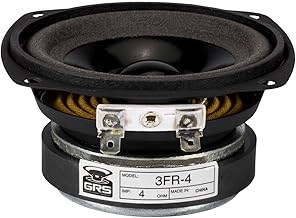
The GRS 3FR-4 is a 3-inch, 4-ohm full-range speaker driver. Its compact size and full-range designation make it a candidate for projects where a small driver is being considered to reproduce a broad portion of the audio spectrum. The product name identifies the size and nominal impedance, two details that can help narrow an initial search.
Best for: DIY builders comparing compact full-range drivers, especially when a 4-ohm driver is needed. It was selected because it offers a different design category from the products explicitly described as midrange drivers.
Check before buying: The supplied product information does not state sensitivity, power handling, frequency response, or recommended enclosure. Confirm those details against the manufacturer’s documentation and compare them with your amplifier and design. Avoid choosing it solely because the word “full-range” appears in its name; system results depend on the complete design.
Pyle PDMR5 5-Inch Midrange Driver

The Pyle PDMR5 is identified as a 5-inch high-performance midrange driver. The stated size places it between the compact 3-inch options and the 8-inch Celestion in this group. It may be a useful product to compare when a project calls for a dedicated midrange driver rather than a model labeled full-range.
Best for: Buyers who need to investigate a 5-inch midrange driver for a speaker build or replacement project. It was selected because its product name directly identifies it as a midrange driver and specifies its diameter.
Check before buying: The supplied listing information does not include impedance, sensitivity, power handling, frequency range, or mounting dimensions. Those details matter for amplifier matching, crossover planning, and physical fit. Choose this model only after confirming that its complete specifications align with the rest of the system.
Visaton M 10 Sealed-Back Midrange

The Visaton M 10 is described as a 4-inch sealed-back cone midrange driver with an 8-ohm impedance. Its sealed-back construction is an important distinction to review when comparing it with open-back drivers. The listed size and impedance also provide more initial selection information than is supplied for some of the other products here.
Best for: Builders considering a 4-inch, 8-ohm midrange driver and specifically looking for a sealed-back design. It was selected for its explicit midrange designation and clear construction, size, and impedance details.
Check before buying: The provided information does not specify sensitivity, power handling, frequency response, or the exact mounting requirements. Sealed-back construction alone does not establish whether a driver will suit a particular cabinet or crossover. Check the full manufacturer specifications and the available installation space before ordering.
Celestion 8-Inch Midrange Driver

The Celestion is an 8-inch midrange driver with stated sensitivity of 94 dB and power handling of 100 watts RMS under the AES standard. Its listing also specifies a 1.75-inch high-temperature copper voice coil wound on a polyimide former, and says the driver achieves optimal performance in compact enclosures. These supplied details make it the most specification-rich option in this selection.
Best for: Buyers comparing larger midrange drivers who want published sensitivity and RMS power-handling figures. It was selected because these figures and construction details help buyers evaluate it alongside the rest of a system.
Check before buying: The stated power-handling figure is not a guarantee of compatibility with every amplifier or crossover. Verify impedance, frequency response, mounting dimensions, and other system requirements in the full specifications. Choose this model if its size and electrical details suit your design, not on power handling alone.
Dayton Audio PC83-8 Full-Range Driver

The Dayton Audio PC83-8 is named as a 3-inch full-range poly-cone driver. The product name also includes “8,” but the supplied information does not explicitly spell out the impedance unit. Check the product documentation to confirm the electrical specifications rather than inferring details from the model name.
Best for: Buyers comparing small full-range drivers with a poly-cone construction. It was selected because its 3-inch size and full-range designation make it a useful compact alternative to the GRS 3FR-4.
Check before buying: The information provided here does not include sensitivity, power handling, frequency response, or enclosure recommendations. Confirm the complete specifications and fit before integrating it into a project. Choose it over a dedicated midrange driver only when a full-range design matches the intended system.
Buying Guide: How to Choose a Midrange Speaker Driver
Do you need a dedicated midrange or a full-range driver?
A dedicated midrange driver is intended for the midrange part of a speaker system. A full-range driver is labeled for broader audio reproduction, although that label does not by itself tell you how it will perform across the frequencies your project requires. The Pyle, Visaton, and Celestion products are explicitly called midrange drivers. The GRS and Dayton Audio products are labeled full-range.
Start with the design goal. If you are replacing a driver in an existing speaker, identify the original driver’s role and specifications. If you are designing a new system, decide whether you need a dedicated midrange alongside other drivers or a compact full-range unit. Then check frequency-response data and crossover requirements from the manufacturer.
Which driver size should you compare?
Diameter affects the physical space needed for installation, but it is not enough to determine whether a driver is suitable. The options here include 3-inch, 4-inch, 5-inch, and 8-inch models. Measure the mounting location and check the driver’s actual cutout and overall dimensions before purchase; the nominal diameter in a product name may not provide all the measurements needed for a fit.
Smaller drivers may be relevant when a project has limited space, while larger models require an installation plan that accommodates their dimensions. Do not assume that a larger driver is automatically a better choice. Match the driver size to the enclosure, baffle, crossover design, and intended listening setup.
How important is impedance?
Impedance is a key amplifier-matching consideration. The listed product names identify the GRS 3FR-4 as 4 ohms and the Visaton M 10 as 8 ohms. The supplied details do not clearly state impedance for every other product, so check the full specifications before connecting a driver to an amplifier or combining it with other drivers.
When replacing a speaker driver, compare the replacement’s impedance with the original and the system requirements. In a new multi-driver design, consider the combined load presented to the amplifier. Do not assume that two drivers with the same diameter are electrically interchangeable.
What do sensitivity and power handling tell you?
Sensitivity can help compare how efficiently drivers convert an input signal into sound, but comparisons are meaningful only when the measurement conditions are consistent. The Celestion listing states 94 dB sensitivity. The supplied information for the other products does not provide a sensitivity figure, so avoid treating missing data as evidence that a product performs better or worse.
Power handling describes a stated power limit under specified conditions; it does not replace amplifier matching, crossover design, or responsible use. The Celestion is listed at 100 watts RMS under the AES standard. For the other choices, confirm power-handling information in their full documentation before selecting an amplifier or setting system levels.
What should you check before installation?
- Dimensions: Confirm cutout diameter, mounting depth, and clearance using the manufacturer’s specifications.
- Impedance: Match the driver to the amplifier and the other drivers in the system.
- Frequency response: Check whether the driver covers the frequencies assigned to it in your design.
- Crossover: Review crossover frequency and slope requirements rather than relying only on the driver’s size or label.
- Enclosure: Follow the manufacturer’s enclosure guidance. The Celestion listing mentions compact enclosures, but the supplied details do not provide a specific enclosure volume.
- Documentation: Verify any missing electrical or installation data before ordering or wiring the driver.
These checks are particularly important when replacing a driver. A similar-looking unit may differ in impedance, mounting dimensions, or operating range. For a new build, make the driver, crossover, enclosure, and amplifier decisions together so that one component does not constrain the rest of the system.
Frequently Asked Questions
What is the difference between a midrange driver and a full-range driver?
A midrange driver is intended to reproduce the middle portion of a speaker system’s frequency range. A full-range driver is labeled for broader coverage. The labels do not replace detailed frequency-response data, so consult the specifications to see whether a specific driver suits your design.
Which product in this list has the most stated specifications?
The Celestion 8-inch midrange driver has the most performance details in the supplied information: 94 dB sensitivity, 100 watts RMS power handling under the AES standard, a 1.75-inch high-temperature copper voice coil, and a polyimide former.
Which listed drivers have a stated impedance?
The GRS 3FR-4 is listed as 4 ohms, and the Visaton M 10 is listed as 8 ohms. Confirm the impedance of the other products in their full product documentation before matching them to an amplifier.
Can a full-range driver replace a midrange driver?
Not automatically. The system’s frequency range, crossover, enclosure, and electrical requirements determine whether a full-range model can serve the intended role. Compare the driver’s manufacturer specifications with the original design before making a replacement.
Should I choose a driver based on diameter alone?
No. Diameter helps assess physical fit, but impedance, frequency response, sensitivity, power handling, mounting dimensions, and enclosure requirements also matter. Compare these specifications as a set before selecting a driver.
What should I verify when product details are missing?
Look up the manufacturer’s data for impedance, sensitivity, frequency response, power handling, mounting dimensions, and enclosure recommendations. The supplied information for several drivers does not include all these details, so verify them before purchase and installation.