
The best small vacuum tube amplifier depends on whether you want a ready-to-use system or a DIY board. The Fosi Audio MC331 is best for a compact, all-in-one setup with multiple inputs; MICNAUX is best for hands-on tone adjustment; and the Eujgoov kit is best for DIY builders. The Juson JTA100 is a more connected hybrid option, while the Kuuleyn board kit offers another 6J1 preamp design. Check each product’s output and connection requirements against your speakers and sources before buying.
| Product | Best For | Format |
|---|---|---|
| Fosi Audio MC331 | Multiple digital and analog sources | Integrated amplifier and DAC |
| MICNAUX 5654W | Equalizer and volume control | Compact tube amplifier/preamp |
| Eujgoov 6J1 kit | DIY assembly | Amplifier board kit |
| Kuuleyn 6J1 board | DIY preamp projects | Tube preamp/headphone amp kit |
| Juson Audio JTA100 | Many source connections | Hybrid integrated amplifier |
Fosi Audio MC331 All-In-One Tube Amplifier
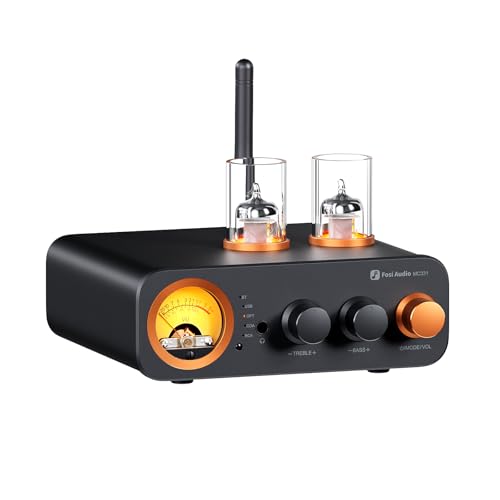
The Fosi Audio MC331 combines a DAC, amplifier, preamplifier, and headphone amplifier in one unit. Its listed connections include Bluetooth, USB, coaxial, optical, and RCA. A remote control is included for switching sources, and the unit has a VU meter and visible tubes for a retro-style appearance.
Best for: Buyers who want a compact desk or home listening system with several types of audio sources. The combination of digital inputs and headphone output can reduce the need for separate components. It is a more complete choice than a bare DIY board when the goal is a ready-made integrated system.
Choose this if you need an amplifier that can accept audio from a computer, phone, CD player, or a turntable with a built-in phono preamp. Limitation: the listed product details do not provide dimensions or output specifications, so confirm that its physical size and speaker requirements fit your setup.
MICNAUX 5654W Compact Tube Amplifier

The MICNAUX is described as a compact tube amplifier with 5654W vacuum tubes, volume control, and a three-band equalizer. Its product information says it can be used as a preamplifier with audio systems that include active speakers and phono or turntable equipment. It also lists support for several tube models, including 6J1, EF95, 6P1, 6AK5, 403A, and 403B.
Best for: Listeners who want direct control over high, mid, and low frequencies, or who are looking for a tube preamp for an existing audio setup. The built-in EQ is a practical difference compared with the MC331’s emphasis on integrated DAC and input options.
Choose this if tone adjustment and a compact enclosure matter more than a listed selection of digital inputs. Limitation: the supplied features do not specify its input types, output power, or dimensions. Verify that it connects appropriately to your existing equipment before purchase.
Eujgoov 6J1 Vacuum Tube DIY Kit

This Eujgoov product is a board-based DIY tube amplifier kit centered on a 6J1 preamp. The listed design includes eight 470-microfarad capacitors for filtering and DC 12V filament power. The product description says the filaments need to be connected in series to reduce noise, making power and assembly details important considerations.
Best for: Electronics hobbyists who want to build or integrate a tube preamp board rather than buy a finished amplifier. The small-board format can suit a custom project where the builder plans the enclosure, wiring, and connections.
Choose this if you are comfortable checking the circuit and completing the required connections. It is not the most straightforward option for someone seeking a plug-and-play speaker amplifier. Limitation: the listing describes a DIY kit and does not establish that it includes a finished enclosure, all required accessories, or a complete standalone audio system. Confirm the included parts before starting.
Kuuleyn 6J1 Tube Preamp Board Kit
The Kuuleyn kit is listed as a 6J1 tube preamp and headphone amplifier board kit. Its product features describe eight 470-microfarad capacitors and DC 12V filament power, with the filaments connected in series to reduce noise. The stated use is to place the 6J1 preamp between a sound source and an amplifier.
Best for: DIY builders who want to add a tube preamp stage to a separate audio project. Compared with a finished integrated amplifier, this board offers a project-focused format and calls for the buyer to plan how it will connect to the rest of the system.
Choose this if you need a preamp board and already have a suitable downstream amplifier or a project plan. Limitation: product details do not give dimensions, full assembly instructions, or a complete list of included components. The listing also closely resembles another 6J1 kit, so compare the included parts and documentation carefully before choosing.
Juson Audio JTA100 Hybrid Tube Amplifier

The JTA100 combines a vacuum-tube preamp with transistor power amplification. Its listed inputs include AUX, coaxial, phono, optical, and Bluetooth 5.0. It also has headphone and subwoofer outputs, a remote, and a high-low gain switch for the headphone output. The product description states 200 watts RMS output and says the headphone output is intended for headphones from 16 to 600 ohms.
Best for: Buyers who need varied source connections and want one amplifier to handle speakers, headphones, and a subwoofer output. Its hybrid design distinguishes it from the small preamp boards, while the digital and phono inputs offer flexibility for a mixed-source system.
Choose this if connectivity and multiple output options matter more than a minimalist, board-level project. Limitation: the product information provided does not include dimensions, so it cannot be confirmed as the best fit for a space-constrained desk or shelf. Check the physical footprint and speaker requirements before purchase.
Buying Guide: How To Choose A Small Vacuum Tube Amplifier
Do you need a finished amplifier or a DIY board?
A finished unit is usually the more direct option when you want to connect sources and speakers without designing a circuit or enclosure. The Fosi MC331 and Juson JTA100 are integrated products with multiple listed connections. The Eujgoov and Kuuleyn products are board kits, so buyers should expect to assess assembly, power, wiring, and enclosure needs instead of treating them as complete, ready-to-use systems.
Check the product description for what is included. A board kit may not provide a finished case or every part needed for a particular project. If you are new to electronics, confirm the assembly requirements and power specifications before ordering.
Which inputs and outputs should you check?
Start by listing the sources you plan to connect: a computer, phone, CD player, turntable, or another amplifier. The MC331 lists Bluetooth, USB, coaxial, optical, and RCA inputs. The JTA100 lists AUX, coaxial, phono, optical, and Bluetooth. For turntables, distinguish a phono input from a line-level connection: the JTA100 lists phono, while the MC331 is described as working with turntables that have a built-in phono preamp.
Also check the output you need. Some buyers need speaker connections, others want a headphone output, and some want a subwoofer output. Do not assume an amplifier supports a particular connection simply because it has other audio inputs. Confirm the exact input and output options in the product listing.
Is a tube preamp the same as a tube power amplifier?
No. A preamp processes a source signal before it reaches a power amplifier; it does not necessarily drive passive speakers on its own. The Eujgoov and Kuuleyn descriptions position their 6J1 circuits as preamps placed between a source and an amplifier. The MICNAUX is described as usable as a preamp with systems such as active speakers. Check whether the product can directly power your speakers or needs another component.
The MC331 is described as an integrated amplifier, while the JTA100 uses a tube preamp stage and transistor power amplification. Those configurations are more appropriate starting points for buyers seeking a combined component, but confirm speaker compatibility and output details for the intended system.
How important are size and placement?
“Small” can mean a compact desk unit, a short component for a crowded shelf, or a circuit board for a custom enclosure. The supplied product details call the MICNAUX compact but do not give measurements. Dimensions are not listed in the provided details for several other products either. Measure your available space and compare it with the manufacturer’s current product specifications before buying.
Placement also matters for a project board. Plan for the enclosure, wiring, power connection, and access to controls. For finished amplifiers, consider how you will reach the inputs and controls once the unit is installed.
Should you choose extra controls or simpler operation?
Choose based on how much adjustment you expect to use. The MICNAUX lists independent volume control and a three-band EQ, which suits buyers who want to adjust frequency ranges. The MC331 emphasizes source flexibility and remote source switching. The JTA100 adds a headphone gain switch, remote control, and multiple input types. A DIY board may offer a smaller project footprint, but requires the builder to handle more setup decisions.
What should DIY buyers verify before powering a kit?
Read the product instructions and verify the required supply voltage, connection order, component list, and grounding approach. The Eujgoov and Kuuleyn descriptions specify DC 12V filament power and say the filaments should be connected in series to reduce noise. Do not assume that the board can be connected directly to every source or power supply. If the instructions or parts list are unclear, resolve those questions before assembly.
Frequently Asked Questions
What is the best small vacuum tube amplifier for a desk setup?
The Fosi Audio MC331 is a strong option when you want an integrated amplifier and DAC with several listed inputs and a headphone output. Verify its dimensions and speaker requirements before choosing it for a specific desk.
Can a 6J1 preamp board power passive speakers?
The Eujgoov and Kuuleyn descriptions identify their products as preamp or board kits, not clearly as complete speaker power amplifiers. Check the kit documentation and plan for a separate power amplifier if required.
Which option has a built-in equalizer?
The MICNAUX lists a three-band equalizer with high, mid, and low frequency adjustment, plus independent volume control.
Which amplifier has Bluetooth and digital inputs?
The Fosi MC331 lists Bluetooth, USB, coaxial, and optical inputs. The JTA100 lists Bluetooth 5.0, coaxial, and optical connections, along with AUX and phono inputs.
Are tube amplifiers compatible with every speaker?
No. Compatibility depends on amplifier output, speaker requirements, and the available connections. The provided details do not establish compatibility with every speaker, so check the amplifier specifications and your speaker’s requirements before purchase.
What should I check before buying a small amplifier?
Confirm its dimensions, input and output types, whether it is a preamp or power amplifier, power requirements, and whether the product is a finished unit or a DIY kit. These checks help prevent a mismatch with your available space and audio equipment.