
For a 50-watt, 8-ohm speaker, match the speaker type to the job: Goldwood’s 8-inch coaxial drivers suit enclosure builds, while Pyle’s horn speakers are designed to project announcements or sound across indoor and outdoor spaces. The Goldwood two-speaker set is best when you need a matched pair. The Edifier M60 is a powered desktop alternative, not a 50-watt, 8-ohm passive speaker.
| Product | Best suited for | Key distinction |
|---|---|---|
| Goldwood GW-8004/8 two-speaker set | Building a stereo or paired setup | Two 8-inch coaxial drivers; 50 watts maximum each |
| Pyle 8.1-inch PA horn | PA sound projection | 8 ohms, 50 watts peak, 103 dB output |
| Pyle 6-inch PA horn | Voice amplification and announcements | 8 ohms, 50 watts, 500 Hz–5 kHz response |
| Goldwood GW-8004/8 single driver | Replacing or building around one driver | 8-inch coaxial driver; 50 watts maximum |
| Edifier M60 | Compact desktop listening | 66 watts RMS total; powered multimedia speaker |
Goldwood GW-8004/8 Two-Speaker Set

This Goldwood set contains two 8-inch coaxial drivers, each rated at 35 watts RMS and 50 watts maximum, with 8-ohm impedance. Each combines a woofer and tweeter, so it is intended for audio projects needing a compact two-way driver rather than a separate woofer-and-tweeter arrangement.
- Frequency response: 35–20,000 Hz; sensitivity: 87 dB SPL.
- Poly cones, rubber surrounds, neodymium tweeters, and stamped steel frames.
- Overall diameter: 8 inches; listed enclosure cutout: 7.2 inches; mounting depth: 3.36 inches.
Best for: Buyers building a two-speaker setup or replacing a matched pair of 8-ohm drivers. It was selected because its impedance and 50-watt maximum rating directly match the search, and the pair format makes it useful when two drivers are needed.
Limitation: The 50-watt figure is maximum power, not RMS; the listed continuous rating is 35 watts per speaker. Confirm the cutout and depth against the enclosure before ordering.
Pyle 8.1-Inch Indoor/Outdoor PA Horn

This Pyle horn speaker is rated at 50 watts peak power and 8 ohms, with a stated output of 103 dB. Its product description positions it for indoor or outdoor PA applications where clear, projected voice or music is more important than conventional home hi-fi listening. A mounting bracket and hardware are included, according to the listing.
- 8.1-inch portable PA horn format.
- 8-ohm impedance and 50-watt peak power rating.
- Listed 103 dB output; intended for indoor and outdoor PA use.
Best for: Buyers who need an 8-ohm, 50-watt-peak speaker for announcements or sound projection. It was selected because it directly meets the impedance and peak-power criteria while offering a different form factor from the Goldwood drivers.
Limitation: The listing specifies peak power, not an RMS rating, and does not provide a frequency-response range in the supplied information. Check the rest of the PA system’s requirements before choosing it for music reproduction.
Pyle PHSP4 6-Inch PA Horn

The Pyle PHSP4 is a 6-inch horn speaker with 8-ohm impedance and a 50-watt power rating. Its listed frequency response is 500 Hz to 5 kHz, and the product description gives a 100 dB output figure. That specified range makes its role clearer: it is aimed at amplifying voice and midrange sound in a PA setup, rather than reproducing a full music spectrum by itself.
- 6-inch PA horn format with mounting bracket and hardware listed in the product name.
- 8-ohm impedance and 50-watt power rating.
- Frequency response: 500 Hz–5 kHz; stated output: 100 dB.
Best for: Buyers prioritizing speech, calls, or announcements who want a compact horn with a stated response range. It was selected as a more voice-focused option than the larger Pyle horn.
Limitation: Its listed response begins at 500 Hz and ends at 5 kHz, so the product data does not indicate full-range bass or treble reproduction. Consider that limitation when planning a music system.
Goldwood GW-8004/8 Single Driver

This single Goldwood driver has an 8-inch coaxial design, 8-ohm impedance, and a 50-watt maximum rating. Its listed continuous rating is 35 watts RMS. A woofer and neodymium tweeter are combined in one driver, with a stated frequency response of 35–20,000 Hz and sensitivity of 87 dB SPL.
- Poly cone with rubber surround and stamped steel frame.
- 1-inch voice coil and 20-ounce magnet with bumper plate.
- Overall size: 8 inches; listed cutout: 7.125 inches; mounting depth: 3.5 inches.
Best for: A buyer who needs one driver for an enclosure project or a single-speaker replacement. It was selected because its electrical rating and coaxial design closely match the keyword, while the single-unit format suits projects that do not call for a pair.
Limitation: The maximum rating is 50 watts, while the RMS rating is lower at 35 watts. Its specified cutout and depth differ slightly from the two-driver set, so check the exact listing dimensions against the cabinet.
Edifier M60 Powered Desktop Speakers
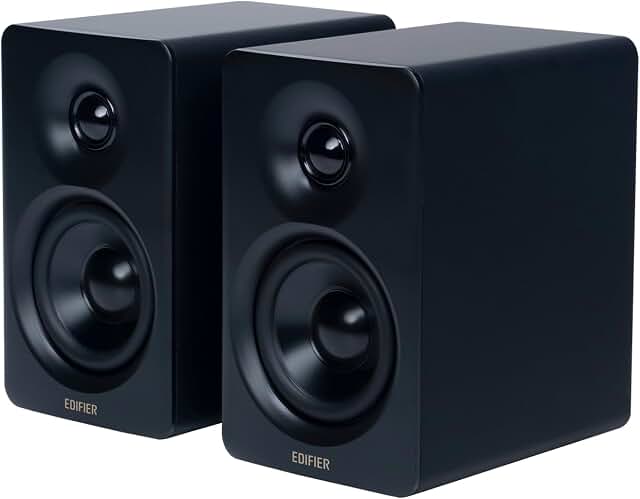
The Edifier M60 is included as a comparison for people whose real goal is compact desktop audio rather than a passive 50-watt, 8-ohm driver. It is a powered multimedia speaker system with 66 watts RMS total output, Bluetooth 5.3, USB-C and AUX inputs, and a 3-inch mid-low driver paired with a 1-inch silk-dome tweeter in each speaker.
- 66 watts RMS total output, described as 18 watts plus 18 watts for mid-low and 15 watts plus 15 watts for treble.
- Built-in Class-D amplification, DSP, and two-way active crossover.
- Compact listed dimensions per speaker: 100 × 168 × 147 mm.
Best for: Desktop users looking for a self-powered system with wired and wireless input options. It was selected as a useful adjacent comparison, not as a direct match for 50-watt, 8-ohm passive speakers.
Limitation: Its 66-watt RMS total output and powered design do not match the requested 50-watt, 8-ohm passive-speaker specification. Choose it for a desktop setup, not as a replacement driver for a passive speaker enclosure.
Buying Guide: How to Choose a 50-Watt, 8-Ohm Speaker
Does 50 watts mean RMS or maximum power?
Check whether a listing says RMS, continuous, or peak/maximum. These terms are not interchangeable. The Goldwood drivers are listed at 35 watts RMS and 50 watts maximum each. The Pyle listings describe 50 watts as peak power or a power rating, depending on the model. If an amplifier’s output is stated in RMS, compare it with the speaker’s RMS or continuous rating when that information is available.
Do not assume that a “50-watt” label means the speaker can continuously handle 50 watts. When the listing does not specify RMS power, treat that as missing information and consult the manufacturer’s detailed specifications before designing a system around it.
Why does 8-ohm impedance matter?
Impedance is an electrical load, measured in ohms. Confirm that the speaker’s impedance is suitable for the amplifier or receiver, and follow the amplifier’s instructions for connecting one or more speakers. Adding speakers can change the total load depending on whether they are wired in series or parallel. Do not assume that an amplifier designed for one 8-ohm speaker can safely drive multiple speakers in every wiring arrangement.
Should you choose a coaxial driver or a horn speaker?
A coaxial driver combines a woofer and tweeter in one unit. The Goldwood models are 8-inch coaxial drivers with a stated 35–20,000 Hz response, making them potential candidates for enclosure-building projects where one combined driver is preferred. Enclosure fit matters: compare the listed cutout diameter and mounting depth with the cabinet.
A horn speaker is a different form of PA speaker. The Pyle models are described for indoor and outdoor PA use and voice amplification. The 6-inch PHSP4 lists a 500 Hz–5 kHz frequency range, which is a relevant distinction for buyers focused on speech rather than full-range music.
What should you check before installation?
- Cutout diameter: Compare the required cabinet opening with the driver’s listed enclosure hole size.
- Mounting depth: Make sure there is enough clearance behind the panel for the speaker and its connections.
- Speaker type: Determine whether you need a passive driver for an existing amplifier or a powered system with amplification built in.
- Frequency response: Check the range when music playback, bass, or speech clarity is important.
- Number of speakers: Choose a single driver or a two-speaker set based on the system design and amplifier’s supported load.
- Power terminology: Separate RMS/continuous specifications from peak or maximum ratings.
Is a powered desktop speaker a substitute for a passive 8-ohm driver?
No. A powered speaker includes its own amplification and is generally used as a complete audio system. The Edifier M60 is a 66-watt RMS powered desktop system, while the Goldwood and Pyle products are described by impedance and speaker power ratings. Choose a powered system for convenient desktop listening; choose a passive driver when your project requires a separate speaker connected to an amplifier.
Frequently Asked Questions
Can an 8-ohm speaker be used with any amplifier?
No. Check the amplifier’s supported speaker impedance and connection instructions. An 8-ohm rating identifies the speaker’s nominal electrical impedance, but the amplifier must be suitable for the connected load.
Is a 50-watt maximum speaker rated for 50 watts continuously?
Not necessarily. Maximum or peak power is different from RMS or continuous power. For example, the Goldwood drivers are listed at 50 watts maximum and 35 watts RMS each.
Which listed speaker is best for a voice PA system?
The Pyle PHSP4 is a voice-focused option based on its stated 500 Hz–5 kHz response and PA positioning. The larger Pyle horn is another option for indoor or outdoor PA use, with a listed 103 dB output figure.
Which Goldwood option should I choose: one driver or a pair?
Choose the single GW-8004/8 when the project needs one driver. Choose the two-speaker set when the design calls for a pair. Compare the listed enclosure cutout and mounting depth for the exact version.
Is the Edifier M60 a 50-watt, 8-ohm speaker?
No. The Edifier M60 is described as a powered desktop speaker system with 66 watts RMS total output. The supplied product details do not identify it as a 50-watt, 8-ohm passive speaker.