
The JOYO Extreme Metal JF-17 is the strongest match for thrash players who want adjustable mids, tight low end, and a boost control. The EX Inferno suits players seeking a compact, high-gain pedal with three distortion modes, while the Flatsons KMF-1 is better for buyers who want distortion alongside amp simulations and practice tools. The options below range from dedicated metal distortion to a multi-effects unit, so the right choice depends on how much tone-shaping control you need.
| Product | Best For | Standout Feature |
|---|---|---|
| JOYO Extreme Metal JF-17 | Thrash rhythm and lead tones | Sweepable mid-frequency EQ and boost |
| EX Inferno | Compact high-gain setups | Three distortion modes |
| Heavy Metal Distortion Pedal | Broad EQ adjustment | Six rotary controls and three-band EQ |
| Flatsons KMF-1 | Practice and multi-effects flexibility | Effects, amp and cabinet simulations |
| JOYO JF-04 | Players wanting a wider gain range | Analog distortion with treble and mid controls |
JOYO Extreme Metal JF-17

The JOYO JF-17 is the best fit in this selection for thrash guitarists who want detailed control over distortion and midrange. Its six controls include Low, Mid, High, Boost, Level, and Drive. A sweepable mid-frequency control lets players adjust where the midrange is centered, which can help tailor rhythm and lead tones for different arrangements.
The pedal is described as having a tight low end for palm-muted riffs. Its boost switch adds saturation and volume for leads, making it a practical choice for players who want a dedicated metal distortion with a way to change emphasis between rhythm and solo parts. The product description specifically identifies thrash among the styles it targets.
- Best for: Players seeking adjustable mids, tight palm mutes, and a boost option.
- Why it stands out: The sweepable mid-frequency control offers more targeted EQ shaping than a basic tone knob.
- Consider: Six controls provide flexibility but may take more adjustment than a simpler pedal.
EX Inferno Death Metal Distortion

The EX Inferno is a compact high-gain option for players who want to switch between several distortion characters without a large number of controls. Its Raw, Brutal, and Inferno modes provide three starting points, while Level, Tone, and Distortion knobs let the player adjust output, tonal balance, and gain.
The product is designed for metal and hard rock. Its feature description calls out tight, punchy distortion, searing solos, and growling low tones, making it relevant to players pursuing aggressive thrash sounds. True bypass is also listed among its features.
- Best for: Players who want a mini pedal with high-gain modes and straightforward controls.
- Why it stands out: The three-mode switch gives distinct starting options without requiring a multi-band EQ setup.
- Consider: It has fewer dedicated EQ controls than the JOYO JF-17, so detailed mid-frequency shaping is not specified.
Heavy Metal Distortion Pedal

This heavy metal distortion pedal is a fit for players who want separate bass, mid, and treble adjustments alongside gain and boost. Its six rotary controls are listed as Treble, Mid, Bass, Boost, Volume, and Distortion. That layout gives players direct access to the frequency bands that shape a rhythm tone, rather than relying on one general tone control.
The product description presents it for metal, rock, and punk, with a range from heavy blues and hard rock to high-gain metal. It also emphasizes clarity at higher gain settings. This makes it worth considering for thrash players who want to experiment with EQ while retaining a broad range of distortion styles.
- Best for: Players who prefer independent bass, mid, and treble controls.
- Why it stands out: Its three-band EQ and separate boost and distortion controls support more direct tone adjustment.
- Consider: The listing describes a broad range of styles, rather than a specific thrash mode or dedicated mid-frequency sweep.
Flatsons KMF-1 Multi-Effects Pedal

The Flatsons KMF-1 is better for guitarists who want distortion as part of a broader practice or performance setup. It includes 77 effects across eight modules, including drive, amplifier, cabinet, modulation, delay, dynamics, reverb, and filter. The product also lists 18 amp models, 18 cabinet simulators, and 50 presets.
For practice and arranging, it includes a built-in tuner, a 30-second looper, 42 drum rhythms, and an aux input for connecting a phone and playing along with backing tracks. These features make it more versatile than a dedicated distortion pedal. Its DSP processing and cabinet simulations may also appeal to players who want multiple modeled tones in one unit.
- Best for: Players who need distortion plus practice tools and additional effects.
- Why it stands out: It combines drive, amp and cabinet options with presets, drums, a looper, and a tuner.
- Consider: It is a multi-effects unit, not a single-purpose thrash distortion pedal; its broad feature set may be unnecessary for players seeking only distortion.
JOYO JF-04 High Gain Distortion
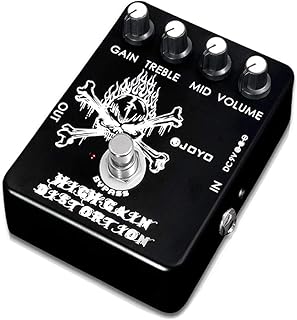
The JOYO JF-04 is a flexible choice for players who want one distortion pedal to cover tones from lighter crunch to heavy metal. Its product description identifies an analog circuit and a wide gain range. Dedicated Treble and Mid controls let players adjust brightness and midrange emphasis, including scooped rhythm settings or a more prominent lead sound.
This model is less specifically targeted at thrash than the JF-17, but its full-range distortion and EQ controls can suit players who move between classic rock and high-gain parts. The described touch-sensitive response also means the pedal is intended to react to picking dynamics and guitar volume changes.
- Best for: Players who want a broad gain range for rock and metal rather than a narrowly focused metal pedal.
- Why it stands out: Its analog circuit and Treble and Mid controls provide a simpler alternative to a six-control metal distortion.
- Consider: The listed EQ controls are Treble and Mid; separate Bass and boost controls are not specified.
Buying Guide: How To Choose A Thrash Metal Distortion Pedal
Do you need a dedicated distortion pedal or a multi-effects unit?
A dedicated distortion pedal focuses on gain and tone controls. The EX Inferno, JOYO JF-17, heavy metal distortion pedal, and JOYO JF-04 all serve this role, with different approaches to mode selection and EQ. A dedicated unit can be easier to set up when distortion is the main sound you need.
A multi-effects pedal is a better fit if you also want amp and cabinet simulations, modulation, delay, reverb, practice rhythms, or a looper. The Flatsons KMF-1 includes those additional tools, but its wider feature set is not necessary for every player. Decide whether you want a single distortion sound source or a broader effects and practice system.
How much EQ control should you look for?
EQ control determines how much you can shape the frequency balance of a distorted guitar tone. The JOYO JF-17 offers Low, Mid, and High controls plus a sweepable mid-frequency adjustment. That is the most detailed listed option for targeting the midrange. The heavy metal distortion pedal also provides separate Bass, Mid, and Treble knobs, while the JOYO JF-04 lists Treble and Mid controls.
The EX Inferno has a Tone knob rather than separate EQ bands. Choose it if you prefer a simpler control layout and its three modes suit your needs. If you expect to make precise adjustments to palm-muted rhythm or lead emphasis, compare the pedals with more specific EQ controls.
What matters for tight, palm-muted riffs?
For fast rhythm playing, consider how the pedal handles low-end definition and whether it offers controls for adjusting the bass and midrange. The JOYO JF-17 specifically describes a tight low end for palm-muted riffs and lets you adjust Low, Mid, and High. The heavy metal distortion pedal also offers a Bass control, but its feature description does not make the same specific palm-mute claim.
High gain alone does not determine whether a rhythm tone will feel clear in a mix. Use the available EQ controls to compare a fuller low end with a more restrained one, and avoid assuming that maximum gain will automatically produce a defined sound.
Would a boost control help your setup?
A boost can provide a different level or saturation for leads, depending on how the pedal is designed and set. The JOYO JF-17 lists a boost switch that adds saturation and volume. The heavy metal distortion pedal lists a separate Boost knob. The supplied product information for the EX Inferno and JOYO JF-04 does not list a dedicated boost control.
Choose a pedal with a boost feature if you want an explicitly listed control for changing a lead sound. If you only need one consistent distortion setting, that extra control may not be essential.
How should you compare gain range and sound options?
Consider whether you want several selectable modes, one broad gain range, or many modeled sounds. The EX Inferno offers Raw, Brutal, and Inferno modes. The JOYO JF-04 is described as covering tones from bluesy crunch to heavy metal. The KMF-1 offers a larger collection of effects and amp and cabinet models.
These features address different needs, so compare them by the number of sounds you expect to use. A mode switch can be straightforward for a few high-gain variations. A multi-effects unit offers more options but requires choosing among presets and effects.
What should you check before choosing?
- Control layout: Decide whether you prefer simple knobs or more detailed EQ and frequency controls.
- Primary use: Match the pedal to rhythm playing, lead boosts, practice, or a mix of tasks.
- Available features: Confirm which controls and tools are actually listed for the model you are considering.
- Setup needs: If you want amp or cabinet simulations, the KMF-1 lists those features; the other selections are presented as distortion pedals.
- Desired flexibility: Compare selectable distortion modes, EQ bands, and presets according to how often you expect to change tones.
Frequently Asked Questions
Which pedal in this list is most specifically suited to thrash metal?
The JOYO Extreme Metal JF-17 is the most direct match because its product description names thrash and lists a tight low end, palm-mute clarity, a sweepable mid-frequency control, and a boost.
Which option has the most detailed midrange control?
The JOYO JF-17 lists a sweepable mid-frequency control along with Low, Mid, and High knobs. This gives it more specific midrange adjustment than a pedal with only a general Tone control.
Which pedal is the simplest high-gain option?
The EX Inferno uses three main knobs—Level, Tone, and Distortion—along with a three-mode switch. It is a suitable option for players who want several distortion starting points without a six-control EQ layout.
Can a multi-effects pedal provide distortion for thrash?
The Flatsons KMF-1 includes a drive module, amplifier models, and cabinet simulations, so it offers components for building distorted tones. It is a multi-effects unit rather than a dedicated thrash distortion pedal, and the product information does not identify a specific thrash preset.
Is a three-band EQ necessary for thrash distortion?
No. A three-band EQ can offer more control over bass, midrange, and treble, but it is not essential for every setup. Choose based on whether you need detailed tone shaping or prefer simpler controls such as a Tone knob.
Which pedal is better for switching between rock and metal sounds?
The JOYO JF-04 is described as covering tones from bluesy crunch and classic rock to heavy metal. The Flatsons KMF-1 also offers multiple modeled effects and presets, but it is a broader multi-effects option rather than a single distortion pedal.