
If you need to split a TRS stereo output into separate mono inputs, choose a stereo breakout cable with one TRS plug and two TS plugs. The Tisino 3.3-foot cable is best for short 1/4-inch connections, while the Cable Matters 6-foot model suits 3.5mm sources such as laptops and phones. These cables separate left and right channels; they do not combine stereo into a single mono signal.
| Product | Best For | Connector Type |
|---|---|---|
| Tisino 3.3-Foot | Short 1/4-inch stereo breakouts | 1/4-inch TRS to dual 1/4-inch TS |
| Cable Matters 6-Foot | 3.5mm devices and mixer inputs | 3.5mm TRS to dual 1/4-inch TS |
| Tisino 10-Foot | Longer 1/4-inch connections | 1/4-inch TRS to dual 1/4-inch TS |
| RIIEYOCA Right-Angle | Tight spaces and short runs | Right-angle 1/4-inch TRS to dual 1/4-inch TS |
| Disino 3.3-Foot | Color-coded channel identification | 1/4-inch TRS to dual 1/4-inch TS |
Tisino 3.3-Foot 1/4-Inch TRS Breakout Cable

Best for: Short connections between 1/4-inch stereo outputs and two mono inputs. This Tisino cable has a single 1/4-inch TRS plug and two 1/4-inch TS plugs, so it can route the left and right sides of an unbalanced stereo signal to separate mono inputs.
The cable is also designed for insert applications on consoles or preamps that use a single TRS jack for send and return. Its two TS ends are color-coded black for left/send and red for right/return. The split point is about 7.5 inches from the TS ends, which helps identify the two branches when connecting equipment.
Why it was selected: Its standard 1/4-inch connectors and stated stereo-breakout and insert uses make it a practical option for compatible audio gear. Choose it if the equipment is close together and a 3.3-foot run is sufficient.
Limitation: This is not a single-plug mono summing cable. The product instructions also advise turning equipment off before changing connections.
Cable Matters 3.5mm-To-Dual-1/4-Inch Cable
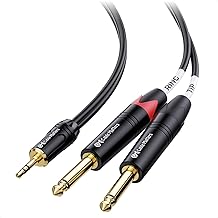
Best for: Sending stereo audio from a phone, tablet, laptop, or computer to two 1/4-inch mono inputs. The 3.5mm TRS end connects to a typical headphone-style stereo output, while the two 1/4-inch TS ends carry the left and right channels separately.
The six-foot cable is intended for connections to equipment such as mixers, amplifiers, speakers, and studio monitors. Its split ends can be separated to suit the setup. Listed construction details include oxygen-free copper conductors, braided copper shielding, and polyethylene insulation.
Why it was selected: It covers a common connector mismatch: a small 3.5mm stereo output feeding two 1/4-inch mono inputs. Choose this over the Tisino models when the source has a 3.5mm output rather than a 1/4-inch TRS output.
Limitation: The two output plugs are 1/4-inch TS, so this cable is not the right choice for equipment that requires two 3.5mm inputs or a single mono output.
Tisino 10-Foot 1/4-Inch TRS Breakout Cable

Best for: Longer connections between 1/4-inch TRS outputs and separate mono inputs. Its wiring and stated functions match the shorter Tisino option: it can split an unbalanced stereo signal into two unbalanced mono signals, and it is intended for insert send/return applications on compatible audio equipment.
The two TS plugs are color-coded black for left/send and red for right/return. That labeling can help keep channel routing clear when connecting a mixer, preamp, or other equipment. The longer cable is useful when a short patch lead cannot reach comfortably between devices.
Why it was selected: It offers the same basic connector arrangement as the 3.3-foot Tisino, with more reach. Choose this version when your setup needs a longer cable path; choose the shorter model when you want less excess cable.
Limitation: Extra length does not change the cable’s function. It separates channels rather than electronically mixing left and right into one mono signal. Turn connected equipment off before changing connections, as the product notes recommend.
RIIEYOCA Right-Angle TRS Y-Splitter

Best for: Short connections where a straight TRS plug may be awkward or there is limited room behind the connected equipment. This 1.64-foot cable has a right-angle TRS connector on one end and two TS plugs on the other.
The product describes stereo splitting and external effects-loop use, with the TRS tip and ring assigned to the signal path. It also lists a flexible braided PVC jacket, foil and braided shielding, and oxygen-free copper conductors. Those features may matter when routing the cable around a compact setup or where the cable needs to bend.
Why it was selected: Its right-angle plug and short length offer a distinct option for tight spaces, unlike the straight-plug, longer-run alternatives. Choose it when connector clearance is a key consideration.
Limitation: At 1.64 feet, it is designed for a short run and may not reach equipment positioned farther apart. Confirm that the right-angle plug and 1/4-inch connectors fit the intended ports and space.
Disino 3.3-Foot Color-Coded TRS Cable

Best for: Users who want visible left-right identification on a short 1/4-inch breakout cable. The Disino has one 1/4-inch TRS plug and two 1/4-inch TS plugs. Its red connector is identified as the right channel, and its blue connector as the left.
The listed uses include splitting stereo into two mono signals and connecting an insert send/return on compatible consoles or preamps. The product also specifies 360-degree easy-grip treads on the TRS connector, gold-plated connectors, and a copper shell intended to block interference.
Why it was selected: Its color coding makes channel identification straightforward, and its stated functions cover both breakout and insert-style routing. Choose it if the red-and-blue labeling suits your workflow better than other cable color schemes.
Limitation: The cable is only 3.3 feet long. Its product description gives a split distance of about 19.6 inches from the TRS end, so check whether the branch layout fits your equipment placement.
Buying Guide: How To Choose A TRS Stereo-To-Mono Cable
Do you need to split stereo or combine it into mono?
A stereo breakout cable separates the left and right channels carried by a TRS plug and routes them to two mono TS plugs. It does not necessarily combine those channels into one mono output. If your goal is to hear both sides of a stereo source through one mono input, check the receiving equipment’s instructions or use a suitable mono summing device. Simply joining left and right outputs with a passive Y cable can cause signal or equipment problems.
Which connector sizes are on your source and inputs?
Check every port before choosing a cable. A 1/4-inch TRS plug will not fit a 3.5mm output, and a cable with dual 1/4-inch TS ends will not directly connect to inputs of another size. The Cable Matters option is designed for a 3.5mm stereo source feeding two 1/4-inch inputs. The Tisino, RIIEYOCA, and Disino options use 1/4-inch TRS-to-dual-1/4-inch TS connections.
How long should the cable be?
Measure the actual path between the source and destination, allowing room for plugs and gentle routing. A shorter cable can reduce slack in a compact setup; a longer one can reach equipment farther apart. Among these options, the RIIEYOCA cable is 1.64 feet, the short Tisino and Disino models are 3.3 feet, Cable Matters is six feet, and the longer Tisino is 10 feet.
Is this for a stereo breakout or an insert loop?
Some TRS-to-dual-TS cables are also used for mixer or preamp insert connections, where one conductor carries a send and the other carries a return. That is not the same routing purpose as sending stereo left and right to two mono inputs, even though the connector arrangement may look similar. Confirm the equipment’s insert wiring and the cable’s channel labels before connecting an effects unit.
What do color coding and plug shape change?
Color-coded TS ends can make it easier to track left and right channels, but labeling conventions vary by product. A right-angle plug can help where a straight connector would be difficult to fit, while a straight plug may suit a more open setup. Also consider the location of the cable split and whether the two branches can reach their respective inputs without strain.
Will shielding or conductor material guarantee better sound?
Product descriptions list materials such as copper conductors and braided or foil shielding, but those specifications alone do not establish how a cable will perform in every setup. Match the cable type, connectors, wiring purpose, and length to your equipment first. Keep audio cables away from sources of interference where practical, and follow the equipment manufacturer’s connection guidance.
Frequently Asked Questions
Can a TRS cable convert stereo to mono?
A TRS-to-dual-TS breakout cable separates stereo left and right into two mono connections. It does not automatically combine them into one mono signal. Use equipment with a mono-summing function or an appropriate summing device when one mono output is required.
What is the difference between TRS and TS?
TRS means tip, ring, and sleeve, and a 1/4-inch TRS connection can carry an unbalanced stereo signal or a balanced mono signal depending on the equipment. TS means tip and sleeve and is commonly used for a mono, unbalanced connection. Connector appearance alone does not tell you how a device is wired.
Can I use a stereo breakout cable as an insert cable?
Some stereo breakout cables share the wiring used by insert cables, but confirm the console or preamp’s insert arrangement and the cable’s tip-and-ring assignments. The Tisino and Disino product descriptions specifically state insert and stereo-breakout uses.
Which cable should I use with a laptop headphone output?
For a laptop with a 3.5mm stereo output and equipment with two 1/4-inch mono inputs, the Cable Matters 3.5mm-to-dual-1/4-inch cable matches those connector types. Check the laptop and receiving equipment ports before ordering.
Do red and black or red and blue always mean the same thing?
No. Follow the cable’s own labeling. The Tisino cables identify black as left/send and red as right/return, while the Disino identifies blue as left and red as right.