
A Bluetooth car charger can add wireless phone audio, hands-free calling, and USB charging to a vehicle through its FM radio. The Nulaxy is best for drivers who want four charging ports and Bluetooth 5.3; the Syncwire suits buyers seeking Bluetooth 5.4 with two-device charging; and the LIHAN is designed for vehicles without Bluetooth or an AUX input. The LENCENT is a fit for drivers who also want to play music from USB drives or microSD cards.
| Product | Best suited for | Standout feature |
|---|---|---|
| Nulaxy 54W Bluetooth 5.3 | Charging several devices | Four ports and 54W maximum output |
| Syncwire Bluetooth 5.4 | Two-device charging | PD 36W and USB-A 12W ports |
| LIHAN Bluetooth 5.4 | Cars without Bluetooth or AUX | FM transmission and phone audio |
| AILKIN Bluetooth 5.4 | Drivers needing four charging ports | Two USB-C and two USB-A ports |
| LENCENT T25 | USB or microSD music playback | Supports several audio file formats |
Nulaxy 54W Bluetooth 5.3 Car Adapter

Best for: Drivers who want to charge several devices while streaming phone audio through the car radio. This adapter combines an FM transmitter, Bluetooth 5.3, and four charging ports in one device.
Its listed 54W charging system includes PD 36W and QC 18W, and the four ports can charge multiple devices at once. Bluetooth 5.3 is intended to support a quick, stable connection for calls and music. The adapter also offers a one-touch bass effect and five-color lighting.
Why it stands out: Choose this model if charging capacity matters as much as wireless audio. It offers more ports than the two-port Syncwire and LENCENT models in this selection.
Limitation: The features do not specify the individual output of every port or the exact distribution of power when all ports are in use. Check device charging requirements if you plan to connect several devices simultaneously.
Syncwire Bluetooth 5.4 FM Transmitter

Best for: Drivers who need to charge two devices and want a Bluetooth 5.4 FM transmitter for calls and music. Its charging ports are listed as PD 36W and USB-A 12W, for a stated combined output of 48W.
Syncwire says Bluetooth 5.4 helps provide a fast, stable connection and that a device does not need to be paired again after the first successful pairing. Its rainbow ambient light can be switched off by double-pressing the red B button, which is useful for drivers who prefer a darker cabin.
Why it stands out: Choose this if two charging ports are enough and you want the option to turn off decorative lighting. It offers newer Bluetooth version information than the Nulaxy model listed here.
Limitation: This model has two USB charging ports, not four. Its features list charging protections, but do not give detailed per-port charging behavior when both ports are occupied.
LIHAN Bluetooth 5.4 Car Adapter

Best for: Drivers with a car stereo that lacks Bluetooth and an AUX input. LIHAN describes the adapter as a way to send phone audio to a car radio using FM transmission, without replacing the stereo.
The product supports audio from music and podcast apps, video apps, GPS navigation, and hands-free calls. Its Bluetooth 5.4 connection is described as having low audio delay and fast re-pairing. The listing also highlights noise reduction intended to help reduce static and radio interference in busy city driving.
Why it stands out: Choose this model if your priority is adding phone audio to an older or basic vehicle stereo. The listing identifies cars, trucks, SUVs, and RVs as intended vehicle types.
Limitation: The product supports one connected device at a time, according to its listed features. Drivers sharing the adapter will need to take turns connecting to it.
AILKIN Bluetooth 5.4 Four-Port Adapter

Best for: Drivers who want both FM audio transmission and several charging connections. The AILKIN has two USB-C and two USB-A ports, with a listed maximum output of 54W.
To play phone audio, the adapter transmits over FM: match its frequency to the car radio. The product listing describes Bluetooth 5.4, faster pairing, and a blue LED ring for visibility and power status. It also lists charging voltage and current combinations, including 5V–3A, 9V–3A, and 12V–3A, with charging dependent on the connected device.
Why it stands out: Choose this model if you need four ports and prefer a mix of USB-C and USB-A connections. Its stated port count and output make it a useful comparison with the Nulaxy.
Limitation: The features do not specify how the 54W maximum output is divided among the four ports. Confirm that the charging setup meets the needs of your devices.
LENCENT T25 FM Transmitter
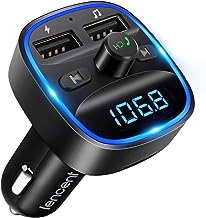
Best for: Drivers who want playback options beyond Bluetooth. The LENCENT T25 can stream phone audio and also play music from a USB flash drive or microSD card, with support for cards up to 32GB.
The listed compatible file formats include WMA, MP3, WAV, APE, and FLAC. For phone calls and navigation, the device uses Bluetooth and lists CVC noise suppression and echo cancellation. Its two USB ports are rated at 5V/2.4A and 5V/1A and can charge two devices at once.
Why it stands out: Choose this if you keep music on removable media or want a broader set of playback sources. The other products in this list focus more strongly on newer Bluetooth versions or higher stated charging output.
Limitation: The listed USB charging outputs are lower than the stated 48W and 54W options in this roundup. Consider another model if faster charging or four ports are priorities.
Buying Guide: How to Choose a Bluetooth Car Charger
How does an FM transmitter connect a phone to a car stereo?
A Bluetooth FM transmitter receives audio from a phone and broadcasts it over an FM frequency. Tune the car radio to the frequency used by the transmitter to hear music, navigation prompts, or calls through the stereo. This approach can add wireless audio to a vehicle without a built-in Bluetooth connection, provided the radio can receive FM broadcasts.
For clearer listening, select an available FM frequency with little or no radio programming, then set both the transmitter and car radio to that frequency. If you hear static or another station, try a different available frequency. Results can vary with local radio traffic, so a feature such as noise reduction may be useful but does not guarantee a static-free signal.
How many charging ports do you need?
Count the devices you expect to charge at the same time. The Nulaxy and AILKIN offer four ports, while the Syncwire and LENCENT list two. Four ports can be more convenient for a driver and passengers, but the total output is shared according to the product design. Check the individual port ratings and device requirements when those details are provided.
Port type matters too. The AILKIN lists two USB-C and two USB-A ports, while the other listings describe USB charging ports without the same four-port mix. Check which cable ends your phones and accessories use before choosing.
Does a higher wattage rating always mean faster charging?
Not necessarily. Charging speed depends on the charger output, the device, the cable, and the charging protocol they support. The Nulaxy lists PD 36W and QC 18W, the Syncwire lists PD 36W and USB-A 12W, and the AILKIN lists up to 54W. These numbers help compare stated capacity, but do not establish the exact speed for every connected device.
If you charge multiple devices at once, look for information about how power is allocated across ports. The listings provided for some models do not state the output available to each port when all ports are occupied.
Which Bluetooth version and extra features should you consider?
The Nulaxy lists Bluetooth 5.3; the Syncwire, LIHAN, and AILKIN list Bluetooth 5.4. Their features describe connection stability, pairing, or reduced audio delay. A version number alone does not tell you how well a specific setup will perform, so consider the transmitter’s FM function and your vehicle’s radio as part of the decision.
Other useful differences include the Syncwire’s switchable ambient lighting, the Nulaxy’s bass effect and five-color lighting, and the LENCENT’s USB-drive and microSD playback. Prioritize features you will use rather than choosing a device for decorative lighting alone.
What should you check before using a car charger?
Confirm that the device fits your vehicle’s power socket and that your radio can tune to the transmitter’s FM frequency. The AILKIN listing says it fits standard cigarette lighter sockets; check the product details for other models if socket fit is uncertain. Also review the number of ports, connector types, and charging requirements for your devices.
For hands-free calls, set up the connection before driving and follow local laws on phone use. Keep the adapter and cables positioned so they do not obstruct controls or the driver’s view. These practical checks help ensure the charger is suitable for your vehicle and routine.
Frequently Asked Questions
Can a Bluetooth car charger work in a car without built-in Bluetooth?
Yes, an FM transmitter can send phone audio to the car radio through an FM frequency. The LIHAN listing specifically describes use in vehicles without Bluetooth or AUX. The car needs a working FM radio, and the transmitter and radio must be tuned to the same frequency.
Can these adapters charge a phone while playing music?
The listed products combine Bluetooth or FM audio features with USB charging ports. Their features describe charging and audio functions, but the exact results depend on the connected phone, cable, available power, and vehicle socket.
Which model has the most charging ports?
The Nulaxy and AILKIN each list four charging ports. The AILKIN specifies two USB-C and two USB-A ports; the Nulaxy lists PD 36W and QC 18W as part of its four-port charging system.
Which option supports music from a USB drive or microSD card?
The LENCENT T25 lists playback from a USB flash drive or microSD card, each up to 32GB. It also lists support for WMA, MP3, WAV, APE, and FLAC files.
Why might an FM transmitter have static?
Static can occur when the chosen FM frequency is occupied or affected by nearby radio signals. Try a different frequency that is clear on the car radio, then match the transmitter to it. The LIHAN listing describes noise reduction to help minimize interference, but does not promise that interference will never occur.