
The best guitar bug wireless system depends on where you play, how much range you need, and whether you prioritize battery convenience or resistance to wireless congestion. The JOYO JW-03 is best for compact, everyday use; the New Bee offers six selectable channels; the Xvive A58 and Flatsons models use 5.8GHz; and the LEKATO includes a charging case for longer sessions.
| System | Best for | Key listed feature |
|---|---|---|
| JOYO JW-03 | Practice and small venues | 220-degree plug and up to 8 hours of use |
| New Bee 2.4GHz | Channel selection and rechargeable convenience | Six channels and a 280-degree plug |
| Xvive A58 | Longer-range setups | 5.8GHz operation and over 100 feet of range |
| LEKATO WS-100 | Long sessions and multi-system setups | Charging case and four-channel support |
| Flatsons 5.8GHz | Busy wireless environments | 5.8GHz band and over 100 feet of range |
JOYO JW-03: Best For Practice And Small Venues

The JOYO JW-03 is a 2.4GHz transmitter-and-receiver system designed for electric guitar, bass, and acoustic-electric instruments. Its listed features include less than 5ms latency, four selectable channels, and an open-area range of up to 65 feet. The 220-degree rotating 1/4-inch plug is useful when an instrument has a recessed output jack or when a straight connector would get in the way.
Best for: Players who want a simple wireless setup for home practice, rehearsals, recording, worship services, or small venues. The product listing states up to eight hours of continuous use and says the included dual-head USB cable can charge both units at once.
Limitation: The listed range is shorter than the 100-foot figures provided for some alternatives. JOYO also advises against large stages and environments with heavy Wi-Fi or Bluetooth activity.
New Bee 2.4GHz: Best For Channel Choices
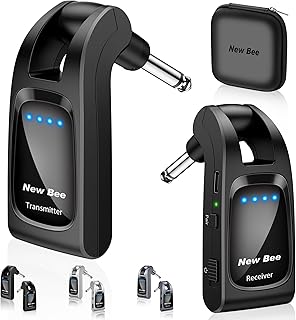
This rechargeable 2.4GHz system offers six channels and a stated transmission distance of more than 20 meters. The manufacturer lists 24-bit/48kHz audio, low noise, and low latency. A 280-degree rotating plug is intended to fit a range of instrument shapes and output-jack positions.
Best for: Guitarists and bassists who want several channel options and a flexible plug angle. The system is described as compatible with most electric guitars, basses, and acoustic guitars, including instruments with active or passive pickups. Its dual-ended USB-C cable and battery indicator are practical details for charging and checking power.
Limitation: The listing says the built-in battery provides at least six hours of operation after a two-hour full charge. It also notes that there is no open “AMP” function when using the system in audio, so buyers should check that detail against their intended setup.
Xvive A58: Best For Longer Range

The Xvive A58 operates on the 5.8GHz ISM band. Its listing specifies a working range of more than 100 feet and latency below 5ms. Those figures make it a candidate for players who need to move farther from an amplifier or receiver than a compact practice setup may require.
Best for: Performers who prioritize stated range and want a 5.8GHz option. The product information says up to four pairs of systems can be used at the same time, which may suit a stage or venue where several wireless instrument or audio links are needed.
Limitation: The supplied product details do not state battery life, charging method, or channel count. Compare those specifications with your expected set length and other wireless equipment before choosing it.
LEKATO WS-100: Best With A Charging Case

The LEKATO WS-100 is a 2.4GHz rechargeable system with a charging case and dual 3.5mm/6.35mm plugs. The listing specifies less than 6.7ms latency, a 100-foot effective transmission range, and four channels. It says the case stores and protects the devices and provides two full recharges, for more than 12 hours total, while each device can run for six hours.
Best for: Players who want a charging case for storage and extra power between sessions. Its four-channel support is also relevant for bands or setups using multiple systems simultaneously.
Limitation: The stated 100-foot range is an effective-range figure, not a guarantee for every room or stage. Actual performance can depend on the environment and placement of the transmitter and receiver.
Flatsons 5.8GHz: Best For Busy Wireless Areas

Flatsons uses the 5.725–5.850GHz band and lists a line-of-sight range of more than 100 feet. Its stated audio specifications include 44.1kHz/24-bit transmission, a 111dB dynamic range, distortion below 0.1%, and latency of 5.58ms. The rechargeable battery is listed for more than six hours of use.
Best for: Guitarists who want to consider a 5.8GHz system for rehearsals or performances in places with many wireless devices. The listing describes the band as less crowded than 2.4GHz and includes USB-C charging and an auto-sleep feature that activates after 10 minutes of inactivity.
Limitation: The listed range is stated as line-of-sight. The supplied details do not give a channel count, so buyers who need to coordinate multiple systems should confirm that specification before purchase.
Buying Guide: How To Choose A Guitar Bug Wireless System
A guitar bug wireless system replaces the cable between an instrument and an amplifier, pedalboard, or other receiving device. Most systems in this selection have a compact transmitter and receiver with 1/4-inch plugs. To compare options, focus on the connection band, range, latency, battery arrangement, channel support, and the fit of the plug on your instrument.
Should You Choose 2.4GHz Or 5.8GHz?
Several products here operate at 2.4GHz, while the Xvive A58 and Flatsons use 5.8GHz. Frequency alone does not guarantee a trouble-free connection. Nearby routers, Bluetooth devices, other wireless audio equipment, walls, and the placement of the receiver can affect real-world performance.
Consider a listed 5.8GHz model if you specifically want to compare systems using that band. Consider a 2.4GHz system if its other features—such as charging case, channel count, or plug rotation—better match your needs. If a venue has wireless congestion, check the manufacturer’s guidance and test the setup in the intended environment when possible.
How Much Range Do You Need?
Range figures help compare products, but they are not identical measurements. JOYO lists up to 65 feet in open areas, while the New Bee lists more than 20 meters. Xvive lists more than 100 feet, LEKATO lists a 100-foot effective range, and Flatsons specifies more than 100 feet line-of-sight.
For home practice or a small rehearsal room, a shorter stated range may be sufficient. For moving around a larger stage, prioritize the higher stated range and read whether it is described as open-area, effective, or line-of-sight. Obstacles and interference can reduce usable distance.
Does Latency Matter For Guitar?
Latency is the delay between playing a note and hearing it through the connected audio system. Lower listed latency is generally preferable for keeping the instrument’s response feeling immediate. The JOYO and Xvive listings specify less than 5ms, Flatsons lists 5.58ms, and LEKATO lists less than 6.7ms. New Bee describes latency as low but does not provide a numeric figure in the supplied details.
Do not compare latency claims as if they were measured under identical conditions unless the manufacturer provides a shared test method. If timing is especially important for your performance, compare the published figure and evaluate the system in your own signal chain.
How Important Are Battery Life And Charging?
Match battery life to your longest practice or performance session. JOYO lists up to eight hours. New Bee lists at least six hours after a two-hour charge. LEKATO lists six hours per charge and a case that provides two additional full recharges. Flatsons lists more than six hours. The supplied Xvive details do not specify battery life.
A charging case can help with carrying and recharging, while a dual-ended cable can charge a transmitter and receiver together. Check what charging cable is included and how long a full charge takes. Recharge the units before a session rather than relying on a low-battery warning during performance.
Will The Plug Fit Your Instrument?
Check the output-jack location and surrounding body shape. A rotating plug can help when an instrument has a recessed jack or when a fixed plug would press against the body. JOYO lists a 220-degree plug, New Bee lists 280 degrees, and LEKATO describes dual 3.5mm/6.35mm plugs.
Product descriptions identify these systems for guitar use, but instrument designs vary. Confirm the connector size and physical clearance, especially for instruments with recessed, side-mounted, or unusually positioned outputs. If you use an acoustic-electric instrument, check the product’s stated instrument compatibility and the requirements of your amplifier or audio input.
Do You Need Multiple Channels?
Selectable channels can help users choose among available transmission options. JOYO lists four selectable channels, New Bee lists six, and LEKATO lists four-channel support. Xvive says up to four pairs of systems can be used at once. These specifications are not interchangeable: channel selection and the number of simultaneously usable system pairs describe different capabilities.
If multiple musicians need wireless connections at the same time, check the exact simultaneous-use guidance for the product and coordinate the systems before a performance. Do not assume that a channel count alone guarantees interference-free operation with every other wireless device.
Frequently Asked Questions
What Is A Guitar Bug Wireless System?
It is a compact wireless transmitter-and-receiver setup that carries an instrument signal without a conventional guitar cable between the instrument and the receiving audio equipment.
Can These Systems Be Used With Bass?
The JOYO listing explicitly identifies electric guitar, bass, and acoustic-electric use. The New Bee listing also names bass among its compatible instrument types. Check the individual product description for the other models before buying for a specific instrument.
Is 100 Feet Of Range Enough For A Stage?
A listed 100-foot range may suit some stage setups, but the usable distance depends on conditions. Obstacles, signal congestion, and receiver placement can affect performance, and a line-of-sight figure may not represent a blocked or crowded venue.
Can Two Or More Systems Run At Once?
Some listings describe multi-system use: LEKATO specifies four-channel support, and Xvive states that up to four pairs can operate at the same time. Check the manufacturer’s instructions for the exact model and coordinate channels before using several systems together.
Are Rechargeable Wireless Guitar Systems Ready To Use Straight Out Of The Box?
They require sufficient battery charge before use. Charging methods and charge times vary by model, so check the included cable and product instructions. JOYO lists a dual-head USB cable, New Bee lists a dual-ended USB-C cable, and LEKATO includes a charging case.