
A car remote frequency scanner checks whether a key fob or related signal is transmitting and can help identify its frequency. The LAUNCH and Xhorse testers are best for dedicated multi-band checks, while the PLAYOCCAR adds battery-voltage testing and flexible power options. The OBDResource combines frequency and key checks with TPMS relearn functions. The ANCEL AD310 is an engine-code reader, not a remote frequency scanner, so it is included only as a related diagnostic tool—not as a substitute.
| Product | Best suited for | Key distinction |
|---|---|---|
| LAUNCH Remote Key Frequency Tester | Multi-band key and signal checks | Tests listed RF bands, IMMO, door-handle, and infrared signals |
| Xhorse XDRT20 | Frequent remote signal testing | Multi-band detection and power-saving design |
| PLAYOCCAR Remote Key Tester | Portable diagnostic work | Frequency, infrared, and button-battery voltage checks |
| OBDResource 5-in-1 Tool | Combined key and TPMS tasks | Frequency testing plus TPMS relearn functions |
| ANCEL AD310 | Engine and emissions codes | OBD-II code reader; does not test key fob frequency |
LAUNCH Remote Key Frequency Tester

The LAUNCH tester is a dedicated tool for checking key-related signals across several listed frequency bands. It detects 315 MHz, 433 MHz, 868 MHz, and 902 MHz signals, along with IMMO, door-handle, and infrared signals. That range makes it useful when a technician needs to check more than one type of remote or vehicle-related signal.
Best for: Automotive technicians, locksmiths, and owners who need a straightforward multi-band signal check. It was selected because its listed functions directly match the car remote frequency scanner search, including both RF frequency detection and infrared signal testing.
Important limitation: The manufacturer’s listing says the device tests key frequency for diagnosis and repair but cannot locate a lost key. It also does not claim to program or pair a key fob. Choose it for testing, not for key recovery or programming.
Xhorse XDRT20 Remote Tester

The Xhorse XDRT20 checks signals on listed bands including 315 MHz, 433 MHz, 868 MHz, and 902 MHz. Its stated detection functions also cover IMMO signals, door-handle signals, and infrared signals. The product listing highlights power-saving features intended to extend battery life and reduce the need for frequent recharging.
Best for: Users who regularly inspect multiple remote types and value the listed battery-saving design. It is a direct match for car remote frequency testing because its core purpose is signal detection across several common bands, with additional signal types included.
Better for: A technician who wants one tester for RF and infrared signal checks. The listing does not describe key programming, vehicle compatibility, or a lost-key location function, so do not choose it expecting those capabilities. Confirm that its stated detection functions meet the specific diagnostic task before purchase.
PLAYOCCAR Three-in-One Remote Key Tester

The PLAYOCCAR tester combines key frequency detection, infrared signal detection, and button-battery voltage testing. It can check car immobilizer signals, door-handle signals, and infrared signals. The listing advises testing close to the detection area for best accuracy.
Its power options are a distinguishing feature: it can run on four AAA batteries for wireless portable use or connect to a power bank through a Type-C cable for extended diagnostic sessions. That gives users a choice between a self-contained setup and a cable-powered option.
Best for: Mobile technicians and DIY users who want to check a remote’s signal and button-battery voltage with one device. It was selected for the extra battery check and flexible power options, not just its frequency detection.
Caution: The listing’s recommendation to test close to the detection area matters for reliable checks. The provided details do not specify a frequency range, so compare the product’s current specifications with the band you need to test before buying.
OBDResource 5-in-1 TPMS And Key Tester
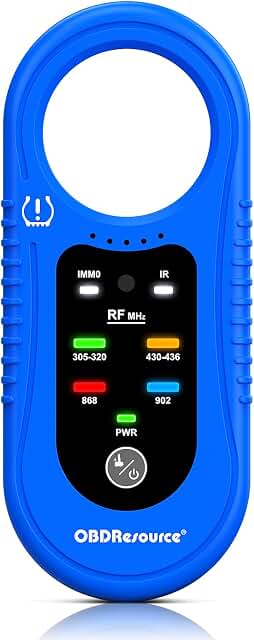
The OBDResource tool combines TPMS relearn functions with frequency detection, remote key testing, IMMO diagnostics, and infrared signal testing. Its stated frequency indicators cover 315 MHz, 433 MHz, 868 MHz, and 902 MHz, with different LED colors assigned to each band.
Best for: Users who need a key or frequency tester and also work with tire-pressure monitoring systems. Its broad feature set is the reason it stands out among these options. The listing names stationary TPMS relearn support for vehicles from brands including GM, Ford, Buick, Cadillac, Lincoln, Mercury, Dodge, and Chevrolet.
Choose this if you want one device for several listed automotive diagnostic tasks. Avoid it if you only need a small, dedicated remote tester and will not use the TPMS functions. The stated vehicle coverage applies to vehicles supporting stationary relearn mode; verify your vehicle’s requirements before relying on that function.
ANCEL AD310 OBD-II Code Reader

This is not a car remote frequency scanner. The ANCEL AD310 is an OBD-II diagnostic tool for reading and clearing engine and emissions trouble codes. Its listed functions include live data, freeze-frame information, I/M monitor readiness, and vehicle information. It draws power from the vehicle’s OBD-II data link connector and has a cable and built-in screen.
Best for: A driver who needs a basic engine or emissions code reader alongside a separate remote tester. It is included to distinguish a commonly searched automotive scan tool from the RF testers above. Its OBD-II functions do not test key fob frequency, infrared output, or remote-key signals.
Do not choose this for diagnosing whether a car remote is transmitting. If your main task is key fob frequency detection, select one of the dedicated testers instead.
Buying Guide: How To Choose A Car Remote Frequency Scanner
A remote frequency scanner is a diagnostic tool for checking whether a key fob or related device is emitting a signal and, on supported models, identifying its frequency. It is different from an OBD-II code reader, which communicates with a vehicle’s onboard diagnostic system to retrieve engine or emissions information. Decide which type of problem you are trying to diagnose before comparing features.
Which frequency bands should the tester detect?
Check the frequency required for the key or device you are testing, then compare it with the tester’s stated range. The products here list 315 MHz, 433 MHz, 868 MHz, and 902 MHz detection, but not every listing provides the same level of detail. A wider stated range may be useful in a shop handling different equipment, but it does not guarantee compatibility with every remote or vehicle system.
Do not assume that a product detects every possible signal simply because its description says “multi-band.” Confirm the exact bands in the product details, especially if you are servicing a specific key. For the PLAYOCCAR model, the supplied features describe multi-type signal detection but do not specify frequency bands.
Do you need RF, infrared, or IMMO signal checks?
RF frequency detection checks for radio-frequency transmission. Infrared testing addresses a different type of signal, while IMMO detection relates to immobilizer signals. Some testers list all three, and some add door-handle signal testing. Choose based on the diagnostic task rather than assuming one type of test covers all remote or security functions.
A signal tester can help determine whether a device is transmitting, but the provided product details do not say these tools program keys, pair remotes, or locate lost keys. If you need those services, look for a tool that explicitly states the relevant function and vehicle coverage.
Would a dedicated tester or a multi-function tool be more useful?
A dedicated remote tester may be the more direct choice when your main need is checking key fobs and related signals. The LAUNCH and Xhorse products are presented around multi-band signal testing. The PLAYOCCAR adds button-battery voltage checks and offers AAA or Type-C power options.
A multi-function option such as the OBDResource tool may make sense if you also need its listed TPMS relearn features. However, additional functions do not automatically make a tool the best fit. Check whether its TPMS features apply to your vehicle and whether you will actually use them.
How should you think about power and portability?
Consider where you will perform the test and how long the device may be used. The PLAYOCCAR listing specifies four AAA batteries for portable operation and Type-C power from a power bank for longer sessions. The Xhorse listing highlights power-saving features. Check the current product information for the exact power arrangement of any model not described here.
For mobile or outdoor work, a self-powered option can avoid dependence on a nearby outlet. For extended diagnostic work, a supported external power method may be useful. Do not infer a battery type or charging method if the listing does not state it.
What does a frequency tester not tell you?
A detected signal is useful diagnostic information, but it does not by itself establish that a key is correctly programmed, paired, or compatible with a particular vehicle. The supplied product details also do not claim that these testers identify a lost key. Treat the tool as one part of diagnosis and verify any required programming or vehicle-specific procedure separately.
If a remote does not operate the vehicle, testing can help distinguish a signal issue from other possible causes, but the scanner’s listed capabilities define what it can confirm. A dedicated tester and an OBD-II code reader serve different purposes and should not be treated as interchangeable.
Frequently Asked Questions
What does a car remote frequency scanner do?
It detects signals from a key fob or related device and may identify the frequency when the product supports that function. Some models also test infrared, IMMO, or door-handle signals.
Can a frequency tester find a lost car key?
Not according to the LAUNCH product’s listing, which specifically says it cannot locate a lost key. The other supplied product details do not claim lost-key location either.
Will a remote frequency tester program a key fob?
The product features provided here describe testing and diagnostics, not key programming or pairing. Check for explicit programming functions and vehicle coverage if you need a tool for that task.
Is an OBD-II scanner the same as a key fob frequency tester?
No. An OBD-II scanner reads vehicle diagnostic information, such as engine or emissions codes. A remote frequency tester checks key-related signals. The ANCEL AD310 is an OBD-II reader, not a key fob tester.
Which listed tester also checks button-battery voltage?
The PLAYOCCAR tester lists button-battery voltage detection along with key frequency and infrared signal testing. Its listing also describes AAA battery and Type-C power options.
Which option combines key testing with TPMS functions?
The OBDResource 5-in-1 tool combines frequency and remote-key testing with TPMS relearn functions. Its listed stationary relearn coverage is limited to vehicles that support that mode, so verify vehicle requirements first.