
A 50-mile two-way radio should be chosen by communication technology and terrain, not by its advertised maximum alone. For conventional GMRS use, the Midland GXT3000 is best for buyers who want repeater capability, while the Midland GXT1000VP4 four-pack suits groups that need several radios. The Rapid Radios G1 uses nationwide LTE service rather than ordinary radio-to-radio range, and the Retevis RT86 is aimed at work teams. Expect actual coverage to vary with obstructions, elevation, and the network or repeater available.
| Product | Best suited for | Key distinction |
|---|---|---|
| Midland GXT3000 | GMRS users seeking extended reach | Repeater capable; rechargeable Li-ion packs |
| Midland GXT1000VP4, 4-pack | Families and groups | Four radios; 50 GMRS channels |
| Rapid Radios G1 | Nationwide communication where cellular service works | LTE push-to-talk and included first-year service |
| Retevis RT86, 4-pack | Warehouses and job sites | High-power radios with long battery life |
| Midland GXT1050VP4 | Hunters and outdoor pairs | Camo finish, headsets, and rechargeable packs |
Midland GXT3000 GMRS Radios

Best for: GMRS users who want the option to extend communication through a repeater. The product listing describes the GXT3000 as repeater capable and advertises communication up to 65 miles when using a GMRS repeater. That is a conditional maximum, not a guarantee of direct radio-to-radio coverage.
The set includes two radios with headsets, rechargeable lithium-ion batteries, 50 channels, and 142 privacy codes. It also lists SOS, NOAA weather features, an LED flashlight, and USB-C charging. The rechargeable packs may suit users who want to top up from a vehicle outlet or power bank while traveling.
Choose this model if your group can use a compatible repeater and wants more reach than a direct connection may provide. Its repeater feature is the key reason it stands out for a 50-mile-range search. Avoid assuming it will cover 50 miles without a repeater or favorable conditions. GMRS use in the United States generally requires an FCC license.
Midland GXT1000VP4 Four-Pack
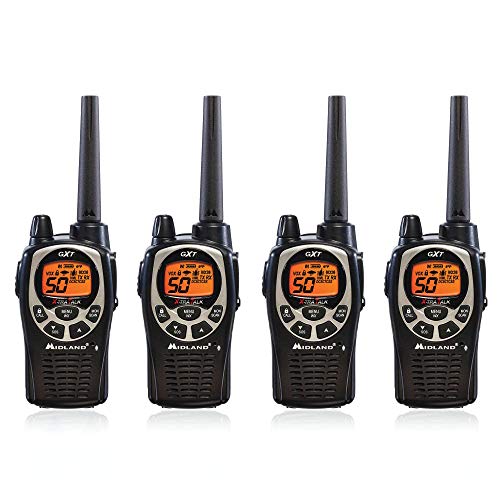
Best for: Families, outdoor groups, and teams that need four radios in one set. This Midland package offers 50 GMRS channels, channel scanning, and 142 CTCSS/DCS privacy codes. It also has JIS4 splash resistance and an advertised range of up to 36 miles in open areas with little or no obstruction.
The product’s range claim is not the same as a dependable 36-mile operating distance in every setting. Hills, buildings, trees, and other obstacles can reduce direct coverage. The privacy codes help users filter unwanted conversations on a channel, but they do not make a conversation private or encrypted.
Choose this four-pack if having units for several people matters more than buying a two-radio set with a repeater feature. Its channel scan and hands-free eVOX operation, with nine sensitivity levels, may be useful when users need to monitor activity or keep their hands free. Avoid this option if your main requirement is a stated 50-mile direct range; the listing advertises up to 36 miles in favorable open conditions.
Rapid Radios G1 LTE Walkie-Talkies

Best for: Buyers who need communication across a wide geographic area and can rely on cellular network coverage. The G1 is described as an LTE push-to-talk radio, not a conventional GMRS handheld with a fixed line-of-sight range. Its listing states nationwide U.S. coverage, includes one year of service per radio, and offers group talk for up to 200 people per talk group.
Noise-cancellation technology is listed as a sound feature. The LTE approach may suit events, distributed teams, or travel between locations where compatible cellular service is available. It addresses a different need from traditional walkie-talkies: nationwide communication depends on the service and network rather than a direct radio link between the units.
Choose this product if broad-area communication is more important than operating independently of cellular infrastructure. The included service is limited to one year per radio according to the listing; additional years are available for a fee. Avoid it if you need communication in places without network coverage or want a conventional radio that communicates directly over shared channels.
Retevis RT86 Four-Pack

Best for: Warehouse, property-management, and construction teams that need durable radios for a work shift. The listing describes high-power radios with high-gain antennas and claims coverage up to 700,000 square feet or communication in a 50-floor building. These are manufacturer-provided coverage claims, not guaranteed results for every building layout.
Each radio has a 2,600mAh lithium battery, with the listing stating more than 16 hours of continuous use and up to 130 hours of standby time. The radios have a hidden screen and an ABS body described as resistant to impact and friction. A charging base with USB is included.
Choose this model if your priority is coordinating a team within a workplace and having four radios available. Its stated battery duration and rugged construction are relevant to long shifts. A specific caution: the listing says the charging base does not support fast charging or high-power adapters such as QC or USB-C PD. Do not choose it based on the “50-floor” claim alone; walls, equipment, and building materials affect signal performance.
Midland GXT1050VP4 Camo Radios

Best for: Hunting pairs and outdoor users who want a camo-finish two-radio set. The listing specifies 50 channels and 142 privacy codes, along with rechargeable battery packs and a charger. The camo pattern is aimed at users who want their radios to blend into outdoor surroundings.
Midland describes the radios as suitable for communication across fields and wooded areas, but the product data does not provide a verified operating distance for every terrain type. A claimed or expected range should not be treated as a guarantee across ridgelines, dense timber, or other obstructions. The listed accessories include headsets, which can be useful when users want hands-free communication.
Choose this model if a pair of radios, headsets, rechargeable packs, and a camo finish match your hunting or outdoor setup. It is a more focused choice than the four-pack for two-person use. Avoid it if your priority is a stated 50-mile connection; the supplied features do not establish that distance as a dependable direct range.
Buying Guide: How to Choose a 50-Mile Two-Way Radio
Does a “50-mile” claim mean 50 miles of reliable coverage?
Not necessarily. Advertised maximum range usually describes favorable conditions, and actual coverage depends on terrain, elevation, obstructions, antenna placement, and radio setup. Open, unobstructed ground can support longer direct connections than a wooded area or a town with buildings between users. Treat the number as a best-case claim unless the product explains a specific network or repeater method.
For a useful comparison, distinguish direct radio-to-radio range from communication through infrastructure. The Midland GXT3000’s longer advertised reach depends on a GMRS repeater. The Rapid Radios G1 uses LTE service. Those approaches may cover greater distances when the required repeater or network is available, but neither is equivalent to an ordinary direct connection between handheld radios.
Should you choose GMRS, workplace radios, or LTE push-to-talk?
- GMRS: Consider the Midland models if you want handheld radio communication on GMRS channels. In the United States, GMRS operation generally requires an FCC license. Check current FCC rules before transmitting.
- Workplace radios: The Retevis RT86 listing emphasizes warehouse and job-site use, a four-radio bundle, and long battery operation. Confirm that a radio’s operating channels and configuration suit your organization’s requirements.
- LTE push-to-talk: The Rapid Radios G1 is designed around cellular service and nationwide communication. Coverage depends on service availability, and the product includes one year of service per radio according to the listing.
How many radios should your group buy?
Count how many people need to communicate at the same time. A two-pack can suit a pair, while a four-pack can supply a small family or work team. Compare what is included rather than assuming all packages contain the same accessories. Some listed models include headsets, rechargeable packs, or a charging base; package contents vary by product.
What battery and charging details matter?
Look at the battery type, stated operating time, and charging method. The RT86 listing gives a 2,600mAh lithium battery, more than 16 hours of continuous use, and a warning against fast-charging or high-power adapters. The GXT3000 listing describes rechargeable lithium-ion packs and USB-C charging. The GXT1000VP4 and GXT1050VP4 listings describe rechargeable packs and chargers. Battery claims are product specifications, not a guarantee of runtime in every use pattern.
Do privacy codes make radio conversations private?
No. Privacy codes can help reduce the number of other users’ conversations that you hear on a channel, but they do not encrypt your transmissions. Other users with compatible equipment may still be able to hear a transmission. Do not share sensitive information over ordinary two-way radio channels.
Which features matter for outdoor use?
For outdoor trips, consider weather alerts, water resistance, battery charging options, and the terrain where you plan to communicate. The GXT1000VP4 listing specifies JIS4 splash resistance; the GXT3000 lists NOAA features and an LED flashlight; and the GXT1050VP4 includes rechargeable packs and headsets. These details can help narrow a choice, but they do not eliminate the need to plan for weak or unavailable coverage.
Frequently Asked Questions
Can a handheld two-way radio reliably reach 50 miles?
Not in every setting. Direct handheld range is strongly affected by terrain, obstructions, and elevation. A repeater or cellular network may extend communication, but that requires the appropriate infrastructure and coverage.
Which listed radio has repeater capability?
The Midland GXT3000 is described as repeater capable. Its listing advertises up to 65 miles when connected through a GMRS repeater, so that reach is conditional rather than a direct-range guarantee.
Are privacy codes the same as encryption?
No. Privacy codes help users filter unwanted transmissions on a channel. They do not make radio conversations private or prevent other compatible radios from receiving them.
Does the Rapid Radios G1 work like a GMRS radio?
No. The G1 is described as an LTE push-to-talk radio that uses cellular service. It differs from conventional GMRS radios, which communicate over radio channels and may use a repeater to extend reach.
Do I need a license for GMRS radios in the United States?
GMRS operation generally requires an FCC license. Review current FCC requirements before transmitting, particularly if you are deciding between a GMRS model and another type of radio.