
The Miditech MIDIface 8×8 is the closest match for an eight-channel MIDI interface: it offers eight MIDI inputs and outputs and USB connectivity. The midiplus 16×16 is better for larger setups, while the Tascam US-16×08 is an audio interface that also includes MIDI functionality. The Behringer ADA8200 and Fender Quantum LT 16 are audio expansion options, not dedicated MIDI interfaces, so they are not substitutes for an eight-port MIDI device.
| Product | Best suited for | Key distinction |
|---|---|---|
| Miditech MIDIface 8×8 | Eight-port MIDI setups | Eight MIDI inputs and outputs to USB |
| midiplus MIDI 16×16 | Larger MIDI studios | 16×16 MIDI interface; USB bus powered |
| Tascam US-16×08 | Recording audio and using MIDI | 16 audio inputs, 8 outputs, MIDI included in product name |
| Behringer ADA8200 | Adding microphone preamps | Audio preamp rather than MIDI interface |
| Fender Quantum LT 16 | Hybrid audio production | USB-C audio I/O rather than MIDI ports |
Miditech MIDIface 8×8
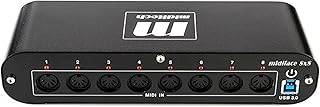
The Miditech MIDIface 8×8 is the most directly relevant option for a search for an eight-channel MIDI interface. It connects eight MIDI DIN inputs and outputs to USB-MIDI. The product description also states that it can support up to 128 MIDI input and output channels, and its 16 LEDs display MIDI input and output activity.
Best for: Musicians and producers who need several DIN-connected instruments or controllers routed through a USB-MIDI interface. Choose this if eight physical MIDI inputs and eight outputs match the equipment you plan to connect.
The activity LEDs provide a visible way to check whether MIDI data is entering or leaving the interface. That is useful when troubleshooting a setup with multiple devices. The black design is described as simple and functional.
Limitation: The supplied product details do not specify operating-system requirements, power method, or routing software. Check those details before buying if your computer or workflow has specific requirements.
midiplus MIDI 16×16

The midiplus MIDI 16×16 is a higher-capacity alternative for a studio with more MIDI connections than an eight-input, eight-output interface provides. Its listed features include USB class-compliant operation for Mac and PC, compatibility with MIDI software, and USB bus power. It has one USB port and supports USB 2.0 and USB 3.0, with the listing noting that USB 3.0 support applies to Windows 10 and Mac OS.
Best for: Users who want room for a larger number of MIDI connections or prefer an interface that is described as bus powered. It is a better fit than an 8×8 model when the extra I/O capacity is useful.
The package includes a USB cable. The listed dimensions are 19 by 8.1 by 2.4 inches, and the stated weight is 5.1 pounds, so plan for a substantial desktop or rack-area footprint.
Limitation: Its higher port capacity may be unnecessary for a setup with only a few MIDI devices. The supplied details do not describe individual port activity indicators or advanced routing features.
Tascam US-16×08 Audio/MIDI Interface

The Tascam US-16×08 is primarily an audio recording interface, not a dedicated eight-channel MIDI interface. Its product name identifies it as an audio/MIDI interface, and its listed features focus on recording: it captures 16 microphone and line inputs, provides eight outputs, and includes eight microphone preamps.
Best for: A recording studio that needs many audio inputs for drums, microphones, or line-level gear and also wants MIDI functionality in the same product. Choose it when audio capture is the main requirement and MIDI is an additional need.
Eight Ultra-HDDA microphone preamps are specified, with up to 56 dB of gain. The unit also provides eight line inputs; two can be switched to instrument level for direct guitar or bass recording. Control software is included according to the product name.
Limitation: The supplied features do not state the number of MIDI DIN inputs or outputs. Do not assume it provides eight MIDI ports; verify its MIDI connections if that is essential to your setup.
Behringer ADA8200 Microphone Preamp

The Behringer ADA8200 is included as an adjacent studio-expansion option, not as an eight-channel MIDI interface. The provided product details identify it as a microphone preamp and list package dimensions of 21.06 by 12.20 by 4.52 inches, a package weight of 6.39 pounds, and a package quantity of one.
Best for: Buyers comparing studio connectivity products who specifically need a microphone preamp. It may be relevant when the aim is to expand audio recording capacity, but the supplied information does not establish MIDI connectivity.
Its larger package size and weight are practical considerations when planning where to place studio equipment. The product listing also mentions a one-year warranty, though buyers should consult the current listing for the applicable terms.
Limitation: The listed features do not describe MIDI inputs, outputs, or USB-MIDI operation. Avoid this product if your primary goal is connecting MIDI instruments or routing MIDI data.
Fender Quantum LT 16 Audio Interface

The Fender Quantum LT 16 is a USB-C audio interface for music production, not a dedicated MIDI interface. Its listed configuration is 16 inputs and eight outputs, with eight MAX-HD microphone preamps and 14 total line inputs. Other stated features include low-latency drivers, loopback, balanced outputs, and a headphone amplifier.
Best for: Producers who need extensive audio I/O for microphones, synths, mixers, or other outboard gear. It is a better fit than a MIDI-only interface when recording and monitoring audio are central to the setup.
The listing says the preamps provide up to 75 dB of gain. It also describes access to Fender amp models and effects through the Fender Studio app after registering the interface and downloading the app.
Limitation: The supplied features do not mention MIDI DIN ports or USB-MIDI functionality. Do not select it as a replacement for an 8×8 MIDI interface unless the listing confirms the MIDI connections you need.
Buying Guide: How to Choose an 8-Channel MIDI Interface
What does “8-channel MIDI interface” mean?
The term can refer to the number of physical MIDI connections or to MIDI channels within the protocol. These are not the same thing. A DIN MIDI connection carries 16 MIDI channels, while an interface described as 8×8 typically means eight physical MIDI inputs and eight physical MIDI outputs. Check the port count rather than relying on the word “channel” alone.
For example, the Miditech MIDIface 8×8 explicitly lists eight MIDI DIN inputs and eight outputs. Its description separately mentions support for up to 128 MIDI input and output channels. When comparing products, confirm whether the manufacturer is describing ports, logical channels, or both.
How many MIDI inputs and outputs do you need?
Count the devices that must send MIDI data to your computer and the devices that must receive data from it. A keyboard used only as a controller needs an input path. A sound module that receives notes needs an output path. Some equipment needs both, so count each direction separately.
- Choose an 8×8 interface if eight physical inputs and eight outputs suit the current studio and expected expansion.
- Consider a 16×16 interface if you have many hardware instruments, sequencers, or controllers to connect.
- Do not pay for extra port capacity you are unlikely to use unless future expansion is a priority.
Do you need MIDI, audio, or both?
A MIDI interface routes performance and control data; it does not replace an audio interface for recording instrument sound. An audio interface handles audio signals through inputs and outputs. Some products combine audio and MIDI functions, but their MIDI port count must be checked independently.
The Tascam US-16×08 and Fender Quantum LT 16 are presented here for audio recording needs. The Tascam product name includes “Audio/MIDI,” but the supplied feature details do not state its MIDI port count. The Fender features focus on audio I/O. Neither should be assumed to provide eight MIDI inputs and outputs.
Will it work with your computer and software?
Check operating-system support, connection type, and driver requirements in the current product documentation. The midiplus listing specifically states class-compliant operation for Mac and PC and compatibility with MIDI software. It also gives a qualification for USB 3.0 support. The supplied Miditech details identify USB-MIDI connectivity but do not give an operating-system list.
Also consider whether your workflow needs standalone routing, preset storage, or software-based routing. The provided details do not establish these functions for every product, so confirm them before choosing an interface for a complex live or studio setup.
Which physical features matter in a studio?
Activity indicators can help identify whether MIDI data is reaching an interface or leaving it. The Miditech MIDIface 8×8 lists 16 LEDs for input and output activity. Power method and placement also matter: the midiplus interface is described as USB bus powered and weighs 5.1 pounds. Compare the listed dimensions with your desk or rack space.
Frequently Asked Questions
Is an 8×8 MIDI interface the same as an eight-channel MIDI device?
Not necessarily. An 8×8 label commonly describes eight physical MIDI inputs and eight physical outputs. A single MIDI port can carry 16 MIDI channels. Confirm the number of physical ports and the supported logical channels in the product specifications.
Which listed product most closely matches an 8-channel MIDI interface?
The Miditech MIDIface 8×8 is the closest match because its listed features specify eight MIDI DIN inputs and outputs connected to USB-MIDI.
Is the midiplus 16×16 a suitable alternative?
It may be suitable if you need more MIDI connections than an 8×8 interface provides. Its listed features include USB class-compliant operation for Mac and PC and USB bus power. Its higher capacity may be unnecessary for a smaller setup.
Can an audio interface replace a MIDI interface?
Only if it provides the MIDI connections and functions your setup requires. Audio inputs and outputs do not themselves establish MIDI compatibility. Check for explicit MIDI port specifications before buying.
Do the Behringer ADA8200 or Fender Quantum LT 16 provide eight MIDI ports?
The supplied product information does not state that either product provides eight MIDI inputs and outputs. The Behringer is described as a microphone preamp, and the Fender is described as a USB-C audio interface.
Should I choose bus-powered operation?
Bus power can reduce the need for a separate power connection when the interface supports it. The midiplus listing identifies USB bus power. Check the product documentation and your intended computer or USB setup for power requirements.