
A 2 ohm stable 4-channel amplifier can power compatible low-impedance speakers across four channels, with some models also supporting bridged operation at a specified impedance. The PRV Audio MDX1200.4 is best for high output, the Taramps TS 1200 for factory-radio integration, and the ORION CEA400.4D for moderate power with adjustable crossover controls. The options below cover different power levels and installation needs; compare their per-channel RMS ratings with your speakers before buying.
| Amplifier | Best For | Listed 2 Ohm Output |
|---|---|---|
| PRV Audio MDX1200.4 | High-output systems | 300W RMS x 4 |
| Taramps TS 1200 | Factory stereo integration | 300W RMS x 4 |
| RECOIL DI800.4 | Flexible tuning | 185W RMS x 4 |
| ORION CEA400.4D | Daily-driver speaker systems | 100W RMS x 4 |
| Taramps TS 400X4 | Moderate-power builds | 100W RMS x 4 |
PRV Audio MDX1200.4
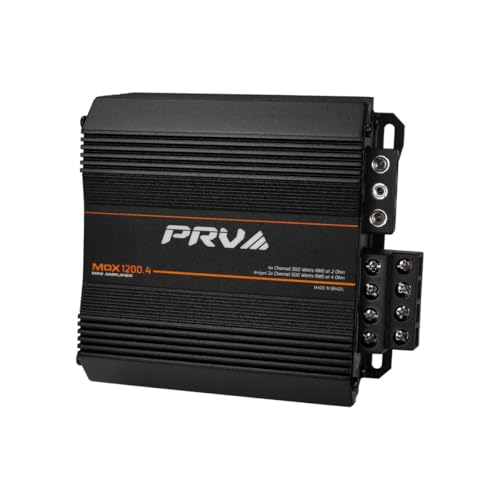
The PRV Audio MDX1200.4 is a compact Class D amplifier rated at 300 watts RMS per channel at 2 ohms. Its listed output makes it a strong fit for systems that need substantial power across four channels rather than a modest upgrade for factory speakers.
It supports full-range output and can be wired with multiple speakers, with power divided by channel. The product information also lists bridged operation at 4 ohms per bridged channel, rated at 600 watts RMS across two bridged channels.
- Best for: Buyers building a high-output, four-channel system for a car or powersports vehicle.
- Why it was selected: It states a clear 2-ohm RMS rating and includes a 4-ohm bridged option.
- Keep in mind: Bridged operation has a 4-ohm minimum per bridged channel; do not assume it can drive a 2-ohm bridged load.
Taramps TS 1200

The Taramps TS 1200 is a Class D full-range amplifier with a stated 1,200 watts RMS total output: 4 x 300 watts RMS at 2 ohms or 2 x 600 watts RMS bridged at 4 ohms. It offers RCA and high-level inputs, plus automatic turn-on with its high-level input, making it a relevant choice when connecting to a factory stereo.
Its HPF, LPF, and Full modes provide options for directing frequency ranges to the connected speakers or system components. The listed features also recommend professional installation.
- Best for: Buyers who want high 2-ohm output and a way to connect directly to a compatible factory head unit.
- Why it was selected: It combines explicit per-channel RMS figures with both low-level and high-level inputs.
- Keep in mind: The product information recommends professional installation, and bridged output is specified at 4 ohms.
RECOIL DI800.4

The RECOIL DI800.4 offers 185 watts RMS per channel at 2 ohms and 125 watts RMS per channel at 4 ohms. Its listed bridged output is 360 watts RMS x 2 at 4 ohms. These ratings position it between the high-output amplifiers and lower-powered daily-driver options in this list.
Adjustable gain, LPF, HPF, crossover, and bass EQ controls give buyers several ways to tune the amplifier for their setup. The product also lists a high-speed MOSFET power supply, premium internal components, and four-way protection circuitry.
- Best for: Buyers who want a 2-ohm stable amp with several built-in tuning controls.
- Why it was selected: It provides stated RMS figures at both 2 and 4 ohms, plus a separate bridged rating.
- Keep in mind: Its 2-ohm rating is lower than the 300-watt-per-channel models, so compare output with speaker requirements.
ORION CEA400.4D Cobalt Elite

The ORION CEA400.4D is a compact Class D full-range amplifier rated at 100 watts RMS x 4 at 2 ohms and 65 watts RMS x 4 at 4 ohms. That output level makes it a better fit for moderate-power speaker systems than for a build that calls for several hundred watts per channel.
Its adjustable high-pass and low-pass filters cover 40Hz to 500Hz. The amplifier is described for mids, highs, and full-range systems, with configurations that can include door speakers, component sets, or midrange drivers.
- Best for: Daily-driver and custom systems that need moderate four-channel power and adjustable frequency filtering.
- Why it was selected: It provides a specific 2-ohm RMS rating and filter controls across a stated frequency range.
- Keep in mind: Its 100-watt-per-channel 2-ohm rating is comparatively modest for high-output speaker systems.
Taramps TS 400X4

The Taramps TS 400X4 is a Class D amplifier rated at 4 x 100 watts RMS at 2 ohms. It is a lower-output alternative to the TS 1200, with a stated 2 x 200-watt bridged rating at 4 ohms. Its smaller listed power capacity may suit buyers who do not need the output of a high-power system.
High-level auto turn-on and RCA inputs support connection with factory and aftermarket stereos, according to the product information. HPF, LPF, and Full Range modes provide basic crossover choices for speakers, drivers, tweeters, or compact subwoofers.
- Best for: A moderate-power system where factory-radio input options and built-in crossover modes are useful.
- Why it was selected: It clearly specifies 100 watts RMS per channel at 2 ohms and offers multiple input types.
- Keep in mind: Its output is not intended to match the higher per-channel ratings of the PRV or TS 1200 models.
Buying Guide: How to Choose a 2 Ohm Stable 4-Channel Amp
What does 2 ohm stable mean?
A 2-ohm stable amplifier is designed to operate with a 2-ohm load on each supported channel. Lower impedance can allow an amplifier to deliver more power, but the speaker wiring must stay within the amp’s stated minimum load. Check each channel’s wiring plan rather than relying only on a product title or total wattage.
Stability at 2 ohms in regular four-channel mode does not automatically mean that the amplifier can handle a 2-ohm bridged load. Bridging combines two channels, and manufacturers may specify a higher minimum impedance for that configuration. For the products above, listed bridged ratings are given at 4 ohms.
How much RMS power should each channel provide?
Match the amplifier’s RMS output per channel to the speakers’ RMS power handling. The PRV MDX1200.4 and Taramps TS 1200 list 300 watts RMS per channel at 2 ohms. The RECOIL DI800.4 lists 185 watts, while the ORION CEA400.4D and Taramps TS 400X4 list 100 watts each at that impedance.
Do not compare maximum or peak power as if it were continuous RMS output. If the product listing gives multiple figures, use the rating that matches your intended impedance and channel configuration. Also confirm the speaker’s nominal impedance and power specification before choosing an amplifier.
Should you choose Class D or Class A/B?
Class D models appear among the selections here and are commonly chosen for their compact amplifier format. The product information for the ORION CEA400.4D, both Taramps models, the PRV MDX1200.4, and the RECOIL DI800.4 identifies them as Class D. Class designation alone does not establish sound quality or compatibility; compare output ratings, inputs, controls, and installation requirements.
The product list also includes a Class A/B ORION CBA2500.4, but its supplied information does not give a clear per-channel RMS rating at 2 ohms. For a buying comparison centered on known RMS output, prioritize models whose listed ratings match the intended load.
Will the amp connect to a factory stereo?
Check the input options before purchase. High-level or speaker-level inputs can connect an amplifier to speaker outputs from a factory radio, while RCA inputs are used with compatible preamp outputs. The Taramps TS 1200 and TS 400X4 list both RCA and high-level input options; the TS 1200 also specifies automatic turn-on through the high-level input.
Confirm the exact installation method for the head unit and vehicle. Input availability does not guarantee that an amplifier includes every wire, adapter, or other installation component your system may need.
Which crossover controls are useful?
High-pass filters can limit lower frequencies sent to speakers, while low-pass filters can limit higher frequencies sent to a suitable low-frequency driver. A Full Range mode may pass a broader signal without those filters. The RECOIL DI800.4 lists adjustable HPF, LPF, crossover, and bass EQ controls. The ORION CEA400.4D gives an adjustable 40Hz–500Hz filter range, and the Taramps models list HPF, LPF, and Full modes.
Choose controls that suit the speakers and system plan. Filter settings do not replace checking speaker impedance, power handling, or the amplifier’s supported wiring configurations.
What else should you check before installation?
- Confirm the number of speakers and the impedance presented to each channel.
- Verify that the speaker’s RMS handling is appropriate for the amplifier’s output.
- Check the minimum impedance for both four-channel and bridged operation.
- Review available inputs and crossover modes for the head unit and speakers.
- Plan the installation and wiring using the amplifier’s instructions; the Taramps TS 1200 listing recommends professional installation.
Frequently Asked Questions
Can a 2 ohm stable 4-channel amp power four 2-ohm speakers?
It can if each speaker is connected to a separate channel and the amplifier’s specifications allow a 2-ohm load per channel. Confirm the wiring and speaker impedance before connecting the system.
Can I bridge a 2-ohm stable four-channel amp?
Some four-channel amplifiers support bridging, but the minimum impedance may change when channels are bridged. Check the bridged rating specifically; the bridged examples in this list specify a 4-ohm load.
Is RMS or peak power more important when comparing amps?
Use RMS output for comparing continuous power at the intended impedance. Peak or maximum power is not the same as continuous RMS output.
Can I connect these amps to a factory radio?
Some listed models offer high-level inputs. The Taramps TS 1200 and TS 400X4 specify high-level input options, but buyers should confirm that the input and turn-on method fit their particular stereo.
Do all five amplifiers have the same output?
No. Their stated output ranges from 100 watts RMS per channel at 2 ohms for the ORION CEA400.4D and Taramps TS 400X4 to 300 watts RMS per channel for the PRV MDX1200.4 and Taramps TS 1200.