
The best preamp for a Jazz Bass depends on whether you want onboard tone shaping, an active/passive option, or a replacement control assembly. The Sadowsky system is best for a focused two-band upgrade with a vintage tone control; the prewired three-band plate suits players seeking broader EQ and gain adjustment. The KAISH circuit and Kaynes harness are component-level options, while the KAISH loaded plate is a control-hardware replacement rather than a clearly specified preamp.
| Product | Best For | Key Distinction |
|---|---|---|
| Sadowsky Onboard Bass Preamp | Two-band EQ with vintage tone control | Four-knob active system; 9V operation |
| Prewired Active/Passive Control Plate | Three-band EQ and adjustable gain | Active/passive push-pull switch |
| KAISH 2-Band Preamp Circuit | A compact two-band circuit replacement | Specified bass and treble boost/cut |
| Kaynes JB Preamp Harness | A Jazz Bass-oriented preamp with gain | Installation diagram is referenced |
| KAISH Loaded Control Plate | Replacing the plate and preassembled controls | Plate dimensions and mounting spacing provided |
Sadowsky Onboard Bass Preamp

Best for: Jazz Bass players who want an onboard two-band EQ combined with a vintage tone control. This is the most clearly specified dedicated active preamp in the list: the product description identifies a four-knob system, two-band EQ, Vintage Tone Control (VTC), and 9V operation.
The two-band layout is a straightforward choice for players who want bass and treble adjustment rather than a separate midrange control. The VTC adds another tone-shaping function, making this option distinct from the simpler two-band circuit below. Its 9V operation is useful to note when planning the instrument’s battery arrangement.
- Four-knob active bass preamp system
- Two-band EQ and Vintage Tone Control
- Operates on 9V
Choose this if the listed control set matches your preferred onboard layout. Before buying, verify that the system’s wiring, control arrangement, and installation requirements suit your particular bass. The provided product details do not specify those fitment requirements or whether the system includes every part needed for installation.
Prewired Three-Band Active/Passive Control Plate

Best for: Players looking for a loaded Jazz Bass-style control plate with three-band EQ, adjustable gain, and active/passive switching. The listed controls include master volume stacked with passive tone, pickup balance, treble, and middle stacked with bass.
The advertised gain adjustment can boost the input signal by up to 15 dB while maintaining a flat frequency response, according to the product information. Its push-pull switch selects active or passive operation, and the description says passive mode works without batteries connected. That battery-independent passive function is a useful distinction for players who want a backup mode.
- Three-band preamp with treble, middle, and bass controls
- Adjustable gain with a listed boost of up to 15 dB
- Push-pull active/passive switching
- Passive mode is described as working without batteries
Choose this if you want more EQ bands and a prewired assembly rather than a standalone circuit. Avoid assuming it will fit every Jazz Bass: confirm the plate dimensions, mounting, and wiring compatibility before purchase. The product information does not provide those dimensions.
KAISH Prewired Two-Band Preamp Circuit

Best for: A buyer seeking a two-band active/passive EQ circuit with specified bass and treble adjustment. The listed controls provide bass adjustment of plus or minus 10 dB at 30 Hz and treble adjustment of plus or minus 10 dB at 6 kHz.
This listing is a circuit rather than a clearly identified complete loaded control plate. Its wiring notes are especially important: P1 should connect to the neck pickup positive lead, P2 to the bridge pickup positive lead, and GND to both pickup negative leads. Those instructions give buyers a starting point for evaluating whether the circuit suits their wiring skills and setup.
- Bass: ±10 dB at 30 Hz
- Treble: ±10 dB at 6 kHz
- Volume and pickup control specifications are listed
- Pickup-positive and ground wiring directions are provided
Choose this if a two-band design and its stated wiring configuration meet your needs. The main limitation is that installation depends on correct connections, and the supplied product details do not describe a complete control plate or provide broader fitment information. Review the wiring requirements before choosing it over a preassembled option.
Kaynes JB Preamp And Wiring Harness
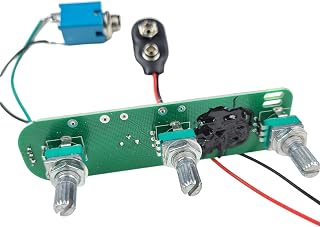
Best for: Buyers looking for a Jazz Bass-oriented preamp and tone-control harness with gain. The product description says it is suitable for Jazz Bass and identifies a preamp and tone control with gain for JB bass.
Compared with the KAISH two-band circuit, this listing emphasizes Jazz Bass suitability and gain but does not state detailed EQ frequencies, boost or cut ranges, or a control layout. That makes it a more limited choice for shoppers comparing exact tonal specifications, but its stated application may help buyers seeking a JB-focused replacement circuit.
- Described as suitable for Jazz Bass
- Includes a preamp and tone control with gain
- Product information refers buyers to a wiring diagram for installation
Choose this if you want a Jazz Bass-focused harness and are comfortable checking the referenced wiring diagram before installation. The product details supplied here do not specify the gain range, EQ bands, battery arrangement, or included installation hardware, so confirm those details if they affect your decision.
KAISH Fully Loaded Jazz Bass Control Plate

Best for: Players replacing a Jazz Bass control plate and seeking a preassembled wiring harness. This product is included as a related control-hardware option, not as a confirmed onboard preamp: its listed features describe a loaded plate, wiring harness, 250K pots, and a .068 µF capacitor, but do not identify an active EQ circuit.
The plate measures 152 mm by 68 mm, and the listed mounting-screw spacing is 49 mm by 124 mm, measured center to center. These measurements help buyers compare the assembly with an existing plate before ordering. The product description says the parts are preassembled for installation.
- Preassembled control plate and wiring harness
- Plate dimensions: 152 mm by 68 mm
- Mounting-screw spacing: 49 mm by 124 mm, center to center
- 250K pots and .068 µF capacitor
Choose this if your main need is a replacement plate and prewired controls rather than onboard active EQ. Avoid choosing it as a preamp upgrade based on the word “loaded” alone; the listed features do not specify an active preamp. Check the dimensions and mounting pattern against your bass before buying.
Buying Guide: How To Choose A Jazz Bass Preamp
A preamp changes the signal and gives you onboard tone-shaping controls. A control plate or wiring harness can replace or reorganize the instrument’s electronics, but that does not automatically mean it contains an active preamp. Start by identifying whether you need tonal adjustment, a full control assembly, or both. The products here cover those different needs, so their features should not be treated as interchangeable.
Do You Want Two-Band Or Three-Band EQ?
A two-band EQ gives you bass and treble controls. It is a simpler choice if those are the main adjustments you want to make on the instrument. The Sadowsky and KAISH circuit list two-band EQ, though their other features differ: Sadowsky adds Vintage Tone Control and specifies 9V operation, while KAISH lists boost and cut ranges and wiring directions.
A three-band EQ adds a middle control. That can be useful when you want a separate midrange adjustment, but it also means checking the assembly’s controls and installation requirements. The prewired active/passive plate lists treble, middle, and bass adjustment as well as gain control. Compare the actual control layout with the way you plan to use your bass.
Should You Choose Active/Passive Switching?
An active/passive switch can provide two operating modes when the product is designed for both. The prewired three-band plate specifically lists a push-pull active/passive switch and says its passive mode works without batteries connected. Do not assume that every preamp or circuit in this list has the same feature; only rely on switching details stated for the product you are considering.
Battery arrangements matter when installing active electronics. The Sadowsky listing specifies 9V operation, while the other product details do not provide a battery specification. Check the relevant product information and installation instructions to confirm what the circuit needs. If preserving a passive mode is important, verify that it is explicitly supported.
Do You Need A Circuit Or A Complete Control Plate?
A circuit may suit a player who plans to fit components into existing controls or carry out wiring work. The KAISH circuit provides pickup connection directions, and the Kaynes listing refers to a wiring diagram. Those details make wiring review an important part of the buying decision. Confirm whether the product includes the controls and hardware you need; the supplied descriptions do not establish that every component is included.
A prewired plate can reduce the amount of assembly work, but “prewired” does not guarantee a direct fit. The three-band plate is described as a Jazz Bass replacement control plate, but its dimensions are not provided in the listing details here. The KAISH loaded plate does provide dimensions and screw spacing, although its features do not specify an active preamp. Match measurements and wiring before selecting either format.
What Should You Check Before Installation?
- Control layout: Compare the listed knobs and switches with the space and layout you want on the bass.
- Plate measurements: Check length, width, and mounting-hole spacing when replacing a control plate. Only one plate in this comparison provides those measurements.
- Pickup wiring: Follow the product’s wiring instructions and verify pickup lead connections before connecting a circuit.
- Power requirements: Confirm the required battery type and installation details where they are not specified in the summary.
- Included parts: Check whether the listing describes a circuit, harness, controls, plate, or a complete assembly.
- Active/passive functions: Verify the product explicitly supports the modes you need rather than inferring them from its name.
Which Option Fits Different Buyer Priorities?
| Buyer Priority | Option To Compare | Reason |
|---|---|---|
| Two-band EQ plus a vintage tone control | Sadowsky onboard system | Its listed controls include two-band EQ and VTC. |
| Three-band EQ and gain adjustment | Prewired active/passive plate | It lists treble, middle, bass, gain, and a push-pull switch. |
| Specified two-band frequency ranges | KAISH circuit | It provides bass and treble adjustment ranges. |
| JB-focused harness with gain | Kaynes preamp harness | It is described as suitable for Jazz Bass and includes gain. |
| Preassembled plate and stated dimensions | KAISH loaded control plate | It lists plate size, mounting spacing, pots, and capacitor. |
These distinctions can narrow the shortlist, but they do not replace fitment checks. Product descriptions vary in how much wiring, power, and compatibility information they provide. If a specification is essential, confirm it from the product’s installation information before purchasing.
Frequently Asked Questions
What does a preamp do in a Jazz Bass?
An onboard preamp processes the bass signal and can provide tone controls such as bass, treble, or midrange adjustment. The precise controls depend on the circuit. A replacement control plate alone does not necessarily include an active preamp.
Is a two-band or three-band preamp better for Jazz Bass?
Neither layout is universally better. A two-band preamp controls bass and treble, while a three-band design adds a separate midrange control. Choose based on the adjustments you want and the product’s wiring and fitment requirements.
Can a Jazz Bass preamp work without a battery?
Some systems provide passive operation, but not all product descriptions confirm that feature. The prewired three-band plate in this comparison specifically states that passive mode works without batteries connected. Check the details for any other circuit before assuming it has battery-free operation.
Is a prewired control plate the same as a preamp?
No. A control plate is a hardware assembly that may include controls and wiring. It is a preamp only if its listed features identify an active preamp or EQ circuit. The KAISH fully loaded plate lists pots and a capacitor but does not specify an active preamp.
What should I check before replacing a Jazz Bass control plate?
Compare the plate dimensions, mounting-hole spacing, wiring connections, and control layout with your instrument. Also verify what parts are included. The KAISH loaded plate lists dimensions and screw spacing, while the other plate listing does not provide those measurements in the supplied details.
Which option is best for a first-time electronics replacement?
A preassembled assembly may be easier to evaluate than a circuit requiring pickup wiring, but the product information does not establish that any option is suitable for every installer. Review the wiring diagram, included parts, and fitment details. Seek qualified installation help if the wiring requirements are unclear.