
The right soundbar connection depends on your TV and devices: HDMI ARC or eARC sends TV audio to a soundbar, while an HDMI input can route a source device through it. Among these picks, the Amazon Fire TV Soundbar, Bose TV Speaker, FUNLOGY soundbar, and Assistrust soundbar connect to TVs using HDMI ARC; the VPFET extractor is an accessory for separating audio from an HDMI signal, not a soundbar. Choose the Fire TV model for simple setup, Bose for dialogue, FUNLOGY for multiple connection types, Assistrust for placement flexibility, or VPFET when a source needs separate audio outputs.
| Product | Best For | Connection Note |
|---|---|---|
| Amazon Fire TV Soundbar | Simple TV setup | HDMI eARC/ARC |
| Bose TV Speaker | Clearer dialogue | HDMI-ARC |
| FUNLOGY Sound Bar | Flexible wired and wireless connections | HDMI ARC, optical, AUX, Bluetooth |
| Assistrust Sound Bar | Flexible placement and sound modes | ARC, optical, AUX, Bluetooth |
| VPFET HDMI Audio Extractor | Separating audio from an HDMI source | HDMI input to optical or 3.5mm output |
Amazon Fire TV Soundbar

Best for: Viewers who want a straightforward HDMI connection to a compatible TV. This compact 2.0-channel soundbar connects through the TV’s HDMI eARC/ARC port using the included HDMI cable. Its dual speakers are designed to provide fuller sound, clearer dialogue, and deeper bass than TV audio alone.
DTS Virtual:X provides a virtual surround effect, while Dolby Audio is intended to add detail. Bluetooth connectivity is also listed, giving the soundbar a wireless option for audio streaming. Its simple connection approach makes it a practical choice when the goal is to improve TV sound without adding a separate subwoofer or multiple speakers.
Connection limitation: The listed HDMI connection is for eARC/ARC from the TV. The product information does not identify a separate HDMI input for routing a game console or streaming device through the soundbar. Check the TV’s available ARC/eARC port before choosing it.
Bose TV Speaker

Best for: People who prioritize speech clarity in TV programs. The Bose TV Speaker is an all-in-one compact soundbar with two angled full-range drivers. Its stated design focus is to clarify vocals and pronunciation, making it a direct option for dialogue-heavy shows, news, and everyday television viewing.
HDMI-ARC connectivity provides a way to send TV audio to the soundbar, and Bluetooth is available for wireless audio. The product also includes a remote control. Its small, single-unit format may suit viewers who want a simpler arrangement than a multi-component home theater system.
Connection limitation: The listed connection is HDMI-ARC, not a documented HDMI passthrough input. Choose it for TV audio over ARC rather than assuming it can accept a console or media player through an HDMI input. Confirm that the TV has a compatible ARC connection.
FUNLOGY 2.1-Channel Sound Bar

Best for: Buyers who want several ways to connect a TV or other compatible source. This 100W, 2.1-channel soundbar lists HDMI ARC, optical, AUX, and Bluetooth 5.0. The listed speaker arrangement is two 20W tweeters and two 30W woofers, aimed at providing clearer detail and stronger bass.
Its DRC and EQ modes are described as helping make dialogue easier to hear at lower volume. That can be useful for late-night viewing or shared living spaces where raising the volume is not ideal. The combination of wired inputs and Bluetooth also gives it more connection choices than an ARC-only setup.
Connection limitation: The listed HDMI connection is HDMI ARC, which carries TV audio to the soundbar; the feature information does not specify a separate HDMI input or video passthrough. Choose this model for connection flexibility across ARC, optical, AUX, and Bluetooth, not as a confirmed HDMI switching hub.
Assistrust Sound Bar

Best for: Buyers seeking placement options and preset sound modes. The product is described as a detachable 2-in-1 soundbar with ARC, optical, AUX, and Bluetooth connections. Its listed four drivers and 80W output are intended for TV, PC, gaming, and projector audio.
Three equalizer modes—movie, music, and news—let users select a preset for different content. The listing also describes automatic volume boost and four placement options: horizontal, vertical, tabletop, or wall-mounted. Those features make it a flexible choice for people who may rearrange a setup or want different listening presets.
Connection limitation: Although ARC is listed, the provided features do not establish that the soundbar has a separate HDMI input for a source device. Verify the exact connection requirements for the TV or projector before purchase, especially if the setup requires HDMI passthrough.
VPFET HDMI Audio Extractor
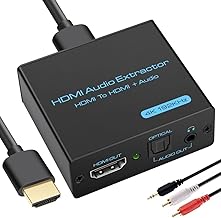
Best for: A setup where an HDMI source needs separate optical or 3.5mm audio output. This device is an audio extractor, not a soundbar. It takes an HDMI signal and sends audio to an AV receiver or other audio equipment through optical or 3.5mm output.
The listed modes are 2.0-channel, 5.1-channel, and pass-through. The product information says to use 2.0-channel mode with 3.5mm stereo output and 5.1-channel mode with optical output. It specifies HDMI 1.4, HDCP 1.4, and up to 4K at 30Hz, with optical DTS 5.1 and 3.5mm PCM 2.0 support.
Important limitation: The listing says the device does not support ARC/eARC and cannot use the TV as its HDMI input source. It also states that Fire TV, Apple TV, and PS4/5 support only 1080p through this extractor. Check the source-device and resolution requirements carefully.
Buying Guide: How To Choose HDMI Connections
What Is The Difference Between HDMI ARC And HDMI Input?
HDMI ARC, or Audio Return Channel, sends sound from a TV to an audio device through a compatible HDMI port. eARC is an enhanced version of ARC. A soundbar’s HDMI input, by contrast, accepts video and audio from a separate source such as a game console or media player. A model with an HDMI input may pass video onward to a TV, but the specific product must list that capability.
Do not treat the terms as interchangeable. A product listing that says “HDMI ARC” confirms an audio connection from a compatible TV, not necessarily a source-device input. In this selection, the Fire TV, Bose, FUNLOGY, and Assistrust listings describe ARC connections; none of the supplied soundbar details confirms a separate HDMI passthrough input.
How Can You Tell Which Connection Your TV Supports?
Look at the labels beside the TV’s HDMI ports or consult the TV manual. The ARC or eARC label identifies the port intended to return audio. If the soundbar uses optical or AUX instead, confirm that the TV provides the corresponding output. Use the connection method supported by both devices, and check the TV’s audio-output settings if sound does not play.
For an ARC connection, connect the soundbar to the TV’s ARC/eARC port. A source device can usually remain connected to another TV HDMI port, with the TV returning its audio to the soundbar. This approach is different from connecting the source device to a soundbar HDMI input.
Do You Need HDMI Passthrough?
HDMI passthrough can be useful when a soundbar has an HDMI input for a source device and an HDMI output to send video to the TV. It can reduce the need to route every source through the TV, but the product must explicitly list input and output ports and supported video formats. The soundbar details supplied here do not confirm passthrough, so buyers who require it should verify the manufacturer’s specifications before selecting a model.
The VPFET extractor has an HDMI input and separate audio outputs, but it is not a soundbar and does not provide the same function as a soundbar’s HDMI input/output arrangement. Its listing also describes specific resolution, channel, and ARC limitations. It is best considered only when its input and outputs match the intended source and audio equipment.
Which Soundbar Features Matter Most?
- Dialogue clarity: The Bose TV Speaker is specifically described as focusing on vocals. FUNLOGY lists DRC and EQ modes intended to help voices remain clear at lower volume.
- Connection choices: FUNLOGY and Assistrust list ARC, optical, AUX, and Bluetooth. Multiple connection types can help when devices do not share the same port.
- Preset sound modes: Assistrust lists movie, music, and news modes. These presets offer a simple way to change the sound profile by content type.
- Compact simplicity: Amazon Fire TV Soundbar and Bose TV Speaker are described as compact, all-in-one-style options, with TV audio connection through ARC.
- Separate audio extraction: VPFET is an accessory for sending HDMI-source audio to optical or 3.5mm equipment, subject to its stated limitations.
What Should You Check Before Buying?
Confirm the exact ports on both the TV and soundbar, whether the soundbar has ARC or eARC, and whether a separate HDMI input is essential. If you use an extractor, check its supported resolution, audio mode, and source-device restrictions. Also consider the room and listening needs: dialogue-focused use, music playback, gaming, and low-volume viewing may favor different listed features.
Read product specifications for the cable requirements and included accessories rather than assuming every cable is supplied. If a product description does not explicitly identify an HDMI input, HDMI output, or video passthrough, do not rely on ARC wording alone as proof that those features are present.
Frequently Asked Questions
Does HDMI ARC Mean A Soundbar Has An HDMI Input?
No. ARC sends TV audio to a soundbar through a compatible TV port. A separate HDMI input accepts a source device, and must be listed independently.
Can I Connect A Soundbar To A TV Without HDMI ARC?
Possibly, if both devices have another matching connection, such as optical or AUX. The FUNLOGY and Assistrust listings include optical and AUX connections, but check the ports on the specific TV and soundbar.
Can A Soundbar Send Video To A TV?
Only if it has a suitable HDMI input and output with video passthrough, as specified by its manufacturer. The supplied feature details for the four soundbars do not confirm that capability.
Is The VPFET Extractor A Soundbar?
No. It extracts audio from an HDMI signal and sends it through optical or 3.5mm output. It does not function as a speaker or soundbar.
Which Pick Is Designed To Improve TV Dialogue?
The Bose TV Speaker is described as focusing on vocals and pronunciation. FUNLOGY also lists DRC and EQ modes intended to make dialogue easier to hear at lower volume.
What Should I Buy If I Need HDMI ARC And Optical?
FUNLOGY and Assistrust list both HDMI ARC and optical connections. Confirm that the soundbar’s specific ports match the TV or source device before choosing between them.