
The best 5.1-to-RCA adapter depends on whether you need six-channel surround outputs or simply want to connect a digital source to stereo RCA inputs. For true 5.1 analog output, the SOUTHSKY decoder is the closest match. The PROZOR and AUTOUTLET converters send optical or coaxial digital audio to stereo RCA, while the SPRODIO is a passive 3.5 mm splitter. The VPFET extracts audio from HDMI but does not provide RCA outputs.
| Product | Best For | Output Type |
|---|---|---|
| SOUTHSKY Digital Sound Decoder | True 5.1 analog connections | Six RCA outputs |
| PROZOR Digital-to-Analog Converter | Optical or coaxial to stereo audio | Stereo RCA and 3.5 mm |
| AUTOUTLET Optical-to-RCA Converter | Optical digital audio to stereo RCA | Stereo RCA |
| SPRODIO Audio Console Converter | Routing stereo analog signals | RCA and 3.5 mm |
| VPFET HDMI Audio Extractor | Separating HDMI audio | Optical and 3.5 mm |
SOUTHSKY 5.1 Audio Decoder

Best for: Connecting a digital audio source to an older AV receiver or speaker setup that accepts separate analog RCA channels. This is the most direct match in this selection for a true 5.1-to-RCA conversion.
The SOUTHSKY decoder accepts optical Toslink/SPDIF and coaxial digital inputs, as well as a 3.5 mm auxiliary input. Its output bank includes six RCA connectors labeled for front left, front right, surround left, surround right, center, and subwoofer. That channel layout is important: unlike a simple stereo DAC, it is designed to provide multiple analog channel connections.
- Supports 5.1-channel and 2.1-channel modes with a one-key switch.
- Lists LPCM and Dolby/DTS/AC-3 decoding support.
- Includes two optical inputs, one coaxial input, and a 3.5 mm input.
- Remembers the selected input after restarting, according to the product details.
Why it was selected: It is the only listed product with six RCA outputs and an explicit 5.1-channel mode, making it the clearest option for multi-channel analog connections.
Limitation: Check that your source sends a supported digital format and that your receiver has the corresponding six RCA inputs. The listed information does not establish support for every surround format or device.
PROZOR Optical and Coaxial DAC

Best for: Sending digital audio from an optical or coaxial source to a stereo amplifier, RCA-connected speakers, or headphones with a 3.5 mm connection.
The PROZOR accepts optical and coaxial digital audio and converts it to left/right RCA analog output or 3.5 mm analog output. Its product information lists a 192 kHz sampling rate and 24-bit incoming SPDIF bit stream. It also lists support for Dolby AC-3, DTS, and PCM input, with conversion to 2.0-channel analog output.
- Digital inputs: optical and coaxial.
- Analog outputs: left/right RCA and 3.5 mm.
- Listed formats include Dolby AC-3, DTS, and PCM.
- Designed to convert supported digital input to two-channel analog output.
Why it was selected: It offers more input and output options than a basic optical-to-RCA converter and is useful when the destination is stereo rather than six-channel surround.
Limitation: Although the listing mentions 5.1 input formats, the stated analog output is 2.0-channel. Do not choose it if you need six separate RCA channels for a full analog 5.1 connection.
AUTOUTLET Optical-to-RCA Converter

Best for: Connecting a device with optical digital audio output to a stereo amplifier or other equipment with RCA analog input.
This AUTOUTLET converter is described as an optical-to-RCA DAC. It receives Toslink digital audio and sends analog audio through RCA connections. The listed specifications include 24-bit/192 kHz processing and optical input sampling rates of 32, 44.1, 48, 96, and 192 kHz. A built-in amplifier chip and dual-channel operational amplifier are also listed as part of the design.
- Converts optical digital audio to RCA analog audio.
- Supports listed optical sampling rates up to 192 kHz.
- Processes 24-bit audio, according to the product information.
- Intended for connection to a stereo amplifier with RCA input.
Why it was selected: It is a straightforward choice when the actual need is optical digital audio to stereo RCA, without the additional inputs and output types of a broader converter.
Limitation: The product details describe stereo RCA conversion, not six-channel 5.1 RCA output. Choose a multi-output decoder instead if you need discrete center, surround, and subwoofer channels.
SPRODIO RCA and 3.5 Mm Adapter

Best for: Routing stereo analog audio between RCA connections and three 3.5 mm stereo plugs, when the connected equipment supports the needed signal arrangement.
The SPRODIO is a passive adapter, not a digital decoder. Its listed 1-in/3-out direction converts stereo RCA analog audio to three 3.5 mm stereo plugs. The product also describes reversible use as three 3.5 mm inputs to one RCA-connected output. It is marketed for multimedia speaker systems, including 5.1 systems.
- Supports stereo RCA input to three 3.5 mm stereo plugs.
- Can be used in the reverse direction, according to the listing.
- Does not perform optical, coaxial, or HDMI digital-to-analog conversion.
Why it was selected: It can suit users whose equipment already handles analog audio and whose connection problem is plug routing rather than digital decoding.
Limitation: Three 3.5 mm plugs do not automatically mean discrete 5.1 decoding or six independent RCA channels. Avoid this adapter if you need a digital source decoded into separate surround channels.
VPFET HDMI Audio Extractor
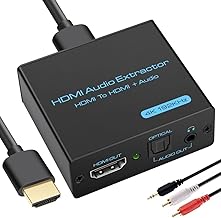
Best for: Extracting audio from an HDMI source when your audio equipment accepts optical or 3.5 mm input rather than HDMI.
The VPFET takes HDMI audio and offers optical and 3.5 mm audio output. It has three modes: 2.0-channel, 5.1-channel, and pass-through. The listed optical output supports DTS 5.1, while the 3.5 mm output supports PCM 2.0. The device is specified for HDMI 1.4, HDCP 1.4, and up to 4K at 30 Hz under listed conditions.
- Extracts audio from an HDMI signal.
- Offers 2.0-channel, 5.1-channel, and pass-through modes.
- Provides optical and 3.5 mm outputs, not RCA outputs.
- The listing says it does not support 7.1-channel audio or ARC/eARC TV input.
Why it was selected: It may be useful when the source only offers HDMI and the next device needs a separate audio connection.
Limitation: This is not a 5.1-to-RCA adapter. Its listed outputs are optical and 3.5 mm, so it requires another suitable conversion step if your receiver only accepts RCA.
Buying Guide: How To Choose A 5.1-To-RCA Adapter
“5.1 to RCA adapter” can mean two different things: a converter that creates six separate analog channels, or a DAC that converts digital audio into a stereo RCA pair. Identify the source output and the destination input before choosing. Connector shape alone does not tell you whether a device decodes surround sound.
Do you need six RCA outputs or stereo RCA?
For discrete analog 5.1, look for a decoder with six RCA outputs identified as front left, front right, center, subwoofer, surround left, and surround right. In this selection, SOUTHSKY is the only product listing that output arrangement. A converter with only a left/right RCA pair provides stereo analog output, even if its description mentions 5.1 input formats.
What audio output does your source have?
- Optical or coaxial: Choose a DAC that accepts the same digital connection. The SOUTHSKY accepts optical and coaxial; PROZOR also lists both; AUTOUTLET lists optical input.
- HDMI: An HDMI audio extractor may separate audio, but check its output type. The VPFET provides optical and 3.5 mm, not RCA.
- Analog RCA or 3.5 mm: A passive adapter such as SPRODIO may route an analog signal, but it does not decode a digital surround signal.
Will the converter support the audio format?
Check the source’s audio output settings and the adapter’s supported formats. A converter may accept a digital surround format but output only two-channel analog audio. For a six-channel setup, confirm both the format support and the presence of six discrete analog outputs. If a source is set to a format the converter does not support, audio may not work as expected.
Does your receiver have the right inputs?
Match each output to an input on the receiver or speaker system. A six-RCA decoder needs a destination with corresponding multi-channel analog inputs. A stereo DAC needs only a left/right RCA input. Confirm labels and channel count on the equipment, rather than assuming that any RCA connection carries surround sound.
When is a passive adapter enough?
A passive splitter or adapter can change connector routing for compatible analog signals. It cannot convert optical, coaxial, or HDMI digital audio into analog RCA by itself, and it cannot create discrete surround channels from a stereo signal. Choose a powered DAC or decoder when digital conversion or format decoding is required.
Frequently Asked Questions
Can a stereo RCA cable carry 5.1 surround sound?
A standard stereo RCA pair carries two analog channels. Discrete analog 5.1 typically requires six separate channel connections, or a different digital connection and a compatible decoder.
Does an optical-to-RCA converter automatically output 5.1?
No. Some optical-to-RCA converters turn supported digital input into stereo analog output. Check whether the product specifically provides six analog outputs if you need discrete 5.1 channels.
Which listed product has six RCA outputs?
The SOUTHSKY decoder lists six RCA outputs for front left, front right, surround left, surround right, center, and subwoofer channels.
Can I use the SPRODIO adapter with an optical source?
Not by itself. SPRODIO is described as a passive adapter for analog RCA and 3.5 mm connections. An optical source requires a compatible digital-to-analog converter first.
Is the VPFET HDMI extractor an RCA adapter?
No. Its listed audio outputs are optical and 3.5 mm. It can extract audio from HDMI, but it does not directly provide RCA output.