
The best wireless guitar setup depends on where you play, how much range you need, and whether your instrument has a recessed output jack or active pickups. The JOYO JW-06 is best for players who want a charging case and up to 18 hours of combined battery life; the JOYO JW-03 is better for guitarists who need a rotating plug. For 5.8GHz systems, the Xvive A58 models and LEKATO option offer alternatives for home, rehearsal, or smaller-stage use.
| System | Best For | Standout Feature |
|---|---|---|
| JOYO JW-06 | Longer sessions and portable charging | Charging case; up to 18 hours total |
| JOYO JW-03 | Recessed or awkwardly positioned jacks | 220-degree rotating plug |
| Xvive A58, 100-foot range model | Players prioritizing range and low latency | 5.8GHz; range over 100 feet |
| Xvive A58, active/passive model | Guitars with different pickup output levels | Selectable active and passive modes |
| LEKATO 5.8GHz | Practice and smaller performances | Rotating plug and 24-bit/48kHz audio |
JOYO JW-06: Best For Longer Sessions

The JOYO JW-06 is a 5.8GHz wireless guitar system with a transmitter, receiver, and charging case. It is best for guitarists who want to reduce cable use during practice, rehearsal, worship, or small gigs while keeping a charging option close at hand.
Its listed audio specifications are 48kHz/24-bit transmission and latency under 6ms. The system provides four channels, which gives users options to switch channels if nearby electronic interference causes noise or dropouts.
- Up to six hours of use per charge, with two additional full recharges from the case for up to 18 hours total.
- Listed open-area range is 65 to 100 feet.
- The manufacturer recommends roughly 30 to 50 feet when walls or other obstacles are present.
Choose this system if battery capacity and a charging case are priorities. A limitation is that the longer stated range applies to open areas; walls and obstructions can shorten the usable distance. The listed charging guidance calls for a 5V/2A charger and the included cable connected to the case’s input port.
JOYO JW-03: Best For Tight Output Jacks

The JOYO JW-03 is a 2.4GHz transmitter-and-receiver set for electric guitar, bass, and acoustic-electric instruments. It is best for players whose guitar has a recessed output jack, an offset body, or limited space around the jack, because its 1/4-inch plug rotates 220 degrees.
The system has four selectable channels, latency below 5ms, and a listed open-area range of about 65 feet. Its rechargeable batteries are rated for up to eight hours of continuous use, and the included dual-head USB cable can charge the transmitter and receiver together.
Choose the JW-03 if plug positioning and simultaneous charging matter more than choosing a 5.8GHz system. The product information says it works with most active or passive pickups. However, it is not recommended for large stages or environments with heavy Wi-Fi or Bluetooth activity, so it is a better fit for practice, recording, worship, rehearsal, and smaller venues.
Xvive A58: Best For Listed Range

This Xvive A58 is a 5.8GHz wireless system intended for guitar players and other wireless applications described by the manufacturer. It is best for musicians who want a stated working range over 100 feet for use at home, onstage, or in settings such as houses of worship.
The listed latency is less than 5ms. The product information also says up to four pairs of systems can be used at the same time. Its 5.8GHz band is the defining feature for shoppers comparing it with the 2.4GHz JOYO JW-03.
Choose this model if its stated range and support for multiple pairs fit your intended setup. Range is not a guarantee in every room or venue: obstacles and the layout of the space can affect wireless performance. The listing does not provide battery-life details in the supplied features, so check the product information for current charging and operating details before relying on it for a long session.
Xvive A58 Active/Passive: Best For Pickup Flexibility
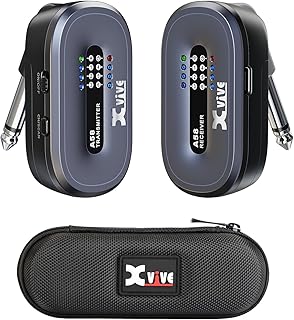
This Xvive A58 model is best for players who switch between instruments with different pickup output levels. Its listed active and passive modes are intended to support active and passive pickups, including high-output active pickups.
The system uses 5.8GHz transmission and lists 24-bit/48kHz audio across a 20Hz to 20kHz frequency range. The manufacturer describes it as a true-diversity wireless system. In passive mode, most guitars and basses are generally compatible according to the supplied information.
For active pickups, the instructions say to hold the transmitter’s Channel button for three seconds to activate Active mode; an Active LED indicates the setting. The product information advises switching to Active mode if the signal distorts in passive mode because the input power is too high.
Choose this version when pickup-mode flexibility is more important than features such as a charging case or a rotating plug. The supplied details do not state battery life or working range, so verify those requirements for your playing situation before choosing it.
LEKATO 5.8GHz: Best For Rotating Plug Convenience

The LEKATO 5.8GHz system pairs a transmitter and receiver for electric guitar and bass. It is best for players who want a rotating plug and a stated range of about 100 feet for practice, studio use, or smaller live performances.
Its listed audio format is 24-bit/48kHz, with latency under 6ms. The product information describes a rechargeable lithium battery with up to five hours of working time after a full charge. A dual USB cable is included for recharging.
Choose this system if the 220-degree plug rotation helps with your instrument’s output-jack position and five hours of listed use fits your session. Its stated battery life is shorter than the up-to-eight-hour rating listed for the JOYO JW-03 and the JW-06’s up-to-18-hour total with its case. The stated range is approximate, so test the system in your actual room or venue.
Buying Guide: How To Choose A Wireless Guitar Setup
A wireless guitar setup usually consists of a transmitter that connects to the instrument and a receiver that connects to an amplifier, pedalboard, or other signal input. These five products use plug-in transmitter-and-receiver designs. Before buying, check the instrument’s output-jack position, pickup type, expected playing distance, and how long you need to play between charges.
Should You Choose 2.4GHz Or 5.8GHz?
The JOYO JW-03 uses 2.4GHz. Its listed range is about 65 feet in open areas, and the manufacturer cautions against using it on large stages or in Wi-Fi- and Bluetooth-heavy environments. The other listed systems use 5.8GHz. Frequency alone does not establish which system will work best in every location, so consider the product’s stated range and test the signal where you plan to play.
How Much Range Do You Need?
Match the stated range to your actual playing space, but treat open-area figures as reference points rather than guarantees. The JOYO JW-06 lists 65 to 100 feet in open areas and recommends shorter distances around walls. The JW-03 lists about 65 feet in open areas, while the LEKATO lists about 100 feet and one Xvive A58 listing specifies over 100 feet. For a venue with obstacles, test for dropouts before a performance.
Does Your Guitar Have Active Pickups?
Pickup type can affect which setup is most convenient. The Xvive A58 active/passive model specifically lists modes for both pickup types and gives instructions for switching to Active mode. The JOYO JW-03 is described as working with most active or passive pickups. For other systems, check the manufacturer’s current instructions if you are unsure about the output level or the instrument’s pickup configuration.
Will The Plug Fit Your Instrument?
A transmitter’s plug can be awkward to position on an instrument with a recessed jack or tight clearance. The JOYO JW-03 and LEKATO list 220-degree rotating plugs, which can make it easier to orient the transmitter. Compare the product image and instrument jack layout before purchase; a rotating plug does not eliminate the need to confirm physical clearance.
How Long Does The Battery Need To Last?
Compare stated operating time with your longest practice, rehearsal, or performance. The JW-03 lists up to eight hours, the LEKATO lists up to five hours, and the JW-06 lists up to six hours per charge plus two full case recharges, for up to 18 hours total. These are product-listed figures; actual use conditions may differ. If you choose a system without supplied battery details, verify those details before depending on it for extended use.
What Do Latency And Audio Specifications Tell You?
Latency describes the delay between playing a note and hearing it through the wireless signal path. The listed figures range from under 5ms to under 6ms. Several products also list 24-bit/48kHz audio. These specifications help compare systems, but they do not replace checking the complete signal chain, including the instrument, receiver connection, pedals, and amplifier.
How Can You Set Up And Check The System?
- Charge the transmitter and receiver according to the product’s instructions before the first session.
- Connect the transmitter to the guitar and the receiver to the intended signal input.
- Select or pair channels as directed by the manufacturer, then test at the distance you expect to use.
- Move away from potential obstacles or interference sources if you hear noise or experience dropouts.
- For systems with selectable channels, try another channel if interference is present.
- Keep a cable available when a wireless system is not suitable for a particular stage or session.
Frequently Asked Questions
Do wireless guitar systems work with bass?
Several products in this list are described for guitar and bass, including the JOYO JW-06, JOYO JW-03, and Xvive A58 active/passive model. Confirm the instrument and pickup requirements in the product details before choosing a system.
Can I use a wireless guitar system at home?
Yes. The listed systems are described for uses that include home practice, and some also list recording or rehearsal. Test the signal in the room where you will play because walls and nearby electronics can affect performance.
Which listed system has the longest stated battery life?
The JOYO JW-06 lists up to 18 hours total when its charging case’s two full recharges are included. Its transmitter and receiver provide up to six hours per charge.
Which systems have a rotating plug?
The JOYO JW-03 and LEKATO 5.8GHz list 220-degree rotating plugs. This feature may help with recessed, offset, or tightly positioned output jacks.
Is a stated 100-foot range guaranteed indoors?
No. A stated range is not a guarantee for every indoor space. Walls, obstacles, and the local wireless environment can reduce the distance, so test the system in the actual playing area.
Can multiple wireless systems operate at once?
The Xvive A58 listing with the 100-foot range states that up to four pairs can be used at the same time. For other products, check the manufacturer’s current channel and simultaneous-use guidance rather than assuming the same capacity.