
The best high-resolution lossless music player depends on your headphones, music library, and need for wired or wireless listening. The Surfans F20 is best for offline FLAC and DSD libraries with included storage; the HIFI WALKER H20 is better for listeners who want balanced and standard headphone outputs; and the Onix XM2 is suited to buyers seeking a touchscreen and extensive expandable storage. The AGPTEK A02 is a simpler general-purpose player, but its listed features do not specify high-resolution lossless format support.
| Player | Best For | Key Listed Feature |
|---|---|---|
| Surfans F20 | Offline lossless collections | ESS DAC, DSD128, included 64GB card |
| HIFI WALKER H2 | Physical controls and wired connections | ESS DAC, USB DAC, line out |
| HIFI WALKER H20 | Balanced-output listening | 4.4mm balanced and 3.5mm outputs |
| Onix XM2 | Touchscreen operation and large libraries | 3-inch OLED, storage expansion to 2TB |
| AGPTEK A02 | Basic portable playback and extra functions | Bluetooth, speaker, FM radio, recorder |
Surfans F20: Best For Offline Lossless Libraries
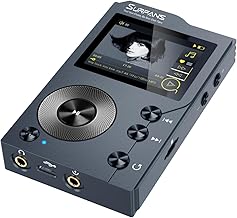
The Surfans F20 is a strong match for listeners who want to carry a sizable library of lossless files without depending on Wi-Fi, apps, or a streaming subscription. Its listed ESS ES9018K2M DAC and support for decoding up to 32-bit/384kHz and native DSD128 make its format support clear.
It plays FLAC, WAV, APE, WMA, MP3, and other formats. The package includes a 64GB microSD card, and the player supports expansion up to 512GB. Bluetooth 5.2 supports compatible wireless headphones or speakers, while the 3.5mm headphone output serves wired earphones. A separate 1.5V line-out is listed for connecting to an audio system, car AUX input, or external amplifier.
- Best for: Listeners building an offline FLAC or DSD collection.
- Why it stands out: It combines named high-resolution formats, included storage, and several connection options.
- Limitation: Its listed maximum expansion is 512GB, which is less than the Onix XM2’s stated 2TB capacity.
Choose this player if format support and a ready-to-use memory card matter more than having a touchscreen or the largest listed storage ceiling.
HIFI WALKER H2: Best For Physical Controls

The HIFI WALKER H2 is a practical choice for buyers who prefer a player with physical controls and wired-system connections. Its product name lists an ESS DAC, support for DSD and FLAC, USB DAC functionality, line out, and a 64GB microSD card. It also supports storage expansion up to 512GB.
USB DAC functionality may be relevant to someone who wants to use a player in a computer audio setup, while line out provides a listed option for connecting to other audio equipment. The product name also specifically calls out physical controls, a useful distinction for shoppers who would rather operate playback with buttons than rely only on a touchscreen.
- Best for: Buyers who want physical controls, a supplied memory card, and a stated USB DAC function.
- Why it stands out: Its listed combination of DSD and FLAC support with line out and USB DAC gives it several use-case options.
- Limitation: The supplied product information does not specify a decoding rate or Bluetooth version, so compare those details on the listing if they are essential.
Choose the H2 if its control style and connections fit your setup. Avoid assuming that it matches another player’s detailed format limits unless the product listing confirms them.
HIFI WALKER H20: Best For Balanced Output

The HIFI WALKER H20 is best suited to listeners who specifically need both a 4.4mm balanced output and a standard 3.5mm output. Its listed ESS9038Q2M DAC and support for DSD256 and 32-bit/768kHz decoding make it the most explicit high-resolution format specification among the supplied product details.
The player comes with a 128GB card, according to its name, and supports Bluetooth. The two output types give buyers a way to match the player to different wired headphone connections, although a balanced output is useful only when the headphones and cable have the corresponding connection.
- Best for: Listeners with compatible 4.4mm balanced headphones or those who want both balanced and 3.5mm outputs.
- Why it stands out: It lists high decoding limits, DSD256 support, and a larger included card than the 64GB cards named for the F20 and H2.
- Limitation: The supplied information does not state the maximum expandable storage, so check the listing if capacity beyond the included card matters.
Choose the H20 when balanced output is a meaningful requirement, not simply because a larger format number appears in its specifications. Your source files and playback chain also affect whether those limits are useful.
Onix XM2: Best For Large Expandable Storage

The Onix XM2 is a compelling option for buyers who want touchscreen operation and room for a very large music library. Its listed features include a 3-inch OLED touchscreen, Bluetooth 5.2, USB DAC functionality, and expandable storage up to 2TB. The product name identifies it as a Hi-Res lossless player and lists a CS4308P 8-channel DAC and Brighton Architecture.
Its stated 800mW output at 32Ω may be relevant to shoppers comparing output specifications, but it should not be treated as a guarantee of performance with every headphone. The listed battery figure is 8.5 hours; actual use can vary, and the supplied information does not detail the conditions for that figure.
- Best for: Listeners prioritizing a touchscreen interface, USB DAC use, and storage expansion beyond 512GB.
- Why it stands out: Its stated 2TB expansion capacity is the highest among these five products.
- Limitation: Its listed battery life is 8.5 hours, so buyers who prioritize long sessions away from charging should compare battery details carefully.
Choose the XM2 if its screen and storage ceiling suit your library. Confirm the formats and output connections you need on the product listing, since the supplied details do not enumerate all supported file types.
AGPTEK A02: Best For Basic Everyday Features

The AGPTEK A02 is better suited to shoppers looking for a straightforward portable player with several general-purpose functions than to buyers specifically seeking documented high-resolution lossless playback. Its listed features include Bluetooth 5.3, a 1.8-inch screen, a speaker, FM radio, and voice recording. The product name states that this version has 32GB and supports expansion up to 128GB.
Those functions may fit a listener who wants radio or recording options in addition to music playback. However, the supplied product details do not name FLAC, DSD, a DAC, or a high-resolution decoding limit. That makes it harder to compare directly with the four players above for a lossless library.
- Best for: Buyers who value Bluetooth, FM radio, a built-in speaker, and voice recording.
- Why it stands out: It combines those everyday features with 32GB of listed storage and expansion up to 128GB.
- Limitation: High-resolution and lossless format support is not specified in the supplied features.
Choose the A02 for its listed extra functions, but verify supported file formats before purchasing it for FLAC, DSD, or other lossless files.
Buying Guide: How To Choose A High-Resolution Lossless Music Player
Which audio formats and decoding limits do you need?
Start with the files you already own. FLAC is named for the Surfans F20 and HIFI WALKER H2, while DSD support is listed for the F20, H2, and H20. The H20 specifically lists DSD256 and 32-bit/768kHz decoding; the F20 lists native DSD128 and 32-bit/384kHz decoding. These specifications describe supported playback limits, not a promise that every recording will sound different or better.
Check the player’s supported formats against your library before buying. If you use formats that are not named in the provided information, consult the product listing or manufacturer documentation rather than assuming compatibility. A player’s maximum decoding specification is most relevant when your files and listening chain can use it.
Do you need a standard, balanced, or line-level connection?
A 3.5mm headphone output is listed for the Surfans F20, and the HIFI WALKER H20 lists both 3.5mm and 4.4mm balanced outputs. The H2 lists line out and USB DAC functionality, while the F20 lists a separate 1.5V line-out. The Onix XM2 also lists USB DAC functionality.
Match outputs to the equipment you already own. A balanced socket requires compatible headphones or a suitable cable; it is not a general replacement for checking your connections. Line out is intended for connecting to other audio equipment, while a headphone output is for headphones. Confirm the connection type and intended use in the product details.
How much storage is enough for your music collection?
Lossless files can use more storage than compressed files, so consider the size of your library and whether you want room to add albums. The F20 and H2 include 64GB cards and list expansion to 512GB. The H20 name lists a 128GB card, but the supplied information does not state its expansion ceiling. The Onix XM2 lists expansion to 2TB, while the AGPTEK A02 lists 32GB of storage and expansion up to 128GB.
Included card capacity and maximum expansion are different measures. Check whether a card is included, the maximum supported capacity, and the card type required. Do not assume that a player accepts every card size or format without confirming the manufacturer’s instructions.
Will you listen over Bluetooth or use a wired setup?
Bluetooth is listed for the Surfans F20, H20, and Onix XM2, and the AGPTEK A02 specifies Bluetooth 5.3. The F20 and XM2 name Bluetooth 5.2. The H2 product name mentions Bluetooth but does not state a version in the information supplied here. For wireless listening, confirm that the player supports the connection method and codecs you need; the listed details do not identify Bluetooth codecs.
Wired listening can be the simpler choice when you want to use the player’s headphone output or connect through line out. If you plan to use the player as a USB DAC, the H2 and XM2 explicitly list that function. Check the required cable and device setup before purchasing.
Is a touchscreen or physical control layout more useful?
The Onix XM2 lists a 3-inch OLED touchscreen, while the HIFI WALKER H2 specifically calls out physical controls. The Surfans F20 and other product names supplied here do not provide enough detail to compare their full control layouts. Consider how you will change tracks and adjust playback, especially if you keep the player in a pocket or operate it while moving.
A screen may make browsing a library more visual, while physical controls can be useful when you want direct button operation. The best fit depends on your habits; verify the interface and navigation details in the product listing rather than inferring them from the brand or product category.
What should you check before buying?
- Confirm that the player supports the exact formats in your music library.
- Compare included storage with the stated maximum expansion capacity.
- Match the headphone output to your wired headphones and cables.
- Check whether Bluetooth codecs are listed if wireless sound quality is a priority.
- Review battery details if you often listen away from a charger.
- Verify the included accessories and connection requirements on the product listing.
Frequently Asked Questions
What is a lossless music player?
A lossless music player is a device that can play audio files encoded without the data loss associated with lossy compression. Support depends on the specific formats listed by the manufacturer, so check compatibility with your files.
Is a high-resolution player necessary for FLAC files?
Not necessarily. FLAC is a lossless format, but a player also needs to support the file’s specific encoding and resolution. Compare the file details with the player’s stated format and decoding limits.
Which listed player has the highest stated decoding limit?
The HIFI WALKER H20 lists support for 32-bit/768kHz decoding and DSD256. That specification does not by itself determine how a listener will perceive playback quality.
Which player lists the most expandable storage?
The Onix XM2 lists expandable storage up to 2TB. The Surfans F20 and HIFI WALKER H2 list expansion up to 512GB, while the AGPTEK A02 lists expansion up to 128GB.
Do these players require streaming or Wi-Fi?
The Surfans F20 is described as suitable for offline listening without relying on Wi-Fi, apps, or streaming subscriptions. The supplied details for the other products do not establish whether they have additional online functions.
Is a balanced output required for high-resolution music?
No. Balanced output is a connection option, not a requirement for playing high-resolution files. Choose it only if it matches your headphones and listening setup.