
The best pro audio tone generator depends on whether you need to send a reference signal, check audio connections, or trace cable runs. The Xvive AT-2 is best for live-sound troubleshooting because it combines a tone generator with several test functions. The Whirlwind Qbox suits users who need multiple audio connections, while the Shure A15TG offers a dedicated tone-generator option. A cable tracer or variable-frequency unit may fit more specialized tasks.
| Product | Best For | Key Listed Feature |
|---|---|---|
| Xvive AT-2 | Live sound and equipment checks | 1 kHz tone, pink noise, and multiple test tools |
| Whirlwind Qbox | Audio line and cable testing | XLR, TT Bantam, and multiple output connections |
| Shure A15TG | Dedicated tone generation | On/off switch and stated battery life |
| Xin Tester Wire Toner | Cable tracing and fault finding | Tracing, continuity, and short-circuit tests |
| PAC Tone Generator | Variable-frequency and speaker polarity checks | 13–10,000 Hz tone range and 0–8 V output |
Xvive AT-2 Audio Tester Pro

Best for: Live-sound engineers and audio professionals who want a signal source and several basic diagnostic functions in one compact device. It is selected for its combination of signal generation, cable checking, phantom-power verification, metering, and monitoring.
The built-in generator supplies a 1 kHz sine tone or pink noise. Three output pad levels—-10, -20, and -40 dB—are listed for matching common inputs. The product also includes an XLR cable tester, a 48 V phantom-power checker, an XLR input meter, and headphone and built-in-speaker monitoring.
This range of functions can help users test mixers, DI boxes, wireless systems, pedals, active PA speakers, and IEM rigs. The phantom-power indicator reports voltage ranges, while the input meter shows signal presence and can flag very hot levels.
Limitation: The listed tone choices are 1 kHz sine and pink noise; choose another model if you specifically need a continuously variable tone frequency.
Whirlwind Qbox Audio Line Tester
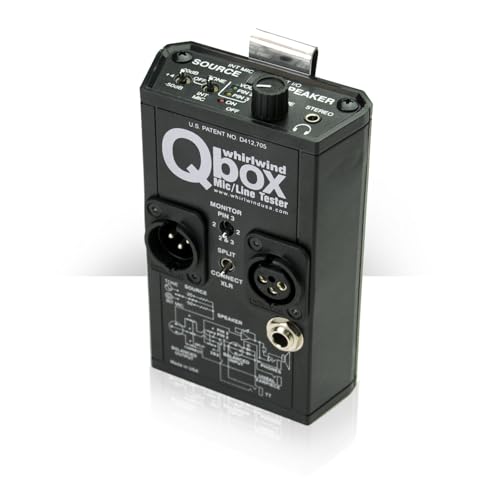
Best for: Audio technicians who need to test signal paths using a range of common audio connections. It is selected for its XLR and TT Bantam inputs and its XLR, unbalanced 1/4-inch, and stereo outputs.
The Qbox is described as an audio line tester, cable tester, and test tone generator. Its listed selectable output impedance is 950 ohms or 20 kOhms, and the feature information specifies 60 dB of gain. These options may matter when diagnosing different parts of an audio setup or tracing a signal through connected equipment.
Choose this model if connection flexibility is a priority and your work involves the listed XLR, TT Bantam, or 1/4-inch interfaces. Its varied input and output connections distinguish it from a basic single-purpose tone source.
Limitation: The product information does not specify the generated tone frequency or describe a display, so confirm those details if your testing workflow requires them.
Shure A15TG Tone Generator

Best for: Buyers looking for a straightforward, dedicated tone generator rather than a multi-function cable and signal tester. It is included as a focused option from Shure, with an on/off switch and a stated battery life of 1,000 hours under continuous use.
The available product details are limited. They identify the A15TG as a tone generator and list the on/off switch and continuous-use battery-life figure. The description does not provide a tone frequency, output level, connector details, or additional diagnostic functions.
Choose this unit if the stated basic operation and battery-life information fit your needs and you can confirm its connection requirements from the full product listing. It may be a simpler choice than a tester that combines signal generation with cable checks or metering.
Limitation: Because key specifications are not included in the supplied details, verify the tone and connection specifications before selecting it for a particular system.
Xin Tester Wire Toner And Probe Kit

Best for: Technicians who need to locate cable runs or investigate continuity and wiring faults, including on audio or video signal cable. It is selected for its tracing and diagnostic functions rather than as a primary studio reference-tone source.
The product information lists support for tracing Cat3, telephone line, coaxial, and audio/video signal cable. It offers continuity testing in two modes, cable on/off detection, break-point location, and short-circuit testing. The kit can also recognize telephone-line busy, idle, or ringing status and detect positive and negative polarity.
Choose this kit when the problem is finding a wire or checking a cable’s condition. Its listed functions address physical wiring and line identification, which is different from generating a reference tone for setting audio levels.
Limitation: The kit uses a DC 9 V (6F22) battery. Its feature list does not provide a pro-audio tone frequency or output-level specification.
PAC Tone Generator And Polarity Tester
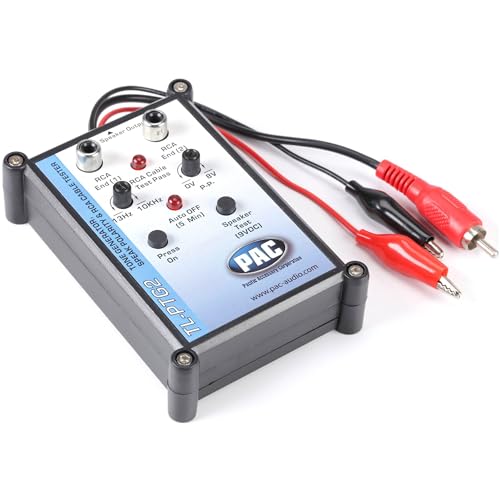
Best for: Buyers working on car audio systems who need a variable-frequency signal and speaker-polarity test function. It is selected because the listed output range is specific: 0–8 volts with a variable tone from 13 Hz to 10,000 Hz.
The PAC unit is described as a tone generator and speaker polarity tester for car audio systems. Its frequency range covers low and high audible test tones, and the adjustable output range can support troubleshooting and testing as described by the manufacturer.
Choose this model if speaker polarity checks and adjustable frequency are central to your task. Compared with the Xvive AT-2, it emphasizes variable-frequency output and polarity testing rather than a bundle of XLR-oriented checks and monitoring functions.
Limitation: The product is specifically presented for car audio systems. The supplied features do not list the connection formats, so verify that its connections suit your equipment.
Buying Guide: How To Choose A Pro Audio Tone Generator
What task do you need the generator to perform?
Start by identifying whether you need an audio reference signal, a way to locate a cable, a polarity check, or several diagnostic tools in one device. A test tone sends a known signal through an audio path. A cable toner and probe help identify a wire or investigate continuity. These tasks overlap in some workflows, but the tools are not interchangeable.
- Signal testing: Look for the tone type, frequency, and output-level options required by your equipment.
- Live-sound troubleshooting: Consider whether XLR cable testing, input metering, phantom-power checking, or monitoring would be useful.
- Cable tracing: Prioritize supported cable types, continuity modes, and wire-location functions.
- Speaker checks: If polarity is important, choose a model whose listed features specifically include a speaker-polarity test.
Do you need a fixed tone or variable frequency?
A fixed 1 kHz sine tone is a defined test signal for checking a signal path. Pink noise is a different signal option and is included in the Xvive AT-2. A variable-frequency generator offers more control when checking different parts of a system or when a specific frequency is required. The PAC model lists a 13–10,000 Hz range; the Whirlwind and Shure details supplied here do not state a tone frequency.
Do not assume that a generator offers a particular tone simply because it is marketed for audio testing. Check the full specifications for frequency, waveform, output level, and whether the signal can be adjusted.
Which connections and signal levels should you check?
Match the device’s listed inputs and outputs to the equipment you plan to test. The Whirlwind Qbox identifies XLR, TT Bantam, and 1/4-inch connections. The Xvive AT-2 lists XLR-focused testing and output pad settings. Other models in this selection do not provide detailed connector information in the supplied features, so confirm the connection type before buying.
Output level also matters. A generator should provide a signal appropriate for the input being tested. The Xvive offers three listed pad levels, while the PAC specifies a 0–8 V output range. These specifications are not directly comparable without considering the connection and the equipment’s input requirements.
Would a multi-function tester save steps?
A combined tester can reduce the number of separate tools needed for routine troubleshooting. The Xvive AT-2 includes tone generation, pink noise, an XLR cable tester, phantom-power checking, input metering, and monitoring. The Whirlwind Qbox focuses on line and cable testing with several audio connections. Choose a combined tool based on the tests you actually perform rather than the number of features alone.
A dedicated generator may be preferable when you want a narrower function or a specific output range. A wire tracer is a better fit for locating cables and checking breaks than for setting a reference level through a mixing console.
What should you verify before purchase?
- Confirm the tone frequency or range and signal type.
- Check output level, attenuation, and connector requirements against your audio equipment.
- Determine whether you need cable tracing, continuity testing, polarity checking, or phantom-power verification.
- For battery-powered equipment, check the required battery type and whether charging or replacement suits your work.
- Review the complete product listing when key specifications are absent from the available feature description.
Frequently Asked Questions
What is a pro audio tone generator used for?
A pro audio tone generator sends a known signal through equipment so a user can check signal paths and troubleshoot audio connections. Some models add tools such as cable testing, metering, or polarity checking.
Is a cable toner the same as an audio tone generator?
No. An audio tone generator supplies a test signal for an audio path. A cable toner and probe primarily help locate wires and check wiring conditions. A cable tracer can support audio work, but it does not replace a reference signal generator when one is needed.
Which product in this list includes pink noise?
The Xvive AT-2 includes pink noise and a 1 kHz sine tone, according to its listed features. It also combines signal generation with several audio diagnostic functions.
Which option has a variable-frequency tone range?
The PAC Tone Generator lists a variable range from 13 Hz to 10,000 Hz and an output range of 0–8 volts. Its product description focuses on car audio systems and speaker polarity testing.
Which product is designed for cable tracing?
The Xin Tester Wire Toner and Probe Kit is designed for cable tracing and fault finding. Its listed functions include continuity testing, short-circuit testing, break-point location, and tracing audio/video signal cable.
What specifications matter most when choosing a tone generator?
Check the tone frequency and type, output level, available connections, and whether the device includes the diagnostic functions you need. For cable work, also verify supported cable types and tracing or continuity features.