
The best car-to-wall converter depends on which direction you need to convert power. A car power inverter turns a vehicle’s 12V DC power into household-style AC power, while an AC-to-DC adapter lets a low-power car accessory run from a wall outlet. The PiSFAU 200W is best for portable charging with multiple ports; the Pro Chaser 400W suits buyers seeking higher stated output; and the two 24W adapters are for low-power 12V devices at home. Check the device’s power requirements before choosing.
| Product | Best For | Power Direction |
|---|---|---|
| PiSFAU 200W Inverter | Portable charging with several ports | Vehicle DC to AC |
| PiSFAU 150W Inverter | Basic AC and USB charging | Vehicle DC to AC |
| Pro Chaser 400W Inverter | Higher stated output and USB-C PD | Vehicle DC to AC |
| AC to DC 24W Adapter | Low-power car electronics indoors | Wall AC to 12V DC |
| Herfair 24W Adapter | Low-power devices with an indicator light | Wall AC to 12V DC |
PiSFAU 200W Car Power Inverter
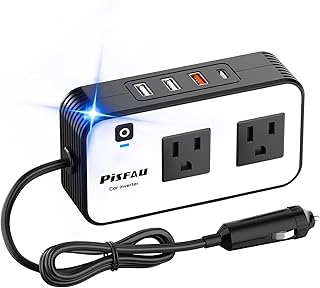
This inverter converts a vehicle’s 12V DC power to 110V AC for compatible electronics. It has two U.S.-style AC outlets and four USB charging ports, including USB-A and USB-C ports. The listing describes a compact, lightweight design and a high-efficiency circuit with heat-dissipation features.
Best for: Travelers who want to charge several small electronics from a car, including devices that use AC outlets and USB ports. It was selected for its combination of two AC outlets, four USB ports, and portable design.
Limitation: The listed features do not specify a continuous wattage rating for this model. Confirm the inverter’s rating and the device’s power draw before connecting AC equipment; do not assume that every laptop or appliance is suitable.
PiSFAU 150W Vehicle Power Inverter
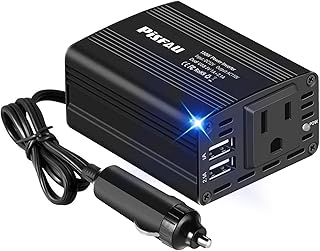
This vehicle inverter is rated for 150 watts of continuous DC-to-AC power and 300 watts of peak power. It provides AC outlets and two USB charging ports. The product listing also describes a smart chip and built-in fuse, with automatic output shutdown and a warning light if the unit detects a fault.
Best for: Buyers who need a vehicle-powered AC outlet and USB charging for compatible, lower-power electronics. It offers a clearly stated continuous rating, making it easier to compare against a device’s power requirement than models without a stated rating.
Limitation: The 300W peak figure is not the same as continuous capacity. Keep connected equipment within the stated 150W continuous limit and check its startup requirements before use.
Pro Chaser 400W Power Inverter

The Pro Chaser converts 12V vehicle power to 110V AC and is listed with 400 watts of continuous output and up to 800 watts of peak output. It has two AC outlets, a USB-A QC 18W port, and a USB-C PD 65W port. A 30-inch cord is described as providing reach for use from a vehicle’s back seat.
Best for: Buyers who want a higher stated continuous output than the 150W option, along with USB-C PD charging. The stated ports and cord length make it a useful candidate for road-trip charging when the connected devices remain within the inverter’s limits.
Limitation: A vehicle’s 12V socket and electrical system may limit the power available. Check the vehicle and inverter instructions, and do not treat the 800W peak rating as continuous output.
AC To DC 24W Car Socket Adapter

This adapter works in the opposite direction from a car inverter: it converts 110–240V AC from a wall outlet into 12V DC through a car cigarette-lighter socket. It is rated at 2A and 24W and is described as a regulated power supply with short-circuit, overheat, and overload protection.
Best for: People who want to power a compatible, low-wattage 12V car accessory indoors. The product listing names devices such as dash cams, FM transmitters, air purifiers, and humidifiers as examples.
Limitation: The adapter is explicitly not a battery charger and is limited to 24W or 2A. Avoid using it with higher-power equipment such as car inflators, vacuums, refrigerators, or other devices exceeding its rating.
Herfair 24W AC To DC Converter

The Herfair adapter converts household AC input rated at 100–240V and 50/60Hz to 12V, 2A DC. It connects a wall plug to a female car cigarette-lighter socket. Its listed features include a 36.5-inch cable, an LED indicator, a built-in fuse, and protection against overheating, overvoltage, and overload.
Best for: Buyers seeking a wall-powered socket for compatible low-power car accessories, especially when a visible indicator and a longer cable are useful. It was selected as a second 24W option with clearly listed input, output, and cable details.
Limitation: The 24W maximum rules out high-power devices, including the air compressors, vacuums, and refrigerators identified in the listing. Verify that the accessory’s voltage, current, and wattage match the adapter.
Buying Guide: How To Choose A Car To Wall Converter
“Car to wall converter” can refer to two different kinds of power adapter. Before comparing ports or output, identify whether power needs to flow from the vehicle to an AC outlet or from a household outlet to a 12V car accessory. The direction determines which product category will work.
Do You Need Vehicle Power At A Wall-Style Outlet?
Choose a car power inverter when you want to use vehicle power for equipment that accepts household-style AC power. The inverter plugs into a vehicle’s 12V power source and produces AC output. The PiSFAU and Pro Chaser products in this list are inverters. Compare their continuous output rating with the device’s power draw; peak output is a separate, short-term rating and should not be used as the main capacity figure.
Do You Need To Run A Car Accessory From A Wall Outlet?
Choose an AC-to-DC converter when the accessory is designed for a 12V car socket but you want to power it indoors. These adapters take household AC input and supply 12V DC through a car-style socket. The two 24W models are intended for low-power equipment. They do not create a household AC outlet and they are not substitutes for an inverter.
How Much Power Does The Device Require?
Read the device label or manual for its voltage, current, and wattage. If the product lists watts, compare that figure with the converter’s output rating. For a 12V device listed in amps, multiplying volts by amps gives an approximate wattage: 12V multiplied by 2A equals 24W. Keep the device at or below the converter’s stated limits, and allow for any startup demand specified by the device manufacturer.
Is Continuous Output More Important Than Peak Output?
For normal operation, continuous output is the key rating. Peak output describes a higher level the inverter may support briefly, not what it can supply continuously. For example, the PiSFAU 150W model lists 150W continuous and 300W peak. The Pro Chaser lists 400W continuous and up to 800W peak. Compare a device’s operating needs with continuous output first.
Which Ports And Cable Details Matter?
Choose an inverter based on the connections your electronics use. AC outlets serve devices with compatible AC power cords, while USB-A and USB-C ports are for USB-powered devices. Check the output specifications for each port, especially when comparing USB charging needs. Cable length and overall size also matter if passengers will use the unit from another seat or if storage space is limited.
What Safety Checks Should You Make?
Confirm that the converter’s input matches the power source and its output matches the device. Do not connect equipment that exceeds the adapter’s current or wattage limit. Keep vents clear, follow the manufacturer’s operating instructions, and stop using a unit if it shows signs of overheating or damage. For a vehicle inverter, check the vehicle’s guidance on 12V outlet capacity; an inverter’s rating does not guarantee that every vehicle socket can supply its full output.
Frequently Asked Questions
Can I use a car inverter to power a car accessory at home?
Not directly from a wall outlet. A car inverter is designed to take vehicle DC power and produce AC power. To run a 12V car accessory indoors, use an AC-to-DC adapter with a matching 12V output and sufficient current and wattage.
Can an AC-to-DC car adapter charge a car battery?
No. The listed 24W AC-to-DC converter is described as a power supply, not a battery charger. Use a battery charger designed for the battery type and follow its instructions.
Can a 24W adapter power a car vacuum or air compressor?
No. The 24W adapters are intended for low-power devices and the listings warn against high-power equipment such as vacuums and air compressors. Check the accessory’s label and use a power supply rated for its requirements.
Does an inverter’s peak wattage show its regular capacity?
No. Peak wattage is distinct from continuous output. Use the continuous rating when checking whether an inverter can operate a device, and consider any startup power the device requires.
Which type should I choose for a laptop?
For a laptop that uses an AC power cord, consider a vehicle inverter with enough continuous output for the laptop’s requirements. If the laptop supports USB-C charging, check whether its required USB-C power matches the inverter’s USB-C output. The product listings do not establish that every laptop is compatible.