
If you are searching for full-range electrostatic speakers, note that none of the listed products is an electrostatic speaker. They are conventional speaker drivers, so they are not direct electrostatic replacements. Among these options, the PRV AUDIO 8FR250 is best suited to higher-output pro-audio builds, while the Gikfun pair is better for compact electronics and small DIY projects. The comparison below focuses on the listed drivers and explains what to check before choosing one.
| Product | Best For | Key Listed Detail |
|---|---|---|
| PRV AUDIO 8FR250 | Higher-output pro-audio builds | 8 inches; 8 ohms; 125 watts RMS |
| ACEIRMC 3-Inch Pair | Compact DIY stereo builds | 10 watts; 8 ohms; 108 Hz–20 kHz |
| Facmogu 3-Inch Pair | Small bookshelf or 2.0/2.1 projects | 5–15 watts; 108 Hz–18 kHz |
| GRS 3FR-4 | Simple 4-ohm driver replacements | Coated paper cone and foam surround |
| Gikfun 2-Inch Pair | Small electronics and hobby projects | 3 watts; 4 ohms; pair included |
PRV AUDIO 8FR250 8-Inch Driver

The PRV AUDIO 8FR250 is the largest and highest-power option in this selection. It is an 8-inch, 8-ohm driver rated for 125 watts RMS and 250 watts continuous program power. Its 93.5 dB sensitivity and dual-cone design make it a candidate for a compact pro-audio system where a separate tweeter is not desired.
The manufacturer lists a frequency range of 50 Hz to 18,000 Hz. It describes the primary cone as handling low and midrange frequencies, with a smaller secondary cone supporting high-frequency response. A low-distortion motor system, copper ring, and woven-cloth dust cap are also listed features.
- Best for: Builders seeking a relatively high-power, single-driver option for pro-audio applications.
- Why it was selected: It has the broadest stated frequency range and highest stated power handling among these products.
- Limitation: It is sold as a single driver, so a stereo build requires two. Its 8-inch size may not suit small enclosures.
This is a conventional dynamic driver, not an electrostatic speaker. Choose it only if its impedance, power handling, and physical dimensions match the planned system.
ACEIRMC 3-Inch 10W Speaker Pair

The ACEIRMC option is a pair of 3-inch, 8-ohm drivers rated at 10 watts each. The listed effective frequency range is 108 Hz to 20 kHz, and the stated sensitivity is 90 dB. These specifications make it a compact option for a small DIY stereo or satellite-speaker project, provided the enclosure and amplifier are appropriate.
The product listing describes an anti-magnetic design intended to reduce interference with surrounding electrical circuits. It also gives an outer diameter of 78 mm, a height of 52 mm, and a mounting-hole diameter of 71 mm. Check those dimensions against the available mounting space before ordering.
- Best for: DIY builders looking for two compact drivers with a stated high-frequency limit of 20 kHz.
- Why it was selected: It combines a pair format, 8-ohm impedance, and clearly listed dimensions and power rating.
- Limitation: Its stated low-frequency limit is 108 Hz, so the specifications do not indicate deep bass reproduction.
Choose this pair for compact builds, not as an electrostatic speaker substitute. The listed frequency range and power rating do not by themselves establish how it will perform in a particular enclosure.
Facmogu 3-Inch Bookshelf Speaker Pair

Facmogu’s pair is intended for compact DIY bookshelf, 2.0, and 2.1 speaker projects. Each driver is 3 inches and 8 ohms. The listed effective frequency range is 108 Hz to 18 kHz, sensitivity is 88 dB, and recommended power range is 5 to 15 watts.
The listing describes the units as full-range audio speakers and mentions a three-band full-range equalizer, along with clear voice reproduction. Those descriptions are product claims rather than a guarantee of results in every cabinet. Enclosure design, amplifier choice, placement, and listening level all affect the finished system.
- Best for: DIY users building a small pair of speakers or a 2.0/2.1 system within the listed power range.
- Why it was selected: It is sold as a pair and provides useful basic matching information, including impedance, sensitivity, and operating power range.
- Limitation: The stated frequency range starts at 108 Hz, so a separate bass solution may be needed if the project calls for deeper low frequencies.
Compared with the ACEIRMC pair, Facmogu lists a lower sensitivity and a slightly lower upper-frequency limit. Compare those figures with the amplifier and intended use rather than treating either specification as a complete measure of sound quality.
GRS 3FR-4 3-Inch Driver
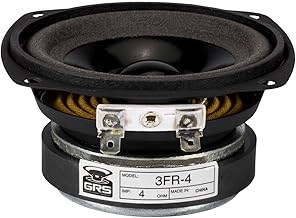
The GRS 3FR-4 is a 3-inch, 4-ohm full-range driver. Its listed construction includes a coated paper cone, foam surround, pincushion-shaped frame with a front gasket, and ferrite magnet assembly. The feature information does not provide a frequency range, sensitivity, or power rating, so confirm those details before using it in a design that depends on specific performance limits.
- Best for: Builders who need a small 4-ohm driver and can verify that the product fits their project requirements.
- Why it was selected: It offers a compact driver format and includes construction details useful when comparing replacement or DIY components.
- Limitation: The supplied product information omits key electrical and acoustic specifications, including power handling and frequency response.
Compared with the 8-ohm Facmogu and ACEIRMC pairs, this 4-ohm driver may require a different amplifier match. Check the amplifier’s supported load and verify mounting dimensions before purchase. It is a conventional cone driver, not an electrostatic speaker.
Gikfun 2-Inch 3W Speaker Pair

The Gikfun set contains two 2-inch, 4-ohm drivers rated at 3 watts. The listing identifies them for DIY soldering, Arduino projects, home audio-visual equipment, radio replacement, and other small speaker applications. It also gives a resonance frequency of 190 Hz with a stated ±20% tolerance, sound pressure level of 77 dB with a stated ±3 dB tolerance, and insulation resistance of 10 megohms.
- Best for: Hobbyists who need a small, low-power pair for electronics or compact audio projects.
- Why it was selected: Its size, low power rating, and stated DIY uses make it the most clearly targeted option for small-scale builds.
- Limitation: The 3-watt rating and 2-inch size make it a poor fit for projects that require high output or substantial bass.
Choose this pair for small enclosures and low-power applications, not for a room-filling system. Check that the amplifier is suitable for a 4-ohm load and does not exceed the drivers’ listed power rating.
Buying Guide: How to Choose a Full-Range Driver
Are these products electrostatic speakers?
No. The five products listed here are conventional speaker drivers. The product details describe cone-based drivers and do not identify any as electrostatic loudspeakers. Electrostatic speakers use a different transducer design, so a cone driver should not be described or bought as an electrostatic replacement. If electrostatic technology is essential, search specifically for a product identified by its manufacturer as an electrostatic speaker.
What does “full range” mean in a product listing?
“Full range” is a product category, not a promise that one driver reproduces every audible frequency evenly or at every volume. Compare the stated frequency response, sensitivity, power rating, and intended application. The listed frequency ranges here vary: the ACEIRMC pair is stated as 108 Hz–20 kHz, the Facmogu pair as 108 Hz–18 kHz, and the PRV driver as 50 Hz–18 kHz.
Those numbers are not directly comparable without knowing the measurement conditions. They are still useful for identifying broad differences and checking whether a driver is a plausible match for a project’s goals.
How should impedance affect the choice?
Match the driver’s nominal impedance to the amplifier’s supported speaker load. The Gikfun and GRS products are listed as 4 ohms; the Facmogu, ACEIRMC, and PRV products are listed as 8 ohms. Do not assume that a 4-ohm and an 8-ohm driver can be substituted without checking the amplifier specifications and wiring arrangement.
How much power should the driver handle?
Compare the amplifier’s output with the driver’s stated power rating and follow the relevant product and amplifier guidance. The Gikfun pair is rated at 3 watts, ACEIRMC at 10 watts, and Facmogu lists a 5–15-watt range. PRV specifies 125 watts RMS and 250 watts continuous program power. The GRS feature information supplied here does not state a power rating, so verify it before designing around that driver.
Does a full-range driver need a subwoofer or tweeter?
That depends on the driver’s measured response, enclosure, listening goals, and desired output. The PRV listing says its dual-cone design is intended to cover high frequencies without a separate tweeter. The other products are described as full-range drivers, but their listed frequency limits do not establish that they will deliver deep bass. A separate woofer, subwoofer, or tweeter may be appropriate in some projects, but should be selected based on system measurements and design requirements.
What dimensions should I check before buying?
Measure the mounting opening, available depth, and space for the frame and wiring. ACEIRMC lists an outer diameter of 78 mm, height of 52 mm, and hole diameter of 71 mm. Gikfun and the other products are described by driver size, but the provided feature information does not supply all mounting dimensions. Confirm the exact dimensions from the product information before cutting a cabinet or replacing an existing driver.
Frequently Asked Questions
Which listed driver is best for a compact DIY stereo?
The ACEIRMC and Facmogu products are both sold as pairs of 3-inch, 8-ohm drivers. ACEIRMC lists 10 watts and a 108 Hz–20 kHz range; Facmogu lists a 5–15-watt range and a 108 Hz–18 kHz range. Choose based on the power and dimensions that suit the design.
Which product is best for a low-power hobby project?
The Gikfun pair is the most clearly suited to small hobby projects in the supplied information. It is a pair of 2-inch, 4-ohm drivers rated at 3 watts, and the listing specifically mentions Arduino and DIY soldering uses.
Which option has the highest stated power rating?
The PRV AUDIO 8FR250 has the highest stated power figures: 125 watts RMS and 250 watts continuous program power. It is an 8-inch, 8-ohm driver sold individually.
Can I replace an electrostatic speaker with one of these drivers?
Not as a direct electrostatic replacement. These products are conventional drivers, and the supplied information does not identify any as electrostatic. A replacement must also match the original system’s design, electrical requirements, dimensions, and crossover or amplification arrangement.
Which product has the least complete specification information?
The supplied details for the GRS 3FR-4 list its cone, surround, frame, gasket, and magnet assembly, but do not state its power rating, sensitivity, or frequency response. Verify those specifications before choosing it for a project that depends on them.