
The best guitar foot pedals for beginners depend on whether you want a range of sounds, hands-free volume control, or a simple pedalboard accessory. The MOOER GE100 and Flatsons KMF-1 are multi-effects units for players who want several sounds and practice tools in one pedal. A passive volume and expression pedal suits players seeking foot control, while colorful switch toppers help make pedal footswitches easier to locate and press.
| Product | Best For | Main Function |
|---|---|---|
| MOOER GE100 | Beginners exploring many tones | Multi-effects, presets, looper, and expression control |
| Flatsons KMF-1 | Practice-focused players | Multi-effects, rhythms, amp and cab simulations, and looper |
| Volume and Expression Pedal | Hands-free level or expression control | Passive dual-function foot controller |
| Jiayouy Footswitch Toppers | Players organizing pedal switches | Color-coded plastic switch caps |
MOOER GE100 Multi-Effects Pedal

Best for: Beginners who want to experiment with different tones without assembling a board of separate effects. The GE100 combines multiple effect types, presets, an expression pedal, and practice features in one unit.
It provides 80 preset patches and 80 user patches, so players can try existing sounds and save preferred tones. Its eight effect modules include 66 effect types. An assignable expression pedal has six parameters, and the product also lists a 180-second looper, 40 drum rhythms, tap tempo, a tuner, and a headphone output.
The adjustable output mode includes a line-out option intended to provide a tone when playing without an amplifier. This makes the unit worth considering for quiet practice or exploring sounds in different setups.
- Why it stands out: A broad collection of effects and practice functions are integrated in one pedal.
- Limitation: The range of effects and settings may feel like more than necessary for someone who only wants one basic effect.
Choose this if preset variety and built-in practice tools are priorities. It is less suited to a beginner who wants only a straightforward volume controller.
Flatsons KMF-1 Multi-Effects Pedal

Best for: Beginners who want effects and practice features in a single device. The KMF-1 is listed with 77 practice effects, 50 presets, 42 drum rhythms, 18 amp and cab simulations, a tuner, an auxiliary input, a looper, and expression, wah, and volume functions.
A color screen is included, and the pedal’s combination of effects, rhythms, and looping can support practice as well as tone exploration. Amp and cab simulations are a useful feature to compare if you want modeled amp-style sounds as part of the multi-effects unit.
- Why it stands out: Its listed features bring together effects, rhythm practice, looping, and amp/cab simulations.
- Limitation: It has many functions to navigate, so it may be unnecessary if you need only one simple effect or controller.
Choose this if the listed practice tools and modeled amp/cab options match your goals. Compare it with the MOOER GE100 by focusing on which feature set matters more to you; the listed effect and preset counts differ, and neither count alone determines which pedal is the better fit.
Passive Volume And Expression Pedal

Best for: A beginner who wants a dedicated foot controller for volume or expression rather than a multi-effects processor. The product is described as a dual-function passive controller that requires no power.
Its listed features include a silent tread, a non-slip design, and 1/4-inch input and output connections for effects, pedalboards, and amplifier control. Because it is passive, it may appeal to players seeking a controller without a separate power requirement.
- Why it stands out: It focuses on hands-free control and lists both volume and expression functions.
- Limitation: It does not provide the collection of effects, presets, or practice tools listed for the multi-effects options.
Choose this if you already have a sound source or effects setup and need foot-operated control. Before buying, check that the function and connection arrangement you need match your equipment; the product information provided does not specify detailed compatibility.
Jiayouy Colorful Footswitch Toppers
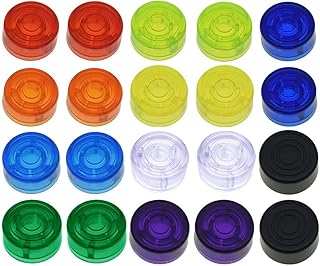
Best for: Beginners who already own effect pedals and want to make their footswitches easier to identify or press. This is an accessory set, not an effects pedal or a standalone sound processor.
The set includes 20 plastic footswitch toppers in 10 colors. The product describes an enlarged touchable surface intended to make a pedalboard more efficient. Its transparent crystal material can amplify and show the bright colors of a pedal’s bottom lamp.
- Why it stands out: The different colors can help distinguish switches visually, while the enlarged surface provides a broader touch point.
- Limitation: Toppers do not add guitar effects or create a new sound; they are useful only alongside compatible footswitches.
Choose this if you want a low-complexity accessory for organizing or locating existing pedal switches. Avoid choosing it as your first sound-shaping pedal if you need distortion, modulation, delay, or another effect.
Buying Guide: How To Choose A Beginner Guitar Pedal
A beginner does not need to buy a large pedalboard immediately. Start by identifying what you want your foot to do: switch between sounds, change volume, control an effect in real time, or make existing switches easier to operate. That decision helps separate multi-effects pedals from dedicated controllers and small accessories.
Do you want several sounds or one specific function?
A multi-effects pedal is a practical choice when you are still discovering which sounds you like. The MOOER GE100 and Flatsons KMF-1 list multiple effects and practice features, so one device can cover several roles. Compare their actual feature lists, including presets, rhythms, looping, and expression or volume functions.
A dedicated volume and expression pedal is a better match when you already have effects or another sound source and need foot-controlled adjustments. It is not a substitute for a multi-effects unit because its listed role is control, not providing a library of sounds.
Which practice features are useful?
A built-in looper lets a player record a phrase and play over it, while drum rhythms can provide a rhythmic practice reference. A tuner helps with tuning tasks, and a headphone output or auxiliary input may suit particular practice arrangements. Check the specific product listing for the features you plan to use rather than assuming every pedal includes them.
The MOOER lists a 180-second looper, 40 drum rhythms, a tuner, and headphone output. The Flatsons listing includes a looper, 42 drum rhythms, a tuner, and auxiliary input. These descriptions make both options relevant to practice, but their controls and feature layouts are not interchangeable.
Should you choose presets or build sounds from scratch?
Presets offer ready-made starting points. User presets provide a place to save sounds you adjust, where supported. The MOOER lists 80 preset patches and 80 user patches; the Flatsons lists 50 presets. A larger number does not automatically mean a better fit. Consider whether you prefer a simple starting sound or want to explore many settings.
What should you check about connections and control?
Before buying, identify how you plan to connect the pedal to your guitar and other equipment. The passive controller lists 1/4-inch input and output connections, but its provided information does not describe detailed compatibility with specific devices. For a multi-effects unit, review its output and practice connections and compare them with your intended setup.
Expression control is different from simply choosing an effect. It lets a player operate an assigned parameter with a foot pedal, when the device supports that control. The MOOER lists six assignable expression parameters; the Flatsons listing includes expression, wah, and volume functions. Confirm that the function you want is present and appropriate for your setup.
Are footswitch toppers worth considering?
Switch toppers are accessories for players who already have pedals. They can make switches more visible or provide a larger contact area, but they do not produce effects. The Jiayouy set lists 20 plastic toppers in 10 colors and an enlarged touchable surface. Check whether the topper shape is suitable for your pedal’s switch before purchasing, since compatibility details are not provided here.
How can a beginner avoid buying more than needed?
Write down the one or two functions you will use most. If you need several sounds and want to practice with rhythms or a looper, compare multi-effects models. If you only need to adjust volume or expression with your foot, compare dedicated controllers. If your sounds are already covered, an accessory may be enough.
Also consider how much adjustment you want to manage. A feature-rich processor offers more options, but a player who wants only a single control may prefer a dedicated pedal. Choose based on the task, not on the highest feature count.
Frequently Asked Questions
What is a good first guitar foot pedal for a beginner?
A multi-effects pedal is a useful first option for a beginner who wants to explore several sounds. A dedicated volume or expression pedal is more appropriate when the player already has effects and only needs foot control.
What is the difference between a multi-effects pedal and an expression pedal?
A multi-effects pedal provides a selection of effects and may include practice functions. An expression pedal controls a parameter, such as a supported volume or effect setting, rather than supplying a broad collection of sounds by itself.
Do beginner guitar pedals need power?
Power requirements depend on the product. The volume and expression controller described here is listed as passive and requiring no power. Check the specific product details for any other pedal before connecting it.
Can a multi-effects pedal help with quiet practice?
Some multi-effects pedals list features for practice without a conventional amplifier. The MOOER GE100 lists a headphone output and an adjustable line-out mode. Check the product’s connection instructions and the equipment you plan to use.
Do footswitch toppers change a guitar pedal’s sound?
No. Footswitch toppers are physical accessories intended to cover or enlarge pedal switches. The Jiayouy set lists color options and an enlarged touchable surface, but it does not add sound effects.
Should a beginner buy several pedals at once?
Not necessarily. Start with the function you need most, then add equipment as your playing goals become clearer. A multi-effects pedal can cover several sound options in one unit, while a dedicated pedal is more focused on one control task.