
The best laptop USB audio interface depends on what you need to connect: the Focusrite Scarlett Solo suits guitarists and vocalists, while the Cubilux CB5 offers several 3.5 mm connections for varied audio setups. The BOMGE is aimed at recording and streaming with XLR, phantom power, direct monitoring, and loopback. For simple headphone and microphone connections, the SABRENT is a basic sound adapter, not a full recording interface.
| Product | Best For | Standout Feature |
|---|---|---|
| Focusrite Scarlett Solo 3rd Gen | Guitar, bass, and vocal recording | Instrument inputs and mic preamp |
| Cubilux CB5 | Multiple 3.5 mm audio connections | Separate mic, line, and output jacks |
| BOMGE USB Audio Interface | Streaming and XLR recording | Direct monitoring and loopback |
| Pyle PMUX9 | Flexible input and effect options | Preset digital effects and phantom power |
| SABRENT AU-MMSA | Basic headphone and mic connection | Simple USB-to-audio adapter |
Focusrite Scarlett Solo 3rd Gen

Best for: Laptop users recording guitar, bass, vocals, or podcasts who want instrument inputs and a dedicated microphone preamp. This is a more suitable choice for music recording than a basic USB sound adapter.
Focusrite lists high-performing microphone preamps and two high-headroom instrument inputs for guitar or bass. Its switchable Air mode is intended to add clarity to acoustic instruments. Gain Halos help users monitor input level and avoid unwanted clipping or distortion.
- Records and mixes at up to 24-bit/192 kHz, according to the listed features.
- Provides a microphone preamp and two instrument inputs.
- Offers an Air mode and Gain Halos.
Why it was selected: Its dedicated music-oriented inputs and stated recording specifications make it a strong fit for solo performers and home recording. Limitation: The listed features do not describe multi-microphone recording, so choose a different model if you need several mic inputs.
Cubilux CB5 USB Audio Interface

Best for: Laptop users who need multiple 3.5 mm audio connections for microphones, line-level sources, headphones, or speakers. The CB5 is a better match than a two-jack adapter when the setup calls for more than one audio input type.
The manufacturer describes the CB5 as a five-in-one hub, with two stereo microphone jacks, a line-in jack, a line-out jack, and a headphone jack. It also lists multi-track recording through independently named interfaces and audio capture up to 96 kHz/24-bit.
- Includes separate microphone, line-in, line-out, and headphone connections.
- Supports assigning independent device names for multi-track recording.
- Listed for Windows and Mac OS.
Why it was selected: Its range of connections makes it useful for varied laptop audio setups and multi-track workflows. Limitation: The line-out and audio-output jacks cannot be used simultaneously, according to the listing. Check whether that affects your monitoring arrangement.
BOMGE USB Audio Interface

Best for: Podcasters, vocalists, guitarists, and streamers looking for an interface that lists XLR, phantom power, direct monitoring, and loopback. These features target more involved recording and streaming than simple laptop headphone playback.
The product name specifies 32-bit/192 kHz audio and identifies the interface for PC recording, streaming, guitar, vocals, and podcasting. It also lists phantom power for microphone setups, direct monitoring, and loopback. Those functions can be relevant when recording a microphone while managing computer audio for a stream or podcast.
- Lists XLR connectivity and phantom power.
- Includes direct monitoring and loopback features in its description.
- Advertises 32-bit/192 kHz capability.
Why it was selected: The named features cover common needs for creators who record and stream from a computer. Limitation: The supplied product details do not specify the number of inputs or output connections. Confirm the exact connections and routing you need before choosing it.
Pyle PMUX9 USB Audio Interface
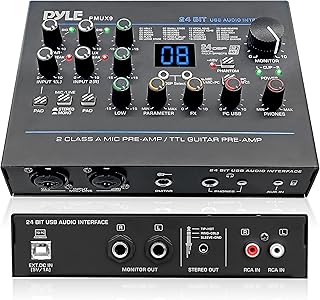
Best for: Buyers seeking a laptop audio device whose listed features include multiple kinds of inputs, monitoring outputs, phantom power, and preset effects. Its description points to a broader input-and-output setup than a small headphone adapter.
The PMUX9 product name lists microphone/line, guitar, AUX stereo, and RCA inputs. It also names 24 digital effects, phantom power, and phone, stereo, monitor, and headphone outputs. These are the relevant advertised features for users comparing a flexible device for computer playback and recording.
- Lists MIC/LINE, guitar, AUX stereo, and RCA inputs.
- Names 24 digital effects and phantom power.
- Lists phone, stereo, monitor, and headphone outputs.
Why it was selected: Its stated variety of connections and effects may suit users who want to combine different audio sources. Limitation: The supplied information does not explain each input’s connector format or how the effects are routed. Verify those details if your setup depends on a specific connection.
SABRENT AU-MMSA USB Sound Adapter

Best for: Laptop users who need a straightforward stereo headphone output and a separate 3.5 mm microphone input. The SABRENT is a basic USB sound adapter rather than a studio-style interface for XLR microphones or instrument recording.
It connects through USB Type-A and is described as bus-powered, with no drivers, software, or external power required. Its green 3.5 mm jack provides stereo output, while the pink jack is a mono microphone input. The listing describes compatibility with Windows, Mac, and Linux systems that support class-compliant USB audio.
- Provides separate headphone/speaker output and microphone input.
- Supports stereo two-channel audio and USB bus power.
- Is described as plug-and-play on supported systems.
Why it was selected: It is a compact option for adding separate basic input and output jacks. Limitation: It does not support a four-pole headset on one combo plug, passive speakers, or surround sound.
Buying Guide: How To Choose A Laptop USB Audio Interface
What will you connect to the interface?
Start with the source, not the advertised sample rate. A singer using an XLR microphone needs a compatible microphone input; a guitarist should look for an instrument input. For everyday headphones and a basic 3.5 mm microphone, a small sound adapter may be enough. A device with several line and stereo connections is more appropriate when you need to bring multiple audio sources into a laptop.
Check the connector type and the signal type separately. A 3.5 mm microphone jack, an XLR input, and an instrument input are not interchangeable just because they all carry audio. Confirm that the product listing describes the connection your microphone, guitar, or other source uses.
Do you need an audio adapter or a recording interface?
A USB sound adapter mainly adds or replaces basic headphone and microphone connections. It can be a simple answer for calls, listening, or a basic mic setup. The SABRENT falls into this category: its listed connections are stereo output and mono microphone input.
A recording interface is a better fit when you need features such as a microphone preamp, instrument input, phantom power, direct monitoring, or loopback. The Scarlett Solo lists preamp and instrument features; the BOMGE lists XLR, phantom power, direct monitoring, and loopback. Compare the actual connections and capabilities rather than relying only on the term “interface.”
How many inputs and outputs do you need?
Count the sources you expect to use at the same time, then count the outputs required for headphones, speakers, or monitoring. One microphone and one guitar can require a different input arrangement from several microphones or a microphone combined with computer audio. The CB5 lists several separate 3.5 mm connections, while the Pyle product name lists several input and output types.
Also check for shared or restricted outputs. The CB5 listing says its line-out and audio-output jacks cannot be used simultaneously. If you want headphones and speakers connected at once, verify that the chosen device supports that arrangement.
What do sample rate and bit depth tell you?
Sample rate and bit depth describe digital audio specifications, but they do not determine whether an interface has the correct inputs for your equipment. The Scarlett Solo lists up to 24-bit/192 kHz, the CB5 lists up to 96 kHz/24-bit, and the BOMGE name advertises 32-bit/192 kHz. Compare these specifications after confirming the interface suits your recording workflow.
Will it work with your laptop and headset?
Check your laptop’s available USB connection and the interface’s connector before buying. The SABRENT specifically uses USB Type-A. The supplied product details identify USB-C for the Scarlett Solo, but do not provide complete connection details for every other model. Confirm the exact port requirements and operating-system support in the current listing.
Do not assume a headset with a single combined plug will work with an adapter that has separate microphone and headphone jacks. The SABRENT listing explicitly says it does not support a four-pole headset on one combo plug. You may need a different connection arrangement if your headset uses that plug type.
Frequently Asked Questions
What is the best laptop USB audio interface for recording guitar?
The Focusrite Scarlett Solo is a strong option among these picks because its listed features include two high-headroom instrument inputs for guitar or bass, a microphone preamp, and recording up to 24-bit/192 kHz.
Can I use the SABRENT adapter for studio recording?
The SABRENT is listed as a basic stereo USB sound adapter with a mono microphone input. It does not list the instrument inputs, XLR connection, or recording functions of the more full-featured interfaces here.
What is loopback on a USB audio interface?
Loopback is a feature listed for the BOMGE interface. It is relevant to streaming and recording computer audio alongside other sources. Check the product’s routing details to confirm how it handles your intended setup.
Does every USB audio interface need external power?
No single answer applies to every interface. The SABRENT is specifically described as USB bus-powered and requires no external power. The supplied information does not establish power requirements for all the other products, so check each model’s listing.
Can I connect headphones and speakers at the same time?
That depends on the interface’s outputs and any shared-output limitations. The CB5 listing says its line-out and audio-output jacks cannot be used simultaneously. Check the product details for your chosen model before planning a simultaneous headphone and speaker setup.