
The best audio speaker selector switch depends on whether you need to distribute one amplifier’s signal to multiple rooms or quickly compare amplifiers and speakers. The Pyle PSLSW6 is best for up to six speaker pairs with individual volume controls, while the Pyle PSLSW4 suits smaller four-pair setups. For A/B comparisons, the SOLUPEAK P2 offers reversible switching, and the Douk Audio VU3 Pro adds dual VU meters and higher stated power handling.
| Product | Best For | Key Detail |
|---|---|---|
| Pyle PSLSW6 | Six-zone distribution | Independent volume controls; up to 100 watts per channel |
| Pyle PSLSW4.5 | Four speaker pairs | Individual zone volume controls |
| SOLUPEAK P2 | Basic A/B comparisons | Passive, reversible 2-in/1-out or 1-in/2-out use |
| Douk Audio VU3 Pro | Switching with visual meters | 2-in/2-out design and stated 350-watt maximum pass-through |
| PROZOR 2-Zone | Two-zone or two-amplifier switching | Independent A/B controls; passive operation |
Pyle PSLSW6 Six-Zone Speaker Selector

The Pyle PSLSW6 is best for a home audio setup that needs to distribute one stereo system to as many as six speaker pairs. Its push-button controls let users activate each pair individually or in combination, and each channel has an independent volume control. This combination makes it more suited to multi-room listening than a simple A/B switch.
The unit is rated for up to 100 watts per channel and is specified for 8-ohm speakers. Its screw-type terminals accept speaker wire up to 14 AWG, and its slim tabletop format can fit near a stereo receiver or other home audio equipment.
- Best for: Homes that need several selectable listening zones and separate volume adjustment for each pair.
- Why it stands out: It controls up to six pairs, offering more zone capacity than the four-pair Pyle models in this guide.
- Consider: The listed specifications call for 8-ohm speakers and state a 100-watt-per-channel maximum. Check your amplifier and speaker requirements before connecting.
Pyle PSLSW4.5 Four-Zone Selector
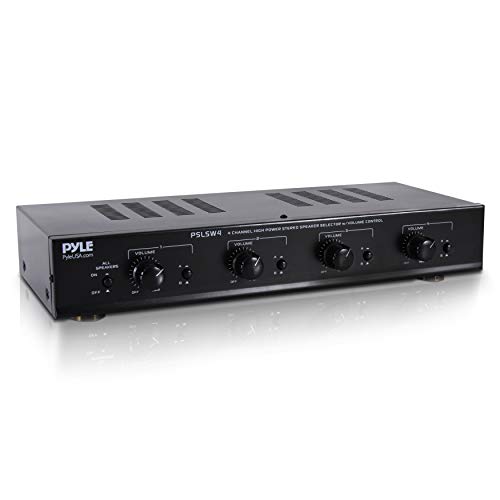
The Pyle PSLSW4.5 is best for listeners who want independent volume adjustment across up to four speaker pairs without choosing a six-zone unit. Each channel has its own volume control, so the output level in one area can be tailored separately from the others. It is designed for home theater or stereo systems and has a compact tabletop form.
The listed specifications state support for up to four pairs, 8-ohm speakers, and a maximum of 100 watts per channel. Compared with the PSLSW6, this model provides fewer zones; that may be a practical fit when the installation only needs four pairs.
- Best for: A four-zone home audio setup where local level adjustment is important.
- Why it was selected: It combines multi-pair distribution with individual channel volume controls in a compact design.
- Consider: The provided feature information does not specify its terminal type or supported wire gauge. Confirm connection details before installation if those requirements matter.
SOLUPEAK P2 Passive A/B Switcher
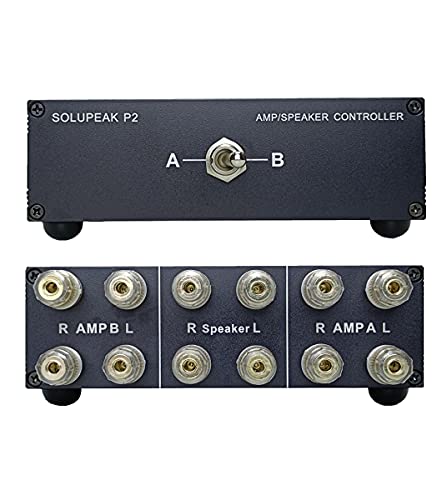
The SOLUPEAK P2 is best for a simple A/B comparison between two amplifiers and one speaker pair, or between one amplifier and two speaker pairs. It supports a 2-in/1-out configuration or a reversible 1-in/2-out arrangement. In the latter setup, it switches between speaker pair A and pair B; the two pairs do not play at the same time.
This is a passive, non-powered switcher with one-press A/B operation. Its input and output connections use gold-plated banana jacks, and the product information specifies support for speaker wire up to 12 gauge when used with banana plugs. It is not described as an RCA audio switch, so it is intended for speaker-level connections.
- Best for: Listeners who want quick, straightforward comparisons without repeatedly changing speaker cables.
- Why it was selected: Its two operating directions cover common amplifier-comparison and speaker-comparison tasks.
- Consider: When used for one amplifier and two speaker pairs, only one pair works at a time. It is not the choice for playing both zones simultaneously.
Douk Audio VU3 Pro Selector

The Douk Audio VU3 Pro is best for users who want a speaker and amplifier switcher with visible analog-style meters. Its 2-in/2-out arrangement is designed to compare two amplifiers and two speaker pairs, and the listed feature information says both speaker outputs can operate at the same time. That makes it different from switches limited to selecting only one speaker pair at once.
Douk lists a maximum 350-watt power pass-through and support for several amplifier types, including Class A, B, AB, and D, as well as tube and BTL designs. Its dual VU meters have 35 backlight colors, five brightness levels, 20 gain settings, and 30 sensitivity settings.
- Best for: Enthusiasts comparing audio equipment who also want adjustable visual meters.
- Why it was selected: It combines 2-in/2-out switching, simultaneous speaker output support, and a stated power capacity higher than the multi-zone Pyle options listed here.
- Consider: The 350-watt figure is a maximum pass-through specification, not a recommendation to exceed an amplifier or speaker’s own limits. Confirm the complete system’s requirements.
PROZOR Two-Zone Speaker Switch

The PROZOR two-zone switch is best for a small setup that needs to select between two speaker pairs or switch between two amplifiers and one speaker pair. Its independent A/B push buttons allow Zone A, Zone B, or both zones to be selected when it is used to connect one amplifier to two pairs. The product information warns that only one amplifier should be selected as the input source when switching between amplifiers.
This is a passive device that requires no external power. It uses spring-clip terminals and is rated in the product name for 150 watts RMS per channel with 4–16-ohm speakers. Unlike the Pyle multi-zone models, it does not provide a separate volume control for each zone.
- Best for: Users who want basic two-zone control or amplifier selection without a power supply.
- Why it was selected: Its two operating layouts and independent buttons make it more flexible than a one-direction-only selector.
- Consider: Do not select two amplifier inputs at once. It also lacks the per-zone volume controls found on the Pyle selectors.
Buying Guide: How to Choose an Audio Speaker Selector Switch
A speaker selector switch routes speaker-level output between an amplifier or receiver and one or more speaker pairs. The right model depends on the wiring layout, number of zones, desired controls, and the electrical limits of the connected equipment. Before buying, identify whether you need to distribute audio to rooms, compare equipment, or do both.
How many speaker pairs do you need to connect?
Count the pairs you plan to connect now, then consider whether you may add more later. A four-pair selector can suit a smaller installation, while a six-pair model provides more selectable zones. More outputs do not automatically mean that every speaker should play at once; check the device’s stated operating modes and the amplifier’s load requirements.
Also distinguish between a selector that controls several pairs and a simple two-way switch. A multi-zone unit may include a button for each pair, while an A/B device generally switches between two choices. For a few rooms, a two-zone selector may be sufficient. For several listening areas, a dedicated multi-zone model is easier to match to the intended layout.
Do you need independent volume controls?
Per-zone volume controls let you adjust one speaker pair without changing the level in other selected areas. This is useful when rooms differ in size, listening distance, or preferred volume. The Pyle PSLSW6 and PSLSW4.5 list independent volume controls. The SOLUPEAK P2 and PROZOR two-zone switch are better understood as switching options rather than multi-zone volume controllers.
Consider whether you need individual level adjustment at the switch itself. If the receiver or speakers already provide the controls you need, a simpler selector may be enough. Do not assume that a model has volume knobs or attenuation features unless the product specifications say so.
Are you distributing sound or comparing equipment?
For distributing one receiver’s output to multiple rooms, choose a selector with enough speaker-pair outputs and suitable zone controls. For comparing two amplifiers through one pair of speakers, look for a switch that explicitly supports two amplifier inputs. A device that switches one amplifier between two speaker pairs serves a different purpose and may not allow both pairs to play together.
Read the connection direction carefully. Some switches are reversible, but the permitted operating modes can differ. The SOLUPEAK P2, for example, supports two amplifiers to one pair or one amplifier to two pairs, with only one speaker pair active in the second configuration. The Douk VU3 Pro lists a 2-in/2-out arrangement and simultaneous output for two speaker groups.
What power and impedance specifications should you check?
Compare the selector’s stated power and impedance limits with the amplifier and speakers. The Pyle PSLSW6 and PSLSW4 models list up to 100 watts per channel and specify 8-ohm speakers. The PROZOR product information lists 150 watts RMS per channel and 4–16-ohm speakers, while the Douk VU3 Pro lists a 350-watt maximum pass-through figure.
These numbers describe different product specifications and should not be treated as interchangeable measurements. A switch’s maximum rating does not increase the amplifier’s power or make an unsuitable speaker load safe. When several speaker pairs are active, verify that the receiver can handle the resulting load and follow the selector’s instructions.
Which terminals and speaker wire will fit?
Check the connection style before ordering. The Pyle PSLSW6 and PSLSW4 specify screw-type terminals, with the PSLSW6 supporting up to 14 AWG speaker wire. The SOLUPEAK P2 uses banana jacks and specifies banana-plug speaker wires up to 12 gauge. The PROZOR uses spring-clip terminals.
Make sure the wire ends and connectors match the selector. If you plan to use banana plugs, verify that the switch has compatible jacks. If you are using bare wire, check that the terminal type accepts it and that the wire gauge is supported. Keep the left and right channels and speaker polarities connected consistently.
Is a passive switch the right fit?
A passive switch does not need an external power supply for switching. That can simplify placement and setup, as with the SOLUPEAK P2 and PROZOR model. Passive operation does not remove the need to check power handling, impedance, wiring, or the correct input selection.
Features such as VU meters, multiple zone controls, or independent volume adjustment may influence which design fits your system. Prioritize the actual routing and control needs first; visual features are secondary if the switch cannot support the required amplifier and speaker configuration.
Frequently Asked Questions
Can one speaker selector connect multiple rooms to one receiver?
Yes, a multi-zone speaker selector can route one receiver’s speaker output to multiple speaker pairs. Confirm the number of supported pairs and whether the receiver can safely drive the selected speakers in the intended configuration.
Can two speaker pairs play at the same time?
It depends on the selector. Some models support multiple pairs at once, while others only switch between pair A and pair B. Check the product’s operating instructions; the SOLUPEAK P2 specifies that its one-amplifier-to-two-pair mode activates only one pair at a time.
Can I use a speaker selector to compare two amplifiers?
Only if the selector explicitly supports two amplifier inputs. The SOLUPEAK P2 and PROZOR list two-amplifier-to-one-speaker configurations. Follow the input-selection warning for the chosen model and do not connect or select amplifiers in a way the instructions prohibit.
Does a passive speaker switch need a power supply?
No. A passive switch such as the SOLUPEAK P2 or PROZOR model operates without an external power supply. It still needs correctly connected speaker wire and must be used within its stated specifications.
Do speaker selectors have individual room volume controls?
Some do, but not all. The Pyle PSLSW6 and PSLSW4.5 list independent volume controls for each channel. The other featured models focus on switching configurations and do not list independent zone volume controls in the supplied product details.
What should I check before connecting a selector?
Check amplifier power, speaker impedance, the switch’s rating, supported wire gauge, terminal type, and whether the selected speakers can operate simultaneously. Connect the equipment according to its instructions and power it down before changing speaker wiring.