
The best 3.5 mm mini-jack to 3-pin XLR option depends on connector direction, plug type, and whether you need an adapter or a cable. The Ancable two-pack is best for a simple TRS female-to-XLR male connection, while the Movo FXLR-PRO adds an integrated phantom power converter. For direct cable connections, choose a cable that matches the plug and socket on both devices. Check connector size and signal direction before ordering.
| Product | Best suited for | Connection type |
|---|---|---|
| Ancable 2-Pack | Basic adapter needs or keeping a spare | 3.5 mm TRS female to 3-pin XLR male |
| Movo FXLR-PRO | Setups needing an integrated phantom power converter | 3.5 mm TRS female to 3-pin XLR male |
| 3.5 mm to XLR Coiled Cable | A short, direct cable connection | 3.5 mm to 3-pin XLR |
| XLR to 3.5 mm Coiled Cable | A connection with the opposite cable direction | 3-pin XLR to 3.5 mm |
| Cable Matters Mini XLR Cable | Listed compatible headphones | 3.5 mm to mini XLR |
Ancable 3.5mm To XLR 2-Pack

The Ancable adapter is a straightforward choice for converting a 3.5 mm stereo TRS mini-jack connection to a 3-pin XLR male connector. The listing identifies it as a two-pack and describes it for use with camcorders, recorders, and mixers.
Best for: Buyers who need the specified female mini-jack-to-male-XLR connector arrangement, or who want a second adapter available as a spare. The two-piece pack is the main practical distinction from a single adapter.
- Listed configuration: 3.5 mm stereo TRS female to 3-pin XLR male.
- Listed uses: Camcorders, recorders, and mixers.
- Why it was selected: It directly matches the requested connector format and states the connector gender and TRS type.
Limitation: This is a passive adapter as described in the product name; the listing does not identify an integrated phantom power converter. Confirm that the connected devices have compatible signal requirements before using it. Avoid it if your source needs a 3.5 mm male plug or your destination requires an XLR female connector.
Movo FXLR-PRO Phantom Converter

The Movo FXLR-PRO is a 3.5 mm TRS female microphone adapter with a 3-pin XLR male connector. Its defining listed feature is an integrated phantom power converter, making it the clearest option here for shoppers specifically seeking that function.
Best for: Buyers whose setup calls for the adapter’s stated phantom power conversion feature. It is better suited than a basic connector-only adapter when that conversion is a necessary part of the intended connection.
- Listed configuration: 3.5 mm TRS female to 3-pin XLR male.
- Distinguishing feature: Integrated phantom power converter.
- Why it was selected: It combines the requested connector format with a named conversion feature.
Limitation: The product name alone does not establish compatibility with every microphone, mixer, or power arrangement. Check the full product information and the requirements of both devices before connecting it. Choose a basic adapter instead if you do not need the converter and want a simpler connection.
3.5mm To XLR Right-Angle Coiled Cable

This listed cable provides a direct 3.5 mm mini-jack-to-XLR connection in a right-angle, red braided, coiled design. Its stated length is 50 cm. The product name lists BOYA and Rode Wireless GO II microphones and Sony FX9, FX3, Canon camera, mixer, and recorder equipment as intended applications.
Best for: Buyers who want a short cable rather than a separate adapter, especially when a coiled form and right-angle connector suit the physical layout. The listed device examples may help narrow consideration, but they do not replace checking the exact input and output ports.
- Listed form: Right-angle male cable with a red braided, coiled design.
- Listed length: 50 cm.
- Why it was selected: It offers the requested connector family as a compact cable and identifies example camera and microphone applications.
Limitation: At 50 cm, this is a short connection, not a long run. The product name does not specify all wiring or signal-conversion details, so confirm that the connector genders and signal path match your equipment before buying.
XLR To 3.5mm Right-Angle Coiled Cable

This cable is described in the reverse order from a 3.5 mm-to-XLR cable: it connects XLR 3-pin to a 3.5 mm mini-jack. It is a right-angle male cable with a red braided, coiled design and a listed length of 50 cm. The product name references BOYA and Rode microphones, RED Komodo 6K and DSMC2 cameras, phones, and computers.
Best for: Buyers whose connection needs run from an XLR 3-pin device toward a 3.5 mm mini-jack device, subject to verifying the actual cable ends and signal direction. It is a better fit than the preceding cable only when that reversed layout matches the equipment.
- Listed connector order: XLR 3-pin to 3.5 mm mini-jack.
- Listed design: Right-angle, male, red braided, and coiled.
- Why it was selected: Its connector direction covers a common alternative to a mini-jack-to-XLR connection.
Limitation: Connector order does not by itself confirm electrical compatibility or signal conversion. Avoid choosing it based only on a matching list of device names; verify the ports, connector genders, and audio requirements for your specific setup.
Cable Matters 3.5mm To Mini XLR Cable
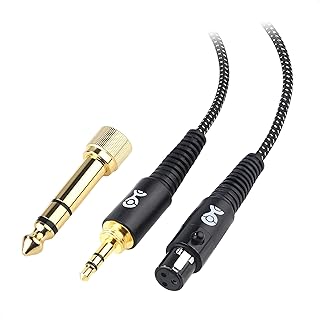
This Cable Matters product is a 4-foot braided 3.5 mm-to-mini-XLR headphone cable. Its listed compatible models include Beyerdynamic DT 1770 and DT 1990 Pro, plus AKG K240, K371, and Q701 headphones.
Best for: Headphone owners looking for a replacement cable for one of the listed models, after confirming the specific headphone-side connector. It was selected as a related mini-jack-to-XLR search result, but its mini XLR connector makes it a different category from standard 3-pin XLR microphone adapters.
- Listed length: 4 feet.
- Listed construction: Braided headphone cable.
- Listed use: Compatible headphone models named in the product title.
Limitation: Mini XLR is not the same connector as standard 3-pin XLR. Do not choose this cable for a full-size XLR microphone input unless the equipment specifically requires mini XLR and the complete connection matches.
Buying Guide: How To Choose A 3.5mm To XLR Connection
Do you need an adapter or a cable?
An adapter changes the connector at the end of an existing cable or device. It is useful when the equipment already has the right cable but the connector types do not match. A cable joins two devices directly and can reduce the number of separate connection points. Choose an adapter for flexibility or an existing cable; choose a cable when its length and connector ends match the complete setup.
These product types are not interchangeable by appearance alone. A compact adapter can be labeled 3.5 mm female to XLR male, while a cable may have male connectors at both ends. Check the product description for connector gender at each end before ordering.
Which end is 3.5 mm, and which end is XLR?
Write down the connection path from the source to the destination. For example, note whether the source has a 3.5 mm output and the receiving device has an XLR input, or whether the direction is reversed. Product titles may list the ends in different orders, so do not infer signal direction from a title’s wording alone.
Also check whether each port is a socket or a plug. A 3.5 mm female adapter accepts a 3.5 mm male plug; an XLR male connector fits a compatible XLR female socket. If the required genders do not match, the product will not connect directly even when the connector sizes look right.
Is your mini-jack TRS, TRRS, or another type?
The Ancable and Movo product names specify a 3.5 mm stereo TRS female input. TRS has a different contact arrangement from TRRS, which is often found on headset connections. Confirm the plug type required by your microphone or device rather than treating every 3.5 mm jack as equivalent.
Look at the device manual or its port labeling if the plug type is unclear. A physical fit does not guarantee the wiring or audio signal is appropriate. The supplied product information does not establish universal compatibility across all TRS, TRRS, stereo, or microphone setups.
Do you need phantom power conversion?
The Movo FXLR-PRO specifically names an integrated phantom power converter. That makes it the relevant option in this selection when the setup requires the feature. The Ancable adapter is described as a basic stereo TRS-to-XLR adapter and does not list an integrated converter.
Do not assume that every XLR connection requires phantom power, or that a product containing a converter works with every microphone. Check the power needs of the microphone and the output or input requirements of the connected equipment. If those requirements are uncertain, verify them in the device documentation before connecting components.
When does a coiled cable make sense?
The two red coiled cable listings are each 50 cm, so they are intended for short connections rather than a long distance between devices. Their coiled form and right-angle design may suit compact camera or recording layouts, but the best choice depends on how the cable routes around the equipment.
Compare the listed connector direction before selecting between them. One is titled 3.5 mm to XLR; the other is XLR to 3.5 mm. The names also cite example equipment, but buyers should still confirm exact ports, connector genders, and signal requirements.
Is mini XLR the same as standard 3-pin XLR?
No. The Cable Matters listing specifies mini XLR and identifies it as a headphone cable. A mini XLR connector is physically different from the full-size 3-pin XLR connector used in many microphone connections. Match the exact connector format on the equipment rather than relying on the shared “XLR” wording.
For headphone replacement, confirm the headphone model and its connector arrangement. For a standard XLR audio input, do not select a mini-XLR cable unless the setup specifically calls for that smaller connector and has a suitable connection path.
What should you check before placing an order?
- Confirm the exact connector type at both ends, including standard versus mini XLR.
- Check plug and socket gender for the source, adapter, cable, and destination.
- Verify the 3.5 mm plug wiring requirement, such as TRS or TRRS.
- Match the cable’s stated length to the distance between devices.
- Determine whether the setup needs an integrated phantom power converter.
- Use device documentation to confirm the intended signal path and power requirements.
Frequently Asked Questions
Can I connect a 3.5 mm microphone to a 3-pin XLR input?
Possibly, if the adapter or cable matches the connector genders, wiring, signal direction, and power needs of both devices. A connector adapter does not guarantee that every microphone and XLR input will work together.
What is the difference between the Ancable and Movo adapters?
Both are described as 3.5 mm TRS female to 3-pin XLR male. The Movo FXLR-PRO lists an integrated phantom power converter, while the Ancable listing emphasizes a two-pack and use with camcorders, recorders, and mixers.
Are the two coiled cables interchangeable?
Not necessarily. Their titles describe opposite connector orders. Check which device has the 3.5 mm connection and which has the XLR connection, then confirm the cable ends and signal requirements.
Does mini XLR mean the same thing as 3-pin XLR?
No. Mini XLR is a smaller connector format. The Cable Matters product is identified as a headphone cable with mini XLR, not as a standard full-size XLR microphone adapter.
Should I buy an adapter or a complete cable?
Buy an adapter if you need to convert an existing connector and the adapter’s genders match your equipment. Buy a complete cable if its length, connector types, and end genders directly match both devices.