
The best acoustic guitar amp depends on where you play, whether you sing, and how much output you need. The Taylor Circa 74 is the highest-powered option in this selection, while the Fender Acoustasonic 40 offers a stated 40-watt output and dual speakers. The Fishman Loudbox Micro is a compact 40-watt combo, and the Flatsons Crush20 is a rechargeable choice for portable playing and vocals. The Fishman PRO-LBT-500 is another model to consider, though the supplied product information does not specify its features.
| Product | Best suited for | Stated output or defining detail |
|---|---|---|
| Taylor Circa 74 | Players prioritizing higher stated power | 150 watts; 10-inch speaker |
| Fender Acoustasonic 40 | Singer-songwriters needing guitar and mic inputs | 40 watts; dual 6.5-inch speakers |
| Fishman Loudbox Micro | Players seeking a compact combo | 40 watts; 5.25-inch speaker |
| Flatsons Crush20 | Portable vocal-and-guitar performance | 20 watts RMS; rechargeable battery |
| Fishman PRO-LBT-500 | Shoppers comparing Fishman models | Specifications not provided |
Taylor Circa 74 150-Watt Acoustic Amp

The Taylor Circa 74 is the strongest match in this group for buyers who prioritize a high stated power rating. Its listed specifications are 150 watts and one 10-inch speaker. Those details make it worth comparing with lower-powered compact combos when output capacity is a central purchase criterion.
Best for: Players looking for a higher-powered acoustic amplifier for performance settings. Why it was selected: Its 150-watt rating is the highest listed among these five options, and the 10-inch speaker distinguishes it from the smaller-speaker models.
Limitation: The supplied information does not describe its inputs, EQ, effects, weight, or battery operation. Confirm those details before choosing it for a specific setup.
Fender Acoustasonic 40 Acoustic Combo

The Fender Acoustasonic 40 combines 40 watts of stated output with two 6.5-inch speakers. Its listed features include built-in reverb and an XLR microphone input, making it a relevant option for a player who wants to amplify both an acoustic guitar and a vocal microphone. The product description identifies it as a portable combo amp.
Best for: Singer-songwriters who want a dedicated microphone input and built-in reverb in a combo format. Why it was selected: The dual speakers and XLR mic input provide clear, decision-useful distinctions from the other listed models.
Limitation: Its 40-watt rating is below the Taylor Circa 74’s stated 150 watts. Buyers who rank maximum listed power above mic input or portability should compare those priorities carefully.
Fishman Loudbox Micro 40-Watt Combo
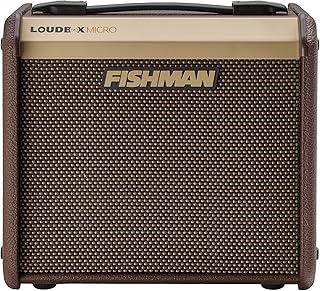
The Fishman Loudbox Micro is listed as a 40-watt acoustic combo amp with one 5.25-inch speaker. Its compact speaker size and stated output make it a useful comparison for buyers who want a smaller combo rather than the Taylor’s 10-inch speaker or the Fender’s two 6.5-inch speakers.
Best for: Players considering a compact Fishman-branded combo with a specified 40-watt output. Why it was selected: The model name and listed output and speaker size give buyers concrete specifications to compare against the other amplifiers here.
Limitation: The supplied product data does not list inputs, effects, EQ, dimensions, or battery power. Do not assume it has particular vocal features or portability options without checking the full listing.
Flatsons Crush20 Rechargeable Acoustic Amp

The Flatsons Crush20 is a 20-watt RMS portable amplifier with separate guitar and vocal channels. It has a 5.5-inch full-range speaker, a two-band bass-and-treble EQ, and reverb on both channels. Its listed 3,000mAh battery is rated for up to eight hours of playtime, and a four-level LED display shows battery power.
Best for: Singer-songwriters who need a rechargeable amp for portable guitar-and-vocal playing. Why it was selected: The dual inputs, channel-specific reverb, battery operation, and stated playtime make it the clearest battery-powered option in this group.
Limitation: Its 20-watt output is lower than the stated output of the Taylor, Fender, and Fishman Loudbox Micro. Choose another model if higher listed wattage is your primary requirement.
Fishman PRO-LBT-500 Acoustic Amplifier

The Fishman PRO-LBT-500 is listed as an acoustic guitar amplifier in brown. The supplied product information does not provide wattage, speaker size, inputs, effects, or power details, so a direct specification-based comparison with the other models is not possible from the available details.
Best for: Shoppers who are already considering this Fishman model and are prepared to verify its full specifications. Why it was selected: It is explicitly identified as an acoustic guitar amplifier and adds another model from a brand represented in this selection.
Limitation: Key buying specifications are missing from the provided data. Check the full product description to confirm its features and whether they suit your instrument, performance space, and input needs.
Buying Guide: How To Choose An Acoustic Guitar Amp
“High-end” can refer to a powerful output, a particular feature set, or a model suited to a specific performance setup. The wattage alone does not establish sound quality or suitability for every venue. Compare the listed specifications with your intended use, and verify missing details before purchasing.
How much power do you need?
Start by considering where you will play and how much amplification you need. In this selection, the Taylor is rated at 150 watts, the Fender and Fishman Loudbox Micro at 40 watts, and the Flatsons at 20 watts RMS. These ratings are useful comparison points, but they do not provide a complete measure of real-world loudness or coverage. Room size, other instruments, and the available sound system can affect what is practical.
If you need to perform with a band, ask whether the amp can provide sufficient sound for your role or whether you will connect it to a larger PA system. If you mostly practice at home or play in small settings, a lower-powered or smaller combo may be easier to manage. Do not choose solely by the highest wattage number.
Do you need an input for vocals?
For singing while playing, look for a dedicated microphone input and a clear description of how the channels work. The Fender listing specifies an XLR microphone input. The Flatsons lists independent guitar and vocal channels, dual inputs, and reverb on both channels. The supplied details for the other products do not confirm their vocal-input arrangements.
Check whether the amp offers the connection your microphone requires. A guitar input and a microphone input serve different purposes, so do not assume that one can replace the other. Also check whether vocal and guitar controls can be adjusted separately if you need different levels or tone settings.
Does speaker size matter?
Speaker size is one comparison factor, not a guarantee of sound quality. The listed models range from the Fishman Loudbox Micro’s 5.25-inch speaker to the Fender’s two 6.5-inch speakers and the Taylor’s 10-inch speaker. Flatsons specifies a 5.5-inch full-range speaker. These figures help describe the hardware, but they do not reveal every aspect of an amp’s sound.
Look for details about the speaker configuration and intended use, then consider the amp’s full feature set. If the listing omits specifications that matter to you, such as inputs or effects, verify them before making a decision.
Should you choose a battery-powered model?
Battery power is useful when an electrical outlet is not available or when a more portable setup is important. The Flatsons is the only model here with supplied battery details: a 3,000mAh battery and up to eight hours of stated playtime. Battery life can depend on operating conditions, so treat the listed duration as a specification rather than a guarantee for every performance.
Choose a mains-powered combo if you expect to play near an outlet and prioritize the other available features. If you need an amp for travel or outdoor use, check its weight, charging method, and battery details. Those details are not included for most models in this comparison.
Which features should you compare?
List your essential requirements before comparing models. Useful points include wattage, speaker configuration, guitar and microphone inputs, EQ controls, reverb, battery operation, and portability. The Flatsons explicitly lists two-band EQ and reverb; the Fender lists built-in reverb and an XLR mic input. The other supplied product details are more limited, so do not infer that an unmentioned feature is included.
When a feature is essential, confirm it in the complete product specifications. This is particularly important for the Fishman PRO-LBT-500, for which the supplied information gives no technical features. A clear match to your inputs and performance needs is more useful than an unsupported assumption about a model’s capabilities.
Frequently Asked Questions
What is the highest-powered amp in this selection?
The Taylor Circa 74 has the highest stated output among these products at 150 watts. Its listing also specifies one 10-inch speaker.
Which listed amp is best suited to singing and playing guitar?
The Flatsons Crush20 explicitly lists separate guitar and vocal channels and reverb on both. The Fender Acoustasonic 40 also lists an XLR microphone input and built-in reverb.
Which model lists battery operation?
The Flatsons Crush20 lists a rechargeable 3,000mAh battery and up to eight hours of playtime. Battery details are not provided for the other products in this comparison.
Is a higher wattage always better for acoustic guitar?
No. A higher stated wattage may matter when output is a priority, but the right amp also depends on the venue, input needs, speaker configuration, and portability requirements.
What should I verify before buying the Fishman PRO-LBT-500?
Check its full product specifications for wattage, speaker size, input connections, controls, effects, and power requirements. Those details are not included in the supplied product information.
Can the product descriptions establish which amp sounds best?
No. The available specifications support comparisons of listed features, but they do not establish which amp sounds best. Consider your guitar, playing environment, and preferred tone, and verify product details before choosing.