
The PANRR830 is the clearest choice here for variable-speed cassette playback because its listed features include speed and pitch controls. The other four products are cassette players or recorders, but their supplied descriptions do not specify variable-speed playback. Choose the JENSEN or QFX for recording flexibility, the Coby for simple portable playback and recording, or the FiiO for headphone listening with an all-analogue circuit.
| Product | Best For | Variable-Speed Feature Listed? |
|---|---|---|
| PANRR830 RR830 | Speech playback and transcription | Yes: speed and pitch controls |
| JENSEN Portable Player/Recorder | Simple recording and auxiliary input | Not specified |
| QFX RETRO-39BT | USB, Bluetooth, and cassette recording | Not specified |
| Coby Cassette Player and Recorder | Basic playback and voice recording | Not specified |
| FiiO CP13 | Headphone listening and rechargeable use | Not specified |
PANRR830 RR830 Cassette Recorder

The PANRR830 is the strongest match for shoppers specifically seeking a variable-speed cassette player. Its listed features include Speed Talk Variable Speech Control and VSC pitch and speed controls, making it relevant for adjusting recorded speech during review or transcription. Remote review with a foot pedal is also listed, a useful feature for hands-free control in a transcription workflow.
Best for: People reviewing spoken-word recordings who need listed speed and pitch controls. It is selected because the supplied feature set explicitly identifies variable speech and speed adjustment, unlike the other products in this comparison.
Limitation: The supplied product information does not state the adjustment range, whether speed changes affect pitch independently, or what accessories are included. Confirm those details if a particular playback rate or foot-pedal setup is essential.
JENSEN Portable Cassette Player and Recorder

The JENSEN is a portable cassette player and recorder designed for straightforward audio capture. It has one-touch recording, a built-in condenser microphone, and automatic level control for recording. An auxiliary input allows audio from a smartphone, tablet, or another source to be connected for recording.
Best for: Students, note-takers, and people who want a cassette recorder with a built-in microphone and an auxiliary input. It was selected as a versatile recording alternative for buyers who do not require documented variable-speed playback.
Limitation: The listed features do not mention speed or pitch adjustment. Choose another model if changing cassette playback speed is a necessary requirement.
QFX RETRO-39BT Cassette Player Recorder
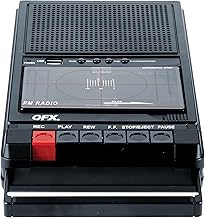
The QFX RETRO-39BT combines cassette playback and recording with several other audio connections. Its listed features include recording digital audio from a USB drive to cassette, plus recording from cassette, Bluetooth, FM radio, microphone, or line-in to USB. It also has USB input, line-in and line-out jacks, external microphone support, Bluetooth playback, and a built-in 3.5-inch speaker.
Best for: Buyers who want more recording sources and connection options than a basic cassette unit provides. It is selected for its USB and Bluetooth features, not for variable-speed playback.
Limitation: The product details supplied do not list speed or pitch controls. Its multiple recording paths may also be unnecessary if the goal is simply to listen to tapes at a changed speed.
Coby Cassette Tape Player and Recorder
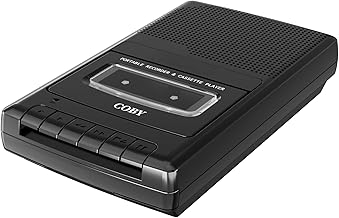
The Coby is a straightforward cassette player and recorder with a built-in microphone. Its listed features cover cassette playback, recording new audio, and battery or AC power. The two power options make it suitable for desk use or situations where access to an outlet may vary.
Best for: People who want a basic cassette device for listening and capturing voice notes, lectures, or interviews without an additional microphone. It was selected as a simple, self-contained option among the products listed.
Limitation: The supplied description does not identify variable-speed playback, pitch control, or auxiliary input. Do not assume it can alter tape speed based on the available product details.
FiiO CP13 Cassette Player

The FiiO CP13 is a cassette player with physical playback controls, a volume dial, USB-C charging, and a 3.5 mm headphone input. Its listed design details include an all-aluminium alloy casing and all-analogue circuit processing. The product description also names a JRC5532 operational amplifier and a large analogue volume potentiometer.
Best for: Listeners looking for a dedicated cassette player with headphone output, USB-C charging, and tactile playback controls. It is selected as a listening-focused option, rather than a transcription or recording device.
Limitation: Variable-speed control and recording are not specified in the supplied features. Choose it for cassette listening, not for a confirmed speed-adjustment function.
Buying Guide: How to Choose a Variable-Speed Cassette Player
“Variable speed” can refer to more than one function. A player may change tape playback speed, adjust pitch, or provide a speech-control mode for reviewing recordings. Product descriptions do not always explain whether these controls work independently. Before buying, check the exact control names and the manufacturer’s description of how speed changes affect sound.
Do you need variable-speed playback or a cassette recorder?
Start with the main task. If you need to slow down or speed up speech on a cassette, prioritize a model that explicitly lists speed adjustment or variable speech control. In this selection, the PANRR830 is the only product whose supplied features expressly identify speed and pitch controls.
A recorder may be useful for capturing new audio, but recording features do not mean that the device can vary playback speed. The JENSEN, QFX, and Coby are described with recording functions; their supplied feature lists do not confirm variable-speed playback.
Will changing speed also change pitch?
Do not assume that speed control and pitch control are interchangeable. When tape runs faster or slower, the sound may change in pitch unless the device provides a separate pitch function or another form of correction. The PANRR830 feature list names both pitch and speed controls, but it does not provide enough detail to establish the adjustment range or exactly how the controls interact.
If accurate speech review matters, look for documentation that explains the available speed range and whether pitch can be adjusted independently. Those details can determine whether a device suits language study, transcription, or another listening task.
Which connections and recording features matter?
Choose connections based on the audio sources you intend to use. The JENSEN has an auxiliary input and built-in microphone, while the QFX lists USB, Bluetooth, line-in and line-out, and external microphone support. The Coby has a built-in microphone. The FiiO CP13 lists a 3.5 mm headphone input and USB-C charging, but the supplied information does not describe recording.
- For voice recording: Compare built-in microphone and one-touch recording details.
- For multiple source types: Check for the specific inputs and recording paths you plan to use.
- For private listening: Confirm the type of headphone connection listed for the device.
- For transcription control: Check whether remote review or a foot pedal is supported and whether any accessory is included.
How should you compare portability and power?
Portability depends on more than the product being described as portable. Check the power method, charging connection, and whether the device has a built-in speaker or requires headphones. The Coby lists battery or AC power, and the FiiO lists USB-C charging. The QFX lists a built-in speaker. The supplied details for other models do not provide enough information to compare their power arrangements.
If you will use a cassette player away from a desk, verify the power requirements and what is included before buying. For home or office use, a speaker or convenient power option may matter more than compact size.
What should you verify before ordering?
Read the current product listing for details that are not included in the supplied feature summaries. Confirm the supported cassette format, power accessories, included cables, and the precise speed-control behavior. For transcription, check foot-pedal compatibility and whether the control accessory is included. For recording, confirm which sources can be recorded to which media.
Use a conservative comparison rule: treat a feature as unavailable unless the product information explicitly confirms it. In this group, the PANRR830 is the documented choice for variable speech and speed controls. The other products may suit playback or recording needs, but their supplied descriptions do not establish variable-speed operation.
Frequently Asked Questions
Which product in this list has variable-speed controls?
The PANRR830 RR830 is the only product whose supplied features explicitly list variable speech control and pitch and speed controls.
Can the JENSEN cassette player change tape speed?
The supplied JENSEN features describe cassette playback, recording, auxiliary input, and a built-in microphone, but they do not specify variable-speed playback.
Does the QFX RETRO-39BT record from USB to cassette?
Yes. Its listed features include recording digital audio from a USB drive directly onto cassette. The description does not list variable-speed cassette playback.
Which model is best for recording voice notes?
The JENSEN and Coby both list built-in microphones and recording features. The JENSEN also lists one-touch recording and automatic recording-level control; the Coby lists battery or AC power.
Is the FiiO CP13 a cassette recorder?
The supplied product details describe the FiiO CP13 as a cassette player and list playback controls, headphone output, and USB-C charging. They do not specify recording capability.
Should I buy a standard cassette player for transcription?
Only if its documented controls meet your transcription needs. For speed adjustment in this selection, the PANRR830 is the option with explicitly listed speed and pitch controls.