
The best pedal here for approaching Brian May-style tones is the Catalinbread Galileo, because its listed treble-boost and overdrive design is more directly aligned with that kind of sound shaping than a conventional distortion pedal. The BOSS DS-1 is a straightforward general-purpose distortion choice, while the Donner and JOYO models offer high-gain options. These pedals can help shape a classic-rock tone, but none is identified as a Brian May signature pedal.
| Pedal | Best For | Listed Distinguishing Feature |
|---|---|---|
| Catalinbread Galileo | Treble-boosted overdrive character | Volume, tone, and gain controls |
| BOSS DS-1 | Conventional distortion | Compact distortion pedal |
| Donner Distortion | Selectable distortion voicings | Natural, Tight, and Classic modes |
| JOYO JF-04 | High-gain rock and metal | Full-range EQ |
| LEKATO Distortion | Compact, two-mode distortion | Mini format and true bypass |
Catalinbread Galileo Treble Boost Overdrive

Best for: Guitarists who want treble-boost and overdrive controls for shaping a bright, expressive classic-rock sound. Of the five options, this pedal is the closest match to the search for a Brian May distortion pedal because its listed design specifically includes treble boost and overdrive rather than only broad distortion.
The Galileo offers volume, tone, and gain controls. Those controls provide separate adjustment points for output level, tonal character, and drive. That makes it a useful starting point for players who want to experiment with a clearer, more cutting overdrive sound instead of immediately choosing a high-gain pedal.
Why it was selected: Its treble-boost and overdrive focus makes it particularly relevant to a classic-rock tone search. The controls also give players a way to adjust the sound without relying on a single fixed distortion setting.
Limitation: The product information does not identify it as a Brian May signature pedal or promise an exact replica of his guitar tone. Players seeking heavy, saturated distortion may prefer a pedal explicitly described as high gain.
BOSS DS-1 Distortion Compact Pedal

Best for: Players who want a conventional distortion pedal rather than a specialized treble-boost overdrive. The DS-1 is listed as a compact distortion pedal, making it a simple option to compare with the more specifically voiced products in this selection.
For a Brian May-inspired sound, a distortion pedal is only one part of the setup. The player still needs to adjust the guitar, amplifier, and pedal together. The DS-1 can serve as a basic distortion option for adding drive, while the Catalinbread Galileo is the more targeted choice for someone prioritizing a treble-boost overdrive approach.
Why it was selected: Its straightforward product category makes it a useful point of comparison for buyers who want distortion without choosing a model advertised specifically for metal or multiple tone modes.
Limitation: The supplied product information identifies it only as a compact distortion pedal. It does not list a treble boost, selectable modes, or a full-range EQ, so buyers wanting those named features should compare the other options.
Donner Distortion With Three Modes

Best for: Guitarists who want to switch among three listed distortion modes: Natural, Tight, and Classic. This pedal is described as high gain and as suitable for electric guitar and bass, giving it a broader stated use than a pedal listed only for guitar.
The product name also specifies three control knobs, a mini size, beginner-friendly operation, and true bypass. Its three modes provide a practical comparison point for players who want to try different distortion characters from one pedal. The Classic mode name may interest classic-rock players, although the listing does not claim that it recreates Brian May’s tone.
Why it was selected: The combination of selectable modes and high-gain positioning makes it a flexible option for buyers who want more than one distortion character. The mini-size description may also matter when pedalboard space is limited.
Limitation: Its product description emphasizes ’80s metal-style distortion. Choose a different option if the primary goal is treble-boosted overdrive rather than high-gain distortion.
JOYO JF-04 High Gain Distortion
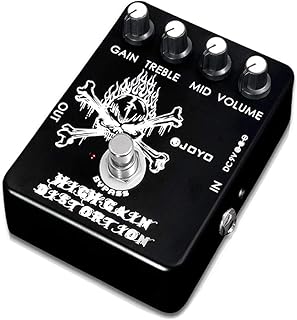
Best for: Players who need a high-gain pedal with more tonal adjustment than a basic distortion control. The JF-04 is described as having an analog circuit and a full-range EQ, with the stated range covering classic rock through heavy metal.
The full-range EQ is its most relevant listed feature for players who want to make broader tonal adjustments. That can be useful when comparing a brighter classic-rock setting with a heavier distortion sound. The product name also specifies true bypass.
Why it was selected: It offers a clear option for buyers who want a pedal described for both classic rock and heavy metal, rather than one positioned only for a specific high-gain style. The EQ feature distinguishes it from products whose supplied descriptions focus on basic distortion or mini size.
Limitation: This is described as a high-gain distortion pedal, not a treble-boost overdrive. Players seeking a lower-drive, more specifically treble-focused starting point may find the Galileo more relevant.
LEKATO Mini Two-Mode Distortion

Best for: Players looking for a mini-format distortion pedal with two modes. The listing describes this as an analog guitar distortion pedal with true bypass and DC 9V operation.
The two-mode design gives buyers a choice between two distortion settings, while the mini format may suit a compact pedalboard. Its stated DC 9V requirement is a practical detail to check when planning a power supply. The product description does not specify the character of each mode, so buyers should not assume that either is a treble boost or a particular classic-rock voicing.
Why it was selected: It provides a compact, two-mode alternative to the larger-sounding feature sets described for the other products. True bypass is another explicitly listed feature that may factor into a buyer’s comparison.
Limitation: The available product information does not name the two modes or provide an EQ description. Choose the Galileo or JOYO instead if a specifically stated treble-boost or full-range EQ feature is important.
Buying Guide: How To Choose A Brian May-Style Distortion Pedal
A pedal search for Brian May’s sound can point buyers toward distortion, overdrive, treble boost, or a combination of effects. These categories are not interchangeable. A treble-boost overdrive pedal is designed around a different stated approach than a high-gain distortion model, so begin by deciding whether you want a clearer, boosted overdrive character or a more saturated distortion sound.
Should you choose treble boost, overdrive, or distortion?
Choose the Catalinbread Galileo if treble boost and overdrive are the main features you want to explore. It is the most directly relevant choice in this group based on its listed controls and product description. Choose a distortion pedal if you specifically want a product categorized around distortion, such as the BOSS DS-1, Donner, JOYO, or LEKATO.
These products should be treated as tone-shaping options, not guaranteed replicas. A pedal’s name or category alone cannot confirm that it will reproduce a particular recording or performer’s exact sound. Guitar, amplifier, playing technique, and the rest of the signal chain also affect the result.
Do you need selectable modes or more EQ control?
Selectable modes can be useful when you want to compare different drive characters without changing pedals. The Donner lists three modes: Natural, Tight, and Classic. The LEKATO lists two modes but does not identify them in the supplied product description.
For more explicitly described tone adjustment, consider the JOYO JF-04 because its listing specifies full-range EQ. The Galileo instead lists volume, tone, and gain controls. Check the controls named for each pedal and avoid assuming that a feature is included when it is not stated.
How much gain do you actually need?
High gain is not automatically the best choice for classic-rock tones. The Donner and JOYO are both described as high-gain distortion pedals, and the Donner listing emphasizes ’80s metal-style distortion. Those descriptions may suit players who want a more saturated sound. For a less explicitly high-gain approach, compare the Galileo’s treble-boost overdrive description or the BOSS DS-1’s general distortion category.
When possible, compare settings at a similar volume. A louder setting can seem more impressive even when the tonal difference is small. Start with modest gain and make one adjustment at a time so you can identify what changes the sound.
What size and power details should you check?
The Donner and LEKATO descriptions identify mini-size formats. That may matter if pedalboard space is limited, but size alone does not determine which pedal best suits your sound. The LEKATO listing specifies DC 9V operation. Confirm the power requirements for any pedal you consider and make sure your intended power setup matches the product information.
The Donner and JOYO product descriptions specify true bypass, as does the LEKATO listing. The supplied descriptions do not identify bypass details for the Galileo or BOSS DS-1, so do not assume those details from this comparison. Check the manufacturer’s current specifications if bypass type is a deciding factor.
Which option is the best starting point?
For a Brian May-inspired search, the Catalinbread Galileo is the clearest starting point because treble boost and overdrive are explicitly named. For a simple, conventional distortion category, compare the BOSS DS-1. For multiple stated modes, compare the Donner. For high gain with full-range EQ, consider the JOYO. For mini size and two modes, consider the LEKATO.
Frequently Asked Questions
Is any pedal in this list a Brian May signature pedal?
No. The supplied product information does not identify any of these five pedals as a Brian May signature model or as an exact replica of his tone.
Which pedal is most relevant to a Brian May-style tone?
The Catalinbread Galileo is the most directly relevant based on its listed treble-boost and overdrive design, along with volume, tone, and gain controls.
Is a distortion pedal the same as a treble-boost overdrive pedal?
No. They are different product descriptions and approaches to shaping a guitar sound. The Galileo is listed as a treble boost overdrive, while the BOSS DS-1, Donner, JOYO, and LEKATO are described as distortion pedals.
Which option has the most listed distortion modes?
The Donner lists three modes: Natural, Tight, and Classic. The LEKATO lists two modes, but the supplied description does not name them.
Which pedal is described as covering classic rock and heavy metal?
The JOYO JF-04 is described as a high-gain distortion pedal with full-range EQ for tones ranging from classic rock to heavy metal.
What should I check before buying a mini distortion pedal?
Compare the stated modes, controls, bypass description, and power requirements. The LEKATO listing specifies DC 9V operation, while the Donner listing describes a mini size and three tone modes.