
The best public address power amplifier depends on your speaker wiring, required output, and input needs. The Pyle PMSA126BU stands out for buyers who want multiple speaker-output options and built-in media playback. The Pyle PCM30A suits paging and music-on-hold setups, while the 100-watt model offers more inputs and independent controls. For compact, straightforward announcements, consider the 40-watt or 120-watt Pyle models below. Confirm that an amplifier’s output terminals match your speakers before choosing.
| Amplifier | Best For | Standout Features |
|---|---|---|
| Pyle PMSA126BU | Flexible speaker and media connections | Listed 500-watt output, Bluetooth-compatible streaming, USB and SD playback |
| Pyle PCM30A | Paging and music-on-hold installations | 60 watts, 25V and 70V outputs, telephone and paging terminals |
| Pyle 100W 25/70V | Multiple inputs and separate level controls | Three microphone terminals, three pairs of RCA inputs |
| Pyle PT210 | Higher-output compact mono applications | 120 watts, two mic inputs, talkover and mix bus |
| Pyle 40W Mini 70V | Small, simple announcement systems | Compact format, 70V output, automatic mic priority |
Pyle PMSA126BU: Best For Flexible Connections
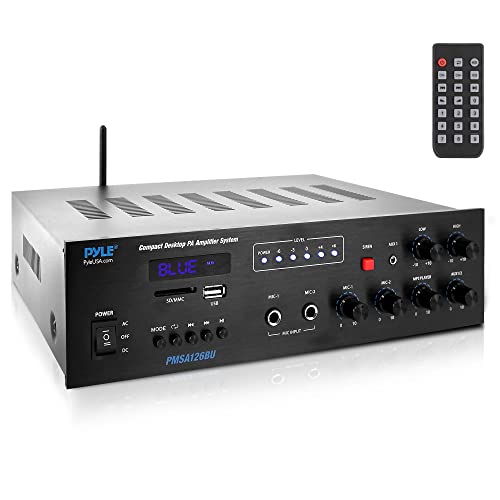
The Pyle PMSA126BU is a flexible choice for buyers who need an amplifier to handle both announcements and music playback. Its listed speaker outputs include 100V, 70V, 16-ohm, 8-ohm, 4-ohm, and COM connections. The product features also state support for speakers from 4 to 16 ohms.
It is listed as a 500-watt amplifier and offers a broad set of playback and connection options: Bluetooth-compatible streaming, USB-A and SD playback, FM radio, AUX, RCA, microphone inputs, and a 12V DC power input. Choose this model if varied input sources and speaker connections matter as much as paging.
- Best for: Users seeking multiple source options and a range of speaker output connections.
- Why it was selected: Its listed 70V and 100V outputs, conventional impedance outputs, and media features cover several common system needs.
- Consider: Check the exact speaker connection and impedance requirements for your installation; the broad list of outputs does not remove the need to match the system.
Pyle PCM30A: Best For Paging And Music On Hold

The Pyle PCM30A is a practical option for installations that combine announcements, background audio, and music-on-hold connections. It is rated at 60 watts and provides COM, 4-ohm, 8-ohm, 16-ohm, 25V, and 70V speaker outputs. Those choices make it relevant to buyers comparing a conventional speaker connection with a distributed-voltage system.
Its listed connections include an AUX RCA input, two microphone terminals, telephone and paging terminals, mute terminals, and monitor outputs for music on hold. MIC 1 has an automatic talkover function. The unit also has an LED indicator and replaceable fuse.
- Best for: Offices or other setups that need paging and music-on-hold connections.
- Why it was selected: It combines 25V and 70V outputs with telephone/paging terminals and a MIC 1 talkover feature.
- Consider: Its 60-watt rating may be less suitable than a higher-output model when the system needs more amplifier capacity.
Pyle 100W 25/70V: Best For Input Control

This Pyle 100-watt amplifier is better for buyers who need several wired sources and separate input-level adjustments. Its listed inputs include three pairs of AUX RCA connections and three microphone terminals. MIC 1 has an automatic talkover function, and the unit also provides telephone/paging, mute, and music-on-hold monitor terminals.
Independent volume gain controls let the user adjust each input separately. Treble and bass controls provide additional tone adjustment. The product is described as a compact indoor receiver and includes a power cable, LED indicator, and replaceable fuse.
- Best for: Small commercial or indoor systems with multiple microphones or wired audio sources.
- Why it was selected: Its 100-watt rating, multiple input groups, and independent gain controls distinguish it from simpler paging amplifiers.
- Consider: The listed speaker outputs are 25V and 70V; choose another option if your installation requires different output connections.
Pyle PT210: Best For Higher-Output Mono Use

The Pyle PT210 is a compact mono amplifier listed at 120 watts. Its features include two quarter-inch microphone inputs with talkover, a 3.5mm AUX input, a headphone jack, and a mix bus jack. The product description identifies public announcements, live bands, office paging systems, and music or vocal program material as possible uses.
Choose this model if a higher listed wattage and two microphone inputs are priorities. Its feature list emphasizes microphone and AUX connections rather than 25V or 70V distributed speaker outputs, so verify the output requirements before selecting it for a commercial speaker installation.
- Best for: Buyers seeking a compact mono amplifier with two mic inputs and a 120-watt listing.
- Why it was selected: It offers more listed output than the 40-, 60-, and 100-watt models in this comparison, plus talkover and mix-bus features.
- Consider: The supplied product details do not list 25V or 70V speaker outputs.
Pyle 40W Mini 70V: Best For Simple Paging

The Pyle 40-watt mini amplifier is suited to a smaller system where compact size and basic announcement functions matter. Its listed speaker outputs are COM, 8 ohms, 25V, and 70V. The product information says it can connect up to four speakers with up to 8-ohm impedance.
For audio sources, it has a quarter-inch AUX input and two quarter-inch microphone inputs. MIC 1 provides automatic mic-talkover priority, allowing announcements to take priority over other audio. The unit includes a detachable AC power cable.
- Best for: Buyers building a modest paging system who want 25V or 70V output options in a mini format.
- Why it was selected: It combines low-complexity input options, mic priority, and distributed-voltage outputs.
- Consider: At 40 watts, it is the lowest-output option in this comparison and may not suit systems that require more power.
Buying Guide: How To Choose A Public Address Amplifier
Do you need 70V, 25V, or low-impedance outputs?
Start with the speakers and wiring plan. Distributed systems commonly use 70V or 25V outputs, while other setups may use direct low-impedance connections. The models here differ: the PMSA126BU lists 70V, 100V, and 4- to 16-ohm outputs; the PCM30A lists 25V, 70V, and several impedance outputs; and the 40-watt mini lists 25V, 70V, COM, and 8-ohm connections. Match the amplifier output to the speaker system rather than choosing by wattage alone.
How much amplifier power should you choose?
Compare the amplifier’s stated output with the needs of the speaker system and the intended use. The products in this list range from 40 watts to 500 watts as described in their supplied feature details. More listed wattage is not automatically a better match: consider the number and type of speakers, the output configuration, and how loud the system needs to be. The product data does not provide a single recommended speaker count or coverage area for every model.
Which inputs and paging controls matter?
Make a list of the sources and microphones you will connect. AUX and RCA inputs suit certain wired audio sources, while microphone terminals support announcements. Talkover or mic-priority features are useful when a spoken message needs to take precedence over background audio. For telephone paging or music on hold, look for those specific terminals; the PCM30A and 100-watt Pyle model list telephone/paging and monitor connections.
Do you need wireless or built-in media playback?
If you want playback without a separate source device, check for built-in features. The PMSA126BU lists Bluetooth-compatible streaming, USB-A and SD playback, and FM radio. The 100-watt model focuses instead on multiple wired inputs and independent volume controls. Choose based on the actual source devices you plan to use, and confirm that the required input format is listed.
How should you compare compact models?
Compact dimensions can help when installation space is limited, but check the connection layout and stated output before deciding. The 40-watt mini is described as a small unit with mic priority, while the PT210 is a compact mono option with a higher listed wattage and headphone and mix bus connections. Compact size alone does not indicate that an amplifier fits a particular rack or mounting location.
Frequently Asked Questions
What does a 70V public address amplifier do?
A 70V amplifier provides an output intended for a 70V distributed speaker system. Confirm that the speakers and wiring are designed for that system and that the amplifier has a matching 70V output.
Can one PA amplifier connect microphones and music sources?
Some models support both. For example, the products listed here include microphone inputs alongside AUX or RCA connections, but the number and type of inputs vary by model.
Is a higher-wattage PA amplifier always better?
No. The correct choice depends on the speaker system, output type, and intended use. A higher wattage does not make an amplifier suitable if its speaker outputs do not match the installation.
Which listed amplifier includes telephone paging connections?
The Pyle PCM30A and the Pyle 100W 25/70V model list telephone or paging terminals. Check the product connection details against the requirements of your paging system.
Which model includes USB playback and wireless streaming?
The Pyle PMSA126BU lists USB-A playback, SD card playback, and Bluetooth-compatible music streaming, in addition to FM, AUX, and RCA input options.