
The best electronic keyboard piano set depends on the player’s space, learning goals, and need for included accessories. The RockJam RJ5061 is best for a beginner who wants a stand, bench, headphones, and note stickers in one kit. The 88-key digital piano is better for players who want a wider range and semi-weighted keys. The JIKADA set stands out for its three teaching modes, while the RockJam RJ761 and RJ561 provide different combinations of controls and learning features.
| Keyboard set | Best for | Key details |
|---|---|---|
| RockJam RJ5061 | Beginners wanting a complete kit | 61 keys, stand, bench, headphones, pitch bend |
| JIKADA 61-Key | Guided practice and varied sounds | 61 keys, three teaching modes, 255 tones and rhythms |
| RockJam RJ761 | Beginners who want a sustain pedal | 61 keys, stool, headphones, touch display |
| RockJam RJ561 | Simple beginner practice | 61 keys, stool, headphones, teaching functions |
| 88-Key Digital Piano | Players wanting a full keyboard range | 88 semi-weighted keys, Bluetooth, MIDI/USB |
RockJam RJ5061 61-Key Keyboard Kit

The RockJam RJ5061 is a 61-key electronic keyboard set that includes a stand, bench, headphones, and note stickers. Those included pieces make it a practical choice for a first setup: a buyer does not need to source the core seating and support accessories separately.
Its listed features include a pitch bend wheel, an LED panel, 200 rhythms, 200 tones, and demo songs. The keyboard also includes access to Simply Piano lessons, while the stickers are intended to help learners identify notes as they practice.
- Best for: Children or adults starting keyboard lessons who want a bundled practice station.
- Why it was selected: It combines basic learning aids and several sound and rhythm options with a stand, bench, and headphones.
- Consideration: It has 61 keys, so it does not offer the full range of an 88-key keyboard.
JIKADA 61-Key Keyboard With Teaching Modes

The JIKADA 61-key keyboard is designed for learners who want structured practice features and a broad selection of sounds. Its three teaching modes, light-up keys, and note stickers offer several ways to follow lessons and become familiar with key positions.
The listed sound features include 255 tones, 255 rhythms, 50 demo songs, and 61 types of keyboard percussion. It has two built-in stereo speakers, an LCD display, and a memory function for saving settings such as tone, rhythm, and tempo. The listed connections include audio input and output, a microphone jack, and a UDISK port. Headphones are included.
- Best for: New players who want teaching modes and many built-in sound choices.
- Why it was selected: Its combination of light-up keys, three teaching modes, and saved settings offers useful support for guided practice.
- Consideration: The 61-key range may be limiting for pieces or practice that require more keys.
RockJam RJ761 61-Key Kit With Sustain Pedal

The RockJam RJ761 is a beginner-oriented 61-key kit that includes a stand, stool, headphones, and sustain pedal. The pedal is a notable distinction from the other listed RockJam bundles, making this set worth considering for players who want to practice sustained notes and pedal technique.
A touch display panel provides feedback and control over tones, rhythms, and other functions. The product listing also identifies Simply Piano lesson access and keynote stickers as learning supports for children and adult beginners.
- Best for: Beginners who want a sustain pedal included with their keyboard setup.
- Why it was selected: It pairs a stool and headphones with a pedal and a touch-based control panel.
- Consideration: Its 61 keys provide less range than the 88-key option in this guide.
RockJam RJ561 61-Key Beginner Kit
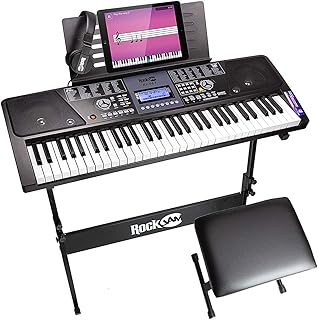
The RockJam RJ561 is a straightforward keyboard set for new players who want common practice accessories and introductory learning features. The bundle includes a stand, stool, headphones, and stickers, so it covers several essentials for setting up a practice area.
Its listed features include 100 rhythms, 50 tones, teaching functions, and demo songs. Keynote stickers and lesson access are intended to help children and adults learn notes and become familiar with the keyboard layout.
- Best for: Beginners looking for a basic 61-key set with a stool, stand, and headphones.
- Why it was selected: It provides a clear starter combination of practice accessories and learning functions.
- Consideration: Its listed selection of 50 tones and 100 rhythms is smaller than the selections stated for the RJ5061 and JIKADA models.
88-Key Semi-Weighted Digital Piano Set

This 88-key digital piano is the better fit for buyers who want the full standard keyboard range rather than a compact 61-key layout. Its semi-weighted keys are described as providing a more piano-like touch than lighter keys, while requiring less force than fully weighted keys.
The listed features include a stand, built-in speakers, a sustain pedal, Bluetooth, MIDI/USB, and connections for MP3, microphone, and headphones. It offers 200 rhythms, 200 sounds, and 70 demo songs. Bluetooth is listed for connecting a smartphone for lessons, and MIDI support enables connection to a computer or other external device for music editing or recording.
- Best for: Beginners or adults who want more key range and device-connection options.
- Why it was selected: It combines 88 semi-weighted keys with a sustain pedal and MIDI/USB support.
- Consideration: The keys are semi-weighted, not fully weighted, so buyers seeking a fully weighted action should compare that specification carefully.
Buying Guide: How to Choose an Electronic Keyboard Piano Set
Should you choose 61 keys or 88 keys?
A 61-key keyboard is a reasonable starting point for buyers who want a more compact instrument for basic learning and general practice. It can also make sense when space is limited or when a bundled beginner setup is the main priority. The RockJam and JIKADA options in this guide all use 61 keys.
An 88-key keyboard provides a wider range for playing music that uses more of the piano’s register. It is the better choice if having a full keyboard span matters more than keeping the instrument compact. The 88-key option here uses semi-weighted keys, so key count and key feel should be considered separately.
Which accessories should a beginner look for?
Check what the set actually includes before buying. A stand and stool or bench provide a ready place to play, while headphones let a learner practice without playing through the speakers. A sustain pedal is useful for practicing sustained notes and pedal technique. Bundles vary: the RJ761 lists a sustain pedal, while the RJ5061 and RJ561 emphasize other accessories.
Also confirm whether the keyboard has built-in speakers if speakers are important to your setup. The 88-key model specifically lists built-in speakers, and the JIKADA model lists two built-in stereo speakers. Avoid assuming that a feature is included just because it appears in another keyboard set from the same brand.
Do teaching modes, stickers, or lessons matter?
Teaching features can make the first stages of practice easier to follow, especially for learners who are not yet comfortable identifying notes. The JIKADA model lists three teaching modes and light-up keys. Several RockJam options list note stickers and lesson access. These aids can support practice, but they do not replace regular instruction or careful practice.
Choose the feature that suits the learner’s needs. A player who wants visual guidance may prefer light-up keys or stickers. Someone who already follows lessons may place greater value on a sustain pedal, more key range, or a connection for a computer or phone.
How many tones and rhythms are useful?
Built-in tones and rhythms give players options for exploring sounds and practicing with accompaniment. They are not the same as piano key range or key action. Compare the stated quantities if variety matters: the RJ561 lists 50 tones and 100 rhythms, while the RJ5061 lists 200 tones and rhythms. The JIKADA lists 255 tones and rhythms.
A large selection may be useful for experimentation, but beginners may prefer straightforward controls and a small number of features they will actually use. Look at the display and controls as well as the sound count, since accessible operation can matter during practice.
When are Bluetooth, MIDI, and USB connections important?
Connections can expand how a keyboard fits into a home practice or music-making setup. The 88-key model lists Bluetooth for connecting a smartphone for lessons and MIDI/USB for connection to a computer or other external device. The product description also identifies MP3, microphone, headphone, and sustain-pedal connections.
The JIKADA listing identifies audio input and output, a microphone jack, and a UDISK port. If you need a particular connection, verify that the specific port or function is listed for the model you are considering. Do not assume that every keyboard supports the same connections.
How should key feel guide your choice?
Key feel affects how a keyboard responds under the player’s fingers. The 88-key model is described as semi-weighted, with a touch intended to be more responsive than an unweighted keyboard but lighter than a fully weighted one. The provided product details do not state that the 61-key models have weighted keys.
For a beginner, the number of keys, included accessories, and practice features may be more important than matching an acoustic piano’s action. If weighted action is a requirement, check the exact key-action specification before choosing a set.
Frequently Asked Questions
What is the best electronic keyboard piano set for a beginner?
The best choice depends on the beginner’s needs. The RJ5061 is a strong fit for a bundled 61-key setup with a stand, bench, headphones, and note stickers. The JIKADA is better suited to learners who want three teaching modes and light-up keys.
Is a 61-key keyboard enough to start learning piano?
A 61-key keyboard can be a practical starting point for general beginner practice. It has fewer keys than an 88-key model, so it may not cover every piece or exercise that uses a wider range.
Which keyboard set includes a sustain pedal?
The RockJam RJ761 and the 88-key digital piano set list a sustain pedal. Check the included accessories for the exact model before purchasing.
What is the difference between semi-weighted and fully weighted keys?
Semi-weighted keys are described for the 88-key model as lighter to press than fully weighted keys. The supplied product details do not identify any option here as having fully weighted keys.
Can these keyboards be used with headphones?
The RockJam RJ5061, JIKADA 61-key keyboard, RJ761, and RJ561 list headphones as included. The 88-key product lists a headphone connection, but its supplied features do not say that headphones are included.
Which option is best for connecting to a computer?
The 88-key digital piano is the clearest choice in this list for computer-based music work because its features specify MIDI/USB connection for editing or recording with a computer or other external device.