
The best chorus flanger phaser pedal depends on whether you want a compact multi-effect, dedicated control over a few classic sounds, or deeper routing options. The JOYO Vision is best for players who want two channels and stereo routing; the SONICAKE four-mode pedal focuses on core effects; and the FLAMMA FC05 offers a compact way to explore several modulation types. The comparison below highlights what each selected pedal includes and who may benefit most.
| Pedal | Best For | Listed Highlights |
|---|---|---|
| JOYO Vision R-09 | Layering and routing options | 18 effects, two channels, stereo I/O, tap tempo |
| SONICAKE 4-Mode | Core modulation sounds | Chorus, flanger, phaser, tremolo, tap tempo |
| FLAMMA FC05 | Compact multi-effect variety | 11 modulation effects, small size, metal shell |
| Donner Mod Square II | Broad effect selection and simple controls | 16 effects, rate, level, and depth controls |
| SONICAKE 11-Mode | Multiple sounds with tap-rate control | 11 modes, three-knob controls, tap tempo |
JOYO Vision R-09 Dual-Channel Modulation Pedal

The JOYO Vision R-09 is best for players who want more than one modulation effect available for layering or switching between two channels. Its 18 listed effects include chorus, flanger, several phaser variations, tremolo, rotary, vibrato, auto-wah, stutter, and low-bit textures.
Each channel has its own Speed/Rate, Control, and Depth/Mix knobs. The pedal also offers independent tap tempo for each channel, stereo I/O, and series or parallel routing. Series sends channel A into channel B; parallel blends the two channels. These options make it the most routing-focused choice in this selection.
- Best for: Players building layered modulation sounds or using stereo signal paths.
- Why it was selected: It combines the core chorus, flanger, and phaser sounds with two channels, tap tempo, and flexible routing.
- Keep in mind: The listed power guidance calls for a dedicated 9V DC supply rated at 170mA or higher; check your power supply before adding it to a board.
SONICAKE Four-Mode Modulation Pedal

This SONICAKE pedal is best for guitarists who want the four familiar modulation categories named in the search: chorus, flanger, phaser, and tremolo. The product description says its effects are based on legendary equipment and are intended to reproduce classic sounds.
A tap-tempo function provides real-time rate control, which can help players align modulation speed with a song’s pulse. With four modes rather than a long list of effect types, this model keeps its focus on the core sounds instead of adding experimental options.
- Best for: Players who prioritize chorus, flanger, phaser, and tremolo in one pedal.
- Why it was selected: It directly covers the three named effects and includes tremolo and tap tempo.
- Keep in mind: Its listed effect selection is narrower than the 11- and 18-effect pedals here, so choose another option if variety is your priority.
FLAMMA FC05 Compact Modulation Pedal
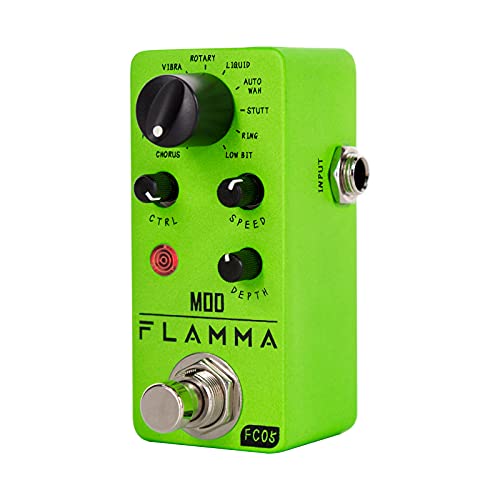
The FLAMMA FC05 is best for players who want a compact pedal with several different modulation effects. Its 11 listed sounds include chorus, flanger, phaser, tremolo, vibrato, rotary, liquid, auto-wah, stutter, ring, and low bit. That selection covers familiar movement effects as well as more unusual textures.
The product information highlights a full metal shell and a small, portable design. This makes the FC05 a practical candidate for players who want a broad set of effects in a space-conscious format. It is also useful for experimenting with sounds beyond the standard chorus-flanger-phaser trio.
- Best for: Players who want a small-format pedal with classic and unconventional modulation choices.
- Why it was selected: It offers all three target effects, alongside eight other listed effect types.
- Keep in mind: The provided feature list does not specify tap tempo or stereo routing, so compare those requirements before choosing it over models that list them.
Donner Mod Square II Multi-Effect Pedal

The Donner Mod Square II is best for players who want a choice of 16 modulation effects and straightforward adjustment controls. The listed effects include chorus, phaser, tremolo, flanger, rotary, vibrato, wah, lo-fi, and detune. Its controls adjust rate, level, and depth, providing basic parameters for shaping the selected sound.
Donner describes the pedal as using digital circuitry and says it is designed for a sound free from unwanted noise and interference. The controls are presented as accessible to beginners as well as more experienced guitarists. Its broad effect list can suit players who want to explore several styles without assembling separate pedals for each effect.
- Best for: Beginners and experienced players seeking many effect choices with rate, level, and depth controls.
- Why it was selected: Its 16 modes cover the core effects and a range of additional modulation sounds.
- Keep in mind: The supplied feature information does not mention tap tempo or stereo I/O, which may matter for players who need those functions.
SONICAKE 11-Mode Modulation Pedal

This SONICAKE model is best for players who want a wide variety of modulation sounds with tap tempo for real-time rate control. Its 11 modes include chorus, vibrato, flanger, phaser, tremolo, Univibe, auto-wah, and bitcrush, among other options listed by the manufacturer.
The product description specifies three-knob controls and a tap-tempo function. That combination can appeal to players who want to adjust effects directly and set a rhythmic rate while playing. Compared with the four-mode SONICAKE pedal, this model trades a narrower focus for more sound categories.
- Best for: Players who want a broad selection of modulation types and tap tempo.
- Why it was selected: It includes chorus, flanger, and phaser, plus additional effects and real-time rate control.
- Keep in mind: The listed features do not specify stereo I/O or dual-channel routing, so players who need those options should compare the JOYO Vision.
Buying Guide: How To Choose A Chorus, Flanger, And Phaser Pedal
A multi-modulation pedal can save board space and provide several textures from one unit. The right choice depends on which effects you use, how much control you need, and whether you want additional functions such as tap tempo or stereo routing. Compare the feature list with your playing setup rather than choosing only by the number of modes.
Which modulation effects do you need?
Chorus, flanger, and phaser are related but distinct effects. Chorus adds a doubled or thickened quality to the sound. Flanger creates a more pronounced sweeping, jet-like motion. Phaser produces moving notches in the tone. These descriptions are general guidance; the exact character depends on the pedal’s design and settings.
If you mainly use those three sounds, a focused model such as the four-mode SONICAKE may be a straightforward fit. If you also want vibrato, rotary, auto-wah, or lo-fi effects, consider a pedal with a larger mode list, such as the FLAMMA, Donner, or 11-mode SONICAKE.
Do you need tap tempo?
Tap tempo lets a player set a modulation rate by tapping a footswitch in time. It can be useful when a song calls for a rate that follows the beat, especially when changing tempos between songs. The JOYO Vision and both SONICAKE models in this comparison list tap-tempo functionality. The supplied features for the FLAMMA and Donner do not specify it.
Would stereo or multiple channels help?
Stereo I/O can matter if your rig uses a stereo signal path and you want modulation across both outputs. Multiple channels can provide separate effect settings or support combinations of effects. The JOYO Vision is the most explicit option here for these needs: its description lists stereo I/O, two channels, independent tap tempo, and series or parallel routing. Check your full signal chain before relying on stereo connections.
How many controls should a pedal have?
More controls can provide additional ways to shape an effect, while a simpler layout may be quicker to learn. Look for controls that adjust parameters you expect to use, such as rate, depth, level, mix, or an effect-specific setting. The Donner lists rate, level, and depth controls; the SONICAKE 11-mode lists three-knob controls; and the JOYO specifies dedicated controls for each channel.
What should you check before buying?
- Effect list: Confirm the pedal includes the specific sounds you plan to use, not just a high total number of modes.
- Control method: Check whether it lists tap tempo and the adjustment parameters you want.
- Signal routing: Verify stereo I/O or series/parallel operation if those functions are important to your setup.
- Board space: Compare the product’s stated size or format with the space available on your pedalboard.
- Power information: Follow the listed power requirements. The JOYO feature information specifies a dedicated 9V DC supply rated at 170mA or higher.
Frequently Asked Questions
What is the difference between chorus, flanger, and phaser?
Chorus creates a doubled, thickened sound; flanger produces a more pronounced sweeping motion; and phaser creates moving tonal notches. Each effect can be adjusted to produce a range of intensities and rates.
Can one pedal provide chorus, flanger, and phaser?
Yes. Every pedal in this comparison lists chorus, flanger, and phaser among its modes. The models differ in additional effects, controls, and routing features.
Which option has the most listed modulation effects?
The JOYO Vision lists 18 effects across two channels. The Donner Mod Square II lists 16, while the FLAMMA FC05 and SONICAKE 11-mode each list 11.
Which pedal in this comparison lists tap tempo?
The JOYO Vision R-09 and both SONICAKE models listed here specify tap tempo. The provided feature information for the FLAMMA FC05 and Donner Mod Square II does not mention it.
Is a multi-effect modulation pedal suitable for beginners?
It can be, especially if the controls and effect modes are clearly laid out. The Donner describes its controls as easy to use for beginners and professionals. New players can start with one effect and adjust its rate, depth, or level before exploring other modes.