
The best choice depends on whether you need an external speaker or a radio with digital signal processing (DSP). The five products below are external communications speakers; the supplied product details do not say that any has built-in DSP. The compact 5-watt rectangular speaker is suited to a simple single-radio setup, the ICOM speaker offers a 3.5 mm jack, and QWORK’s two-pack is useful when you need two speakers. Check your radio’s audio output and connector before choosing.
| Product | Best For | Listed Details |
|---|---|---|
| Rectangular 5-Watt Communications Speaker | A compact, bracket-mounted setup | 5 watts, 8 ohms, mounting hardware |
| ICOM Hands-Free Speaker | A flexible mounting location | 5 watts, 3.5 mm speaker jack |
| QWORK 5-Watt Speaker, Two-Pack | Two-radio or spare-speaker needs | Two speakers, 8 ohms, 3.5 mm plugs |
| Rectangular Speaker With 1.8 m Cable | Positioning a speaker away from a radio | 3.5 mm audio plug, 1.8 m cable |
| Rectangular Speaker With 71-Inch Cable | A straightforward mobile-radio setup | 3.5 mm audio plug, bracket mounting |
Rectangular 5-Watt Communications Speaker

This compact external communications speaker is best for a ham operator who wants a basic, bracket-mounted speaker for a radio, CB, or scanner. Its listed dimensions are approximately 4.5 by 2.5 by 2.25 inches, so it is a practical option when installation space is limited.
- Rated at 5 watts with an 8-ohm specification.
- Includes a mounting bracket and hardware.
- Described as a compact communications speaker.
It was selected for its clearly stated power, impedance, and mounting accessories. These details make it easier to compare with a radio’s audio-output requirements than products with fewer specifications. Choose this if you need one small speaker and have a suitable place to mount it.
Limitation: The supplied details do not identify a connector type or claim DSP processing. Confirm the plug and electrical requirements with the radio documentation before buying.
ICOM Hands-Free External Speaker
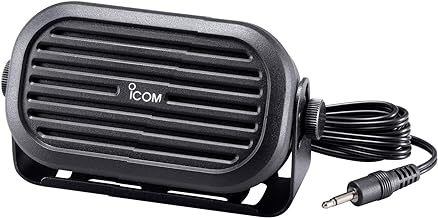
The ICOM speaker is best for buyers who want a 5-watt external speaker with a specified 3.5 mm speaker jack. Its listing says the speaker can be mounted anywhere, making it an option for operators who want to place audio closer to their listening position rather than rely on a radio’s built-in speaker.
- Listed as a 5-watt external speaker.
- Has a 3.5 mm speaker jack.
- Described as mountable in different locations.
This product was selected because it combines a stated power rating with a named connector and flexible mounting. Choose it if those features match your installation needs. The supplied description does not give an impedance rating, dimensions, or cable length, so compare those details with your radio and planned mounting position before purchase.
Limitation: The listing details do not establish that the speaker itself contains DSP or specify which radio models it supports.
QWORK 5-Watt Speaker Two-Pack

QWORK’s two-pack is best for operators who need two speakers, want a spare, or plan to equip more than one listening position. The listing describes the pair as suitable for ham radio, CB, scanners, and HF transceivers, and specifies 5-watt speakers with 8-ohm impedance.
- Two external communications speakers are included.
- Each is listed as 5 watts and 8 ohms.
- Features 3.5 mm plugs and 6.23-foot cables.
It was selected for its two-speaker quantity and useful connector, impedance, and cable-length details. Choose this if you need a pair and your equipment accepts the listed connection. The longer cables can help with placement, although the description does not state that either speaker has a DSP circuit.
Limitation: A 3.5 mm plug alone does not confirm compatibility with every radio. Check the radio’s manual for its speaker jack and supported load.
Rectangular Speaker With 1.8 m Cable

This rectangular communications speaker is best for a buyer who wants to position an external speaker away from the radio. Its listing specifies a 1.8-meter, approximately 71-inch cable and a 3.5 mm audio plug. It also describes bracket installation: attach the bracket with screws, secure the speaker, and plug it into the radio.
- Listed for ham radio, CB radios, and scanners.
- Has a 1.8 m cable and 3.5 mm audio plug.
- Includes a bracket-based installation approach in the description.
It was selected because its cable length and setup instructions address common mounting and placement questions. Choose this if the listed cable reach suits your radio position. The product description claims external speakers can provide louder, clearer sound with less background noise, but it does not supply test data to quantify that benefit.
Limitation: The supplied features do not state wattage or impedance. Verify those specifications and connector suitability with the radio manufacturer before connecting it.
Rectangular Speaker For Mobile Radios

This rectangular external speaker is best for someone seeking a basic speaker for a CB or mobile-radio installation with a 3.5 mm audio connection. Its listed features closely resemble the other rectangular 1.8-meter-cable option: it describes a 71-inch cable, bracket mounting, and a plug-in setup.
- Described for CB radios and mobile radios.
- Uses a 3.5 mm audio plug and 1.8 m cable.
- Provides a bracket-and-screw installation method in the listing.
It was selected as another clearly described option for operators comparing cable placement and straightforward mounting. The product listing says an external speaker may offer louder, clearer audio with less background noise than a radio speaker; treat that as the seller’s description, not a guaranteed result for every installation.
Limitation: The provided product details do not specify speaker power or impedance. Avoid assuming that these match your radio; confirm before purchase.
Buying Guide: Choosing A Speaker For A Ham Radio
Does an external speaker provide DSP?
Not necessarily. DSP means digital signal processing, which can reduce or shape received audio in a radio or a separate signal-processing device. An external speaker reproduces audio from the equipment; it does not automatically add noise reduction or filtering. None of the five supplied product descriptions explicitly claims built-in DSP.
If DSP is your priority, check the radio’s specifications for features such as noise reduction, audio filtering, or digital signal processing. An external speaker can still be useful for changing where sound is heard, but it should not be treated as a substitute for receiver-side DSP.
Which specifications should you check first?
- Connector: Match the speaker plug to the radio’s external speaker jack. Several products list a 3.5 mm plug or jack, but that detail alone does not prove universal compatibility.
- Impedance: Compare the speaker’s impedance with the radio manual. The first rectangular option and QWORK pair list 8 ohms; the other supplied descriptions do not provide an impedance figure.
- Power: Check the radio’s speaker-output requirements against the speaker’s rating. The compact rectangular model, ICOM option, and QWORK pair list 5 watts.
- Cable reach: Consider how far the speaker must sit from the radio. The QWORK pair lists 6.23-foot cables, while the two other rectangular products list 1.8-meter cables.
- Mounting: Look for a bracket and hardware if you want a fixed installation. The first rectangular speaker explicitly includes mounting hardware; other descriptions explain bracket mounting but provide fewer accessory details.
Should you choose one speaker or a two-pack?
Choose a single speaker if you are upgrading one radio or have a specific mounting location in mind. The compact 5-watt model provides stated dimensions and included mounting hardware. Choose the QWORK two-pack if you need two units or want a spare; its listed 8-ohm rating, 5-watt power, 3.5 mm plugs, and cable length make its specifications comparatively clear.
How much does speaker placement matter?
Placement affects convenience and how well the audio reaches your operating position. Measure the path between the radio and intended speaker location, allowing for cable routing rather than just straight-line distance. A bracket can help keep a speaker in a chosen position, but check the included hardware and available mounting space. Do not stretch, pinch, or route a cable where it could interfere with controls or movement.
Can a communications speaker work with a scanner or CB?
Some listings specifically mention scanners and CB radios, but the exact connection and electrical requirements still matter. Confirm the jack type and speaker specifications in your equipment manual. Product category wording is not a substitute for checking the particular radio model.
Frequently Asked Questions
Are these products DSP speakers?
The supplied descriptions identify them as external communications speakers and do not state that they contain DSP. For DSP audio processing, check the radio or a separate processing device’s specifications.
Which option has the clearest listed impedance and power details?
The compact rectangular speaker and QWORK two-pack both list 5 watts and 8 ohms. Confirm that those specifications suit your radio before connecting either product.
Which speaker is best when I need two?
The QWORK product is listed as a two-pack. It specifies 5 watts, 8 ohms, 3.5 mm plugs, and 6.23-foot cables.
Which listed products specify a 3.5 mm connection?
The ICOM speaker lists a 3.5 mm speaker jack. QWORK and both rectangular 1.8-meter-cable listings specify 3.5 mm plugs. Check whether your radio’s jack matches.
Do external speakers guarantee clearer reception?
No. The listings describe potential audio benefits, but the supplied details do not provide comparative test results. Reception and sound depend on the radio, signal, settings, speaker placement, and installation.