
The best sound filter for a microphone depends on the noise you need to control: a pop screen helps tame plosive bursts, while an isolation shield can reduce room reflections around the mic. The penypeal isolation ball is best for a close-fitting foam enclosure, Ramzi suits buyers who want a shield and stand together, and the Aokeo pop filter is a simple choice for vocal plosives. Compare the filter type, microphone fit, mounting method, and available space before choosing.
| Product | Filter type | Best for |
|---|---|---|
| penypeal Microphone Isolation Ball | Foam enclosure with pop screen | Reducing nearby reflections and plosives |
| Ramzi Stand With Isolation Shield | Foldable shield and stand | A combined recording setup |
| Aokeo Microphone Isolation Shield | Foldable reflection shield | Home recording and larger sources |
| Moukey Microphone Isolation Shield | Three-panel foldable shield | Flexible desktop or stand use |
| Aokeo Professional Pop Filter | Dual-layer screen | Plosive control at the microphone |
penypeal Microphone Isolation Ball

This foam enclosure combines a five-sided seal with a double-layer screen across its opening. The listed design aims to limit reflections and noise arriving from several directions, while the screen is intended to reduce plosives, wind interference, and saliva spray. It also helps protect the microphone from saliva during close vocal recording.
Best for: Buyers recording close to a compatible microphone who want a surrounding foam filter rather than a freestanding room shield. The listing says it suits many XLR and USB microphones, including condenser mics with a removable jacket diameter of 50–75 mm, and notes that a holder is included for different microphone sizes. Check the mic body dimensions and mounting arrangement before ordering.
Limitation: The stated fit range is specific, so this is not a universal choice for every microphone shape or size. It is also a close-fitting enclosure, which may not suit someone who wants an open, highly adjustable screen.
Ramzi Stand With Isolation Shield

The Ramzi set combines a microphone stand with a foldable isolation shield. Its described acoustic sandwich uses a sound-reflective layer, a filter layer, and an absorption layer. The listing also describes high-density foam, a front panel backed by lightweight ABS plastic, and two noise-blocking zones. It claims 87% ambient-noise reduction and 26 dB reduction; these are manufacturer-listed figures, not independent test results.
Best for: Buyers who want a stand and shield in one setup for seated studio work or standing performances. The stand is listed as 72.8 inches overall, with an adjustment range of 42–71.5 inches. A steel clamp with a screw lock and quick-release adapters are included, according to the product details.
Limitation: This is a larger stand-based setup, not just a compact pop screen. Check available floor space and the listed height range against your recording position before choosing it.
Aokeo Foldable Microphone Isolation Shield

This Aokeo shield has sound-absorbing foam on the front and a ventilated metal back panel. The listed dimensions are 23.2 by 11 by 2 inches, and the product includes a desktop stand. Its size is presented as suitable for vocal recording as well as recording instruments such as guitars and violins. The shield is made from metal alloy and foam and is described as portable for studio, home, and podcast settings.
Best for: Buyers who want a relatively broad reflection filter for a home or studio recording area, including those recording a voice or instrument. The product listing specifies 3/8-inch and 5/8-inch threaded mounts, which can help shoppers compare its mounting requirements with their setup.
Limitation: The panel measures over 23 inches wide, so it may take more desk or stand space than a small pop filter. The listing describes it as a shield to help with noise during recording; it does not establish that it will block all outside sound.
Moukey Three-Panel Isolation Shield

The Moukey shield uses reflective, filter, and absorbing layers, with high-density acoustic foam on the inner layer. Its three-panel design folds for storage or transport and can be adjusted into an arch. The product details say it can be fixed to a desktop or tabletop, or mounted to a microphone stand, making it a flexible option for different recording locations.
Best for: Buyers who want an adjustable shield that can move between desktop recording and a microphone-stand arrangement. The foldable panels allow the user to change the arch shape and angle, which can help adapt the shield’s position to a particular recording space.
Limitation: The listing does not provide panel dimensions, so compare the product’s size and mounting arrangement with your desk or stand before purchase. An isolation shield can help manage reflections near a microphone, but it is not a substitute for treating an entire room.
Aokeo Professional Dual-Layer Pop Filter
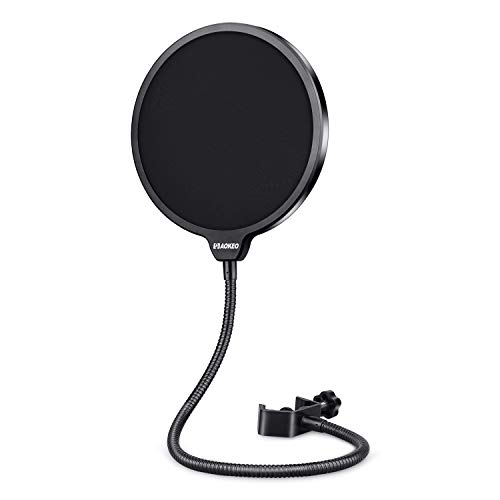
This Aokeo model is a screen-style pop filter rather than an isolation shield. Its two screens are separated by a gap: the first is designed to intercept an air burst, and the second helps disperse what remains. A rotating clamp attaches to a tubular boom or microphone stand, while the steel gooseneck lets the user adjust the filter’s position relative to the microphone.
Best for: Singers, narrators, and podcasters who mainly want to reduce plosive air bursts from close speech. Choose this if you already have a microphone stand and need a positionable screen without adding a large foam shield.
Limitation: A pop filter addresses airflow and plosive sounds at the mic; it does not provide the surrounding acoustic treatment of an isolation shield. The clamp is intended for tubular mounting booms or microphone stands, so verify that your support can accept it.
Buying Guide: How To Choose A Microphone Sound Filter
Do you need a pop filter or an isolation shield?
A pop filter is a screen positioned between the speaker and microphone. It is primarily used to reduce strong bursts of air from sounds such as “P” and “B.” A windscreen or foam enclosure surrounds more of the microphone and may also help manage wind and nearby reflections. An isolation shield sits behind or around the microphone to reduce some sound reflections near the recording position.
These products solve different problems. If plosives are the main issue, a dual-layer pop screen is often the more direct tool. If the recording sounds affected by nearby room reflections, consider a shield or enclosure. Neither type should be assumed to eliminate distant traffic, other people, or all noise entering the room.
Will the filter fit your microphone and stand?
Check the product’s stated microphone dimensions, mount type, clamp style, and thread size. The penypeal listing specifies a removable jacket diameter of 50–75 mm. The Aokeo isolation shield listing mentions 3/8-inch and 5/8-inch threaded mounts, while the Aokeo pop filter describes a clamp for tubular booms or stands. Confirm your own hardware measurements rather than relying on the microphone brand alone.
Microphones can differ in body shape, mounting hardware, and available clearance. A close-fitting foam enclosure needs enough room to fit around the microphone, while a gooseneck pop filter needs a stable place to clamp. A shield also needs a secure mounting position and enough clearance for the mic and speaker.
How much space do you have?
A small pop screen takes less space than a stand-and-shield combination. Foldable shields can be easier to store or reposition, but their panels still need room when open. Compare the listed dimensions where available, and consider whether the setup will sit on a desktop, attach to a stand, or need floor space.
For a shared workspace, portability and storage may matter as much as the filter material. A foldable, adjustable shield can suit users who change recording positions. A fixed desktop arrangement may be more practical if the microphone stays in one place.
Which filter is better for speech, singing, or instruments?
For close speech or singing, a pop screen can help manage plosives. A foam enclosure may combine pop filtering with some reduction of nearby reflections. For recording an instrument, a larger shield may provide a broader surface around the microphone, but the best placement depends on the instrument and room. Avoid expecting a vocal pop screen to perform like a room treatment product.
Choose based on the sound problem rather than the product label alone. “Sound filter” may refer to a pop screen, foam windscreen, reflection filter, or isolation shield. Identify whether the unwanted sound is a burst of air, wind, room echo, or background noise before selecting equipment.
What should you expect from noise-reduction claims?
Manufacturer descriptions can help compare materials and design, but listed reduction figures are not necessarily directly comparable across products. The Ramzi listing includes specific reduction claims, while other listings describe their foam or layered construction without comparable measurements. Treat these as product claims unless the source provides independent testing and a clear test method.
Microphone placement, room acoustics, and the distance between the speaker and mic also affect a recording. A filter can be one part of improving the sound, but it cannot guarantee a clean recording in every environment.
Frequently Asked Questions
What does a microphone pop filter do?
A pop filter sits in front of a microphone to reduce strong air bursts from speech and singing. Dual-layer models use spaced screens to disperse airflow before it reaches the microphone.
Does an isolation shield block all background noise?
No. An isolation shield is designed to manage sound reflections and interference near a microphone. It should not be treated as a soundproof barrier or a guarantee against all room noise.
Can a pop filter reduce room echo?
A pop filter mainly addresses plosives and airflow. It does not surround the microphone with acoustic material, so it is not the same as a reflection shield or foam enclosure.
Is a microphone isolation ball universal?
Not necessarily. The penypeal listing gives a 50–75 mm removable-jacket diameter range and says it includes a holder for different microphone sizes. Check the product’s stated dimensions against your microphone.
Should I choose a foldable shield or a fixed pop screen?
Choose a foldable shield if you want a larger, repositionable surface to help manage reflections near the microphone. Choose a pop screen if your main concern is plosive air bursts and you want a smaller accessory mounted close to the mic.