
The best budget clean boost depends on whether you want a simple volume lift, tone shaping, or a second boost mode. The SONICAKE Sonic Super Master is best for a modest boost with an integrated buffer; the JOYO Roll Boost suits players who want a larger gain range; and the LEKATO offers clean and TS-style modes. The TC Electronic Spark Mini is a compact, straightforward option, while the Pure Boost adds two-band EQ controls. Compare the listed features below, then choose according to your signal-chain needs and preferred controls.
| Pedal | Best For | Standout Feature |
|---|---|---|
| SONICAKE Sonic Super Master | Buffer and modest boost | 0–12 dB gain adjustment |
| Pure Boost | Boost with tone shaping | ±15 dB two-band EQ |
| LEKATO Boost | Two boost characters | Clean and TS booster modes |
| JOYO Roll Boost | Wide boost range | Up to 35 dB boost |
| TC Electronic Spark Mini | Compact, simple operation | 20 dB boost and PrimeTime switching |
SONICAKE Sonic Super Master

The SONICAKE Sonic Super Master combines clean boost functionality with an integrated buffer. Its dedicated gain control adjusts the boost from 0 to 12 dB, and a footswitch turns the effect on or off. This makes it a direct option for players who want a controlled lift rather than a large range of additional gain.
Best for: Guitarists looking for a modest, adjustable boost and a buffer in one pedal. It was selected because its feature set is clearly focused on signal preservation and a straightforward gain adjustment, without adding multiple tone controls to manage.
Consider: The listed maximum boost is 12 dB. Choose another option if you specifically want a higher stated boost ceiling or independent EQ controls.
Pure Boost With Two-Band EQ

This Pure Boost pedal is described as providing more than 20 dB of clean boost, with a two-band EQ offering ±15 dB adjustment for highs and lows. The EQ gives players a way to shape the boosted signal, such as adjusting brightness or warmth, instead of relying only on a volume increase. The product listing also specifies a metal enclosure and true bypass.
Best for: Players who want a boost and separate high- and low-frequency adjustments. It stands out among these options for its stated EQ range, making it better suited to users who want to refine the boosted tone as well as raise signal level.
Consider: Its extra EQ controls may be unnecessary if you want the simplest possible one-control boost. The listing describes it for guitar and bass, but does not provide further setup or compatibility details.
LEKATO Clean And TS Booster

The LEKATO has two modes: a clean booster and a TS-style overdrive booster. The clean mode is described as a volume boost with subtle high- and low-frequency roll-off. The TS mode adds a warm overdrive character and a midrange emphasis. Its three-knob layout includes low- and high-frequency adjustments, allowing users to shape the sound while increasing gain. The listing specifies true bypass and DC 9V.
Best for: Guitarists who want one pedal to cover a cleaner lift and a more driven, mid-focused boost. It was selected because the two modes offer a different approach from pedals focused only on clean volume gain.
Consider: The TS booster mode adds overdrive character, so it is not the right choice if you need a strictly uncolored boost in every setting. Check your power-supply requirements against the listed DC 9V specification.
JOYO Roll Boost JF-38
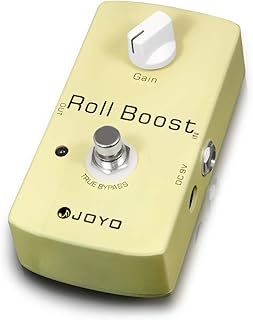
The JOYO Roll Boost is described as a clean, clear boost with up to 35 dB of boost. It has true bypass, an aluminum-alloy housing, and an LED indicator for operating status. The product listing says it supports a maximum input of 18V DC; that is a maximum-input specification, not a requirement to use that voltage.
Best for: Players who want a broad stated boost range and a simple signal-boosting role. It was selected for its higher maximum boost figure and true-bypass design, which distinguish it from the lower-range SONICAKE option.
Consider: The listed features do not specify EQ controls or multiple voicing modes. Check the pedal’s power requirements and your supply’s output before connecting it, and do not exceed the stated 18V DC maximum input.
TC Electronic Spark Mini

The TC Electronic Spark Mini is an ultra-compact booster with an all-analog design and a stated 20 dB of clean boost. Its PrimeTime footswitch can operate as a standard on/off switch or provide momentary boost depending on how long it is held. That switching behavior offers a way to apply a temporary lift without changing the pedal’s overall compact, focused feature set.
Best for: Players who want a small-format boost with simple controls and the choice of momentary or on/off switching. It was selected because the PrimeTime feature differentiates it from basic footswitch designs.
Consider: The listed features do not mention EQ or multiple tonal modes. Choose another pedal if independent frequency shaping is a priority.
Buying Guide: How To Choose A Cheap Clean Boost Pedal
A clean boost raises a guitar signal without necessarily adding an overdrive character. In practice, the result depends on the rest of the signal chain and how the amplifier responds. Compare the pedal’s stated boost range, tone controls, switching, and power details rather than assuming every product labeled “clean boost” will behave identically in every rig.
How Much Boost Do You Need?
Start by deciding what the boost is meant to do. A small level increase for a lead passage may not require the widest available range. The SONICAKE lists adjustment from 0 to 12 dB, while the Spark Mini specifies 20 dB and the JOYO lists up to 35 dB. The Pure Boost specifies more than 20 dB. These figures describe stated capabilities, not a guarantee of a particular volume change in every amplifier or setup.
A higher maximum can provide more adjustment headroom, but it does not mean you must use the pedal at its maximum. If you want a predictable, moderate lift, consider the control range and whether the pedal offers a way to shape the signal. If you are trying to push an amplifier into saturation, the result depends on the amplifier and the level reaching it; a boost pedal alone does not guarantee a specific distortion sound.
Do You Want Tone Controls Or A Simpler Signal Path?
EQ controls can help adjust the boosted sound. The Pure Boost provides ±15 dB high- and low-frequency adjustment, while the LEKATO also includes high- and low-frequency controls alongside its gain and mode options. These may suit players who want to tune the signal for a particular guitar, amplifier, or mix.
A simpler pedal can be easier to set when the goal is mainly to raise signal level. The SONICAKE focuses on gain adjustment and an integrated buffer, while the Spark Mini emphasizes clean boost and switching options. Pick more controls when you expect to use them; otherwise, extra adjustment may add complexity without serving your main purpose.
Should You Choose A Buffer Or True Bypass?
The SONICAKE’s listing specifies an integrated buffer. A buffer is intended to help preserve a signal through a pedal chain, but the supplied product information does not state how it behaves in every setup. The Pure Boost and JOYO listings specify true bypass. These descriptions indicate different design features; neither should be treated as an automatic guarantee of the best sound for every rig.
Consider your full signal chain, including cable runs and other pedals, when deciding which feature matters. If signal preservation is a priority, the SONICAKE is the direct match among these listed options. If you specifically want a product described as true bypass, the Pure Boost, LEKATO, and JOYO list that feature.
Do You Need A Second Boost Character?
Not every boost pedal is limited to a clean volume lift. The LEKATO offers a clean mode and a TS-style booster mode, with the latter described as adding warm overdrive character and a midrange hump. That makes it more versatile for players who want two distinct uses, but less suitable if you want to avoid added overdrive coloration.
The other pedals in this selection focus on clean boosting or signal-level adjustment in their listed features. For a straightforward boost, choose based on range, controls, and switching. For two different boost characters in one unit, the LEKATO is the clear match based on the supplied specifications.
What Should You Check Before Connecting The Pedal?
Confirm the power requirements from the product information and the pedal itself before connecting a power supply. The LEKATO listing specifies DC 9V. The JOYO listing says it supports a maximum input of 18V DC; do not interpret that maximum as a recommended operating voltage. The supplied information does not state power details for every product, so check the manufacturer’s instructions if they are not shown on the pedal or listing.
Also consider physical space and switching needs. The Spark Mini is described as ultra-compact, which may appeal to players with limited pedalboard room. Its PrimeTime switch supports both on/off and momentary operation. If you prefer a conventional footswitch action, compare each pedal’s switching description before buying.
Frequently Asked Questions
What Does A Clean Boost Pedal Do?
A clean boost raises the level of the guitar signal while aiming to preserve its tone. The final sound depends on the pedal’s settings and the rest of the signal chain, including how the amplifier responds to the stronger signal.
Which Pedal Has The Highest Listed Boost?
The JOYO Roll Boost lists up to 35 dB of boost, the highest stated maximum among these five products. The Pure Boost lists more than 20 dB, and the Spark Mini lists 20 dB.
Which Option Includes A Buffer?
The SONICAKE Sonic Super Master is the product in this selection whose listed features specify an integrated buffer. It also provides gain adjustment from 0 to 12 dB.
Which Pedal Offers Both Clean And Overdrive-Style Boosting?
The LEKATO has a clean booster mode and a TS OD booster mode. The listing describes the TS mode as adding a warm overdrive character and midrange emphasis.
Which Boost Pedals List True Bypass?
The Pure Boost, LEKATO, and JOYO listings specify true bypass. Compare that feature with your signal-chain needs rather than assuming it will be preferable for every setup.