
A subwoofer acoustic isolation platform helps reduce vibrations transferred from a subwoofer to the floor or furniture. The Auralex SubDude-II is a compact general-purpose choice, Sound Addicted’s VibeBoss P10 is sized for 8- to 10-inch subs, and the VibeBoss P12 suits larger 12- to 15-inch models. For a broad 15-inch-square surface, consider the Pyle PSI15; for a two-pad setup, the AlloverPower set is the better fit.
| Product | Best For | Key Feature |
|---|---|---|
| Auralex SubDude-II | Compact setups | Designed to decouple a subwoofer from the floor |
| Sound Addicted VibeBoss P10 | 8- to 10-inch subwoofers | Foam, EVA, and MDF construction |
| Sound Addicted VibeBoss P12 | Large subwoofers | 20-by-17-inch platform |
| Pyle PSI15 | General-purpose 15-inch-square placement | High-density engineered foam |
| AlloverPower 2-Pack | Two speakers or a flexible setup | Two three-layer isolation pads |
Auralex Acoustics SubDude-II

The Auralex SubDude-II measures 15 by 15 inches and is 1.75 inches thick. Its stated purpose is to decouple a subwoofer from the floor, helping diminish structural vibrations and reduce sound coloration or muddiness associated with vibration transfer.
Best for: Buyers who want a dedicated, compact isolation platform for a subwoofer and have a subwoofer base that fits within a 15-inch-square surface. It is the most straightforward pick when decoupling from the floor is the main goal.
Why it stands out: The product description specifically identifies subwoofer isolation and structural vibration reduction as its function. Its dimensions make it easier to assess fit before buying than a platform listed without measurements.
Consider: The 15-by-15-inch footprint may not suit a subwoofer with a larger base. Measure the subwoofer’s feet or bottom panel, not just the enclosure’s nominal speaker size.
Sound Addicted VibeBoss P10
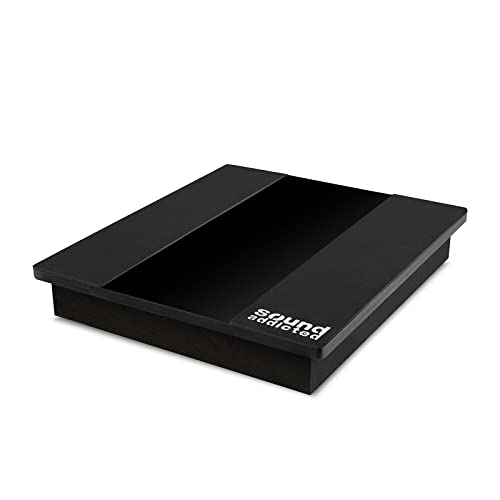
The VibeBoss P10 is a 13.7-by-15.7-inch platform, 2.5 inches thick, intended for 8-, 9-, and 10-inch subwoofers. Its construction combines high-density foam, EVA material, and an MDF board. The manufacturer describes the board as providing extra stability and the foam as supporting sound dampening.
Best for: Owners of an 8- to 10-inch subwoofer who want a platform with a stated size range and a firm board layer. It is also presented for home-studio use, where reducing vibration from the speaker setup may be useful.
Why it stands out: The stated compatibility range makes it a more size-specific option than a broadly described universal pad. The layered construction also distinguishes it from foam-only choices.
Consider: Its 13.7-inch side is narrower than its 15.7-inch side. Check the subwoofer’s bottom dimensions and foot placement to confirm the entire base is supported.
Sound Addicted VibeBoss P12

The VibeBoss P12 measures 20 by 17 inches and is 3 inches thick. It is designed for larger subwoofers, with the product description listing 12-, 13-, 14-, and 15-inch models. Like the P10, it uses high-density foam, EVA material, and a sturdy MDF board.
Best for: Buyers with a large subwoofer who need a wider platform than compact 15-inch-square options provide. Its listed size range and 20-by-17-inch footprint help shoppers compare it against the subwoofer’s actual base.
Why it stands out: Among these selections, it is the option specifically described for 12- to 15-inch subwoofers. Its larger dimensions provide more surface area for a substantial enclosure, while the MDF layer is intended to add stability.
Consider: The larger platform needs more floor space. Confirm that the intended location can accommodate its 20-by-17-inch footprint without blocking walkways or placing the subwoofer unevenly.
Pyle PSI15 Speaker Riser

The Pyle PSI15 is a 15-by-15-inch, 1.8-inch-thick acoustic isolation pad. Its high-density engineered foam is described as helping with speaker stabilization, noise isolation, and sound dampening. The product is marketed for subwoofers as well as studio monitors, loudspeakers, and shelf speakers.
Best for: Buyers who want a square, general-purpose pad for a compatible subwoofer or speaker. The 15-inch-square surface makes it a practical option for setups that do not need a large platform or a specific 8- to 15-inch subwoofer designation.
Why it stands out: It combines a clearly stated footprint with broad intended use. The product description also identifies vibration and unwanted resonance reduction as its purpose.
Consider: The package listing describes one platform pad. If you need to isolate multiple speakers, check the quantity needed rather than assuming the listing includes a pair.
AlloverPower 2-Pack Isolation Pads

This AlloverPower set includes two pads measuring 15.5 by 13 inches. The product is described for 8- to 10-inch studio monitors, loudspeakers, and subwoofers. Its three-layer construction includes shock-absorbent rubber sponge and a non-slip fibreboard base, according to the listing.
Best for: Buyers who need two isolation surfaces, such as for a stereo speaker setup, or who want an extra pad for another compatible speaker. Its stated 8- to 10-inch range makes it relevant to many compact subwoofer setups.
Why it stands out: The two-pad quantity and non-slip base are useful differentiators. The product description says the pads are designed to reduce vibration and help keep audio equipment in place.
Consider: Each pad is 13 inches deep and 15.5 inches wide, so it may be too small for a larger subwoofer base. Check the dimensions and support points before choosing it for a subwoofer.
Buying Guide: How to Choose a Subwoofer Isolation Platform
A platform should suit the subwoofer’s physical base, the floor or furniture beneath it, and the space available. Isolation pads are intended to reduce vibration transfer and resonance; they do not make a room soundproof or guarantee that neighbors will not hear bass. Choose based on measurable fit and construction rather than relying on a speaker’s nominal driver size alone.
What platform size does your subwoofer need?
Measure the subwoofer’s bottom panel or the area occupied by its feet. Compare those measurements with the platform’s listed width and depth. The full support area should sit on the pad, with the subwoofer stable and level. A product’s suggested driver-size range is a useful starting point, but enclosure dimensions can differ between models with the same nominal driver size.
Should you choose a small or large platform?
For compact subwoofers, the Auralex SubDude-II or VibeBoss P10 offers a smaller footprint than the VibeBoss P12. For a larger enclosure, the P12’s 20-by-17-inch surface is the clearest large-format option in this group. A 15-inch-square pad, such as the Pyle PSI15, is a middle-ground choice when the subwoofer base fits its surface.
Do not choose a larger platform without checking floor space. A platform that protrudes into a walkway or sits partly on an uneven surface can create placement problems. The pad should rest securely on the intended floor or shelf.
Does platform construction matter?
These products use different construction approaches. The Pyle PSI15 is described as high-density engineered foam. The VibeBoss P10 and P12 combine foam and EVA with an MDF board, while the AlloverPower pads use a three-layer design with a rubber-sponge component and fibreboard base. These descriptions help compare design, but they do not establish a universal ranking for vibration reduction.
A board layer may be appealing if you want a more structured surface, while a foam pad may suit a simpler setup. Confirm that the platform remains stable under the subwoofer and that its dimensions support the equipment’s feet or base.
Do you need one pad or two?
Most subwoofers need one platform beneath the enclosure. A two-pack may be useful if you are isolating two speakers or want a second pad for another compatible component. Check the product quantity and each pad’s dimensions: the AlloverPower listing specifies two pads, while the Pyle PSI15 listing describes one pad.
Will an isolation platform stop bass from reaching another room?
An isolation platform can help limit vibrations transferred through contact with a floor or furniture, but it cannot eliminate airborne bass or sound traveling through walls and building structures. Results depend on the room, subwoofer placement, construction, and listening level. If low-frequency sound remains disruptive, consider placement changes and room-specific acoustic measures in addition to a platform.
Frequently Asked Questions
What does a subwoofer isolation platform do?
It sits between the subwoofer and the floor or supporting surface. Its purpose is to reduce vibration transfer and unwanted resonance, which may help limit structural vibration and muddiness in a setup.
How do I know if an isolation platform will fit?
Measure the subwoofer’s base and compare it with the platform’s width and depth. Also check where the feet land, the platform thickness, and whether the supporting surface has enough room.
Is a larger platform always better?
No. The platform needs to support the subwoofer securely, but it should also fit the available space. A large platform can be unnecessary for a compact subwoofer, while a small pad may not adequately support a larger model.
Can I use a speaker isolation pad under a subwoofer?
Yes, if the product is described for subwoofers and its dimensions support the subwoofer’s base. The Pyle PSI15 and AlloverPower pads, for example, are listed for subwoofer use, but their surface sizes should be checked before purchase.
Will a platform improve bass sound?
A platform may reduce some vibration-related coloration or resonance, depending on the room and setup. It does not change the subwoofer’s specifications, and the result cannot be guaranteed for every floor or listening environment.