
The best 12-volt battery charger depends on battery chemistry, charging speed, and whether you need simple charging or long-term maintenance. The NOCO GENIUS10 is best for buyers who want a higher 10-amp output and broad battery-type support; the YDBAO adds an LCD and selectable modes; and the Mroinge is a lower-output option that supports both lead-acid and LiFePO4 batteries. Check the charger’s AC input and battery output specifications before buying: a 12-volt charger typically describes its battery output, not its wall-power input.
| Charger | Best For | Output Or Main Feature |
|---|---|---|
| NOCO GENIUS10 | Faster charging and versatile battery support | 10A; 6V and 12V |
| YDBAO 12V 10A | Visible charging information | 10A; LCD and selectable modes |
| Mroinge MBC022 | Small vehicles and supported battery types | 2A; lead-acid and LiFePO4 |
| NOCO GENIUS1 | Low-current maintenance | 1A; 6V and 12V |
| MOTOPOWER MP00205A | 12V lead-acid battery maintenance | 800mA; desulfation feature |
NOCO GENIUS10 10A Smart Charger

The NOCO GENIUS10 is a 6-volt and 12-volt smart charger with a listed 10-amp charging output. It supports lead-acid chemistries, including AGM, Gel, SLA, and VRLA, as well as LiFePO4 lithium batteries. Listed applications include flooded, maintenance-free, deep-cycle, marine, and powersports batteries.
Best for: Buyers who want more charging output than a small maintainer and need support for several battery types. It is also a fit when a single charger needs to serve both 6V and 12V batteries. NOCO lists charging, maintenance, trickle-charging, and desulfation functions.
An integrated thermal sensor adjusts charging according to ambient temperature. Limitation: Its 10-amp output may be more than necessary for buyers seeking only a low-current maintainer for a small battery. Confirm the battery’s chemistry and voltage before selecting a charger setting.
YDBAO 12V 10A Smart Charger

This YDBAO charger is listed as a 12-volt, 10-amp unit for lead-acid batteries, including AGM, GEL, SLA, and VRLA, and for LiFePO4 batteries. Its LCD displays charging information such as voltage, current, battery level, and ambient temperature. The feature list also describes seasonal settings and five selectable modes, including CAR, AGM/GEL/LiFePO4, WET, MOTO, and PULSE REPAIR.
Best for: Buyers who want to see charging data on a display and select a mode based on battery type or use. It combines charging, maintenance, and trickle-charging functions, with listed applications including cars, motorcycles, trucks, and boats.
Limitation: The product instructions say to connect it to a power source before use and not to leave it operating unattended for more than 12 hours. Check the battery chemistry before choosing a mode, and follow the manufacturer’s operating guidance.
Mroinge MBC022 2A Charger

The Mroinge MBC022 delivers 12 volts at 2 amps and offers separate 12V lead-acid and 12V lithium (LiFePO4) battery options. Its listed lead-acid coverage includes flooded, sealed maintenance-free, AGM, and gel batteries. The manufacturer specifies support for LiFePO4 batteries up to 85Ah.
Best for: Owners of motorcycles, lawn mowers, ATVs, boats, and other listed vehicles who need a modest-output charger and maintain function. It is also a useful option for buyers looking for both lead-acid and LiFePO4 support in one product.
Listed safety features include spark-proof operation, reverse-polarity protection, overcharge protection, short-circuit protection, and over-temperature protection. The feature list also mentions bad-battery identification and a low-voltage activation function for 12V LiFePO4 batteries.
Limitation: Its 2-amp output is lower than the 10-amp options, so it is better suited to lower-current charging and maintenance than buyers prioritizing higher output. Select the correct battery type before charging.
NOCO GENIUS1 1A Smart Charger
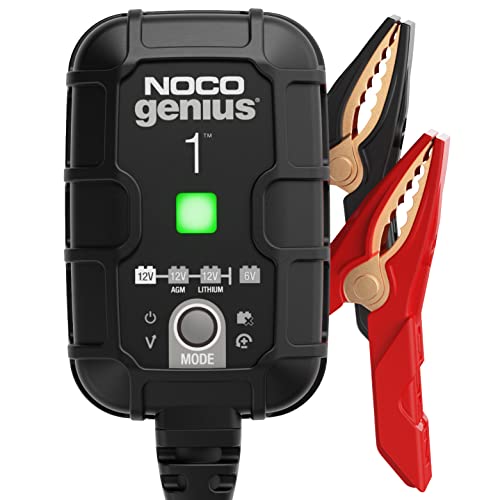
The NOCO GENIUS1 is a 1-amp charger, maintainer, trickle charger, and desulfator for 6-volt and 12-volt batteries. It supports lead-acid batteries, including AGM, Gel, SLA, and VRLA, and LiFePO4 lithium batteries. Listed uses include flooded, maintenance-free, deep-cycle, marine, and powersports batteries.
Best for: Buyers who prioritize maintenance and broad battery-chemistry support over a high charging rate. Its 6V and 12V compatibility may suit households with different battery voltages, provided the battery type is supported.
The integrated thermal sensor adjusts charging based on ambient temperature, helping address hot- and cold-weather charging conditions. Limitation: With a 1-amp output, it is a lower-output choice than a 10-amp charger. Choose it for maintenance or gradual charging rather than when higher output is the priority.
MOTOPOWER MP00205A 800mA Charger

The MOTOPOWER MP00205A is an automatic 12-volt charger with an 800mA output. It is designed for lead-acid batteries, including flooded, sealed maintenance-free, AGM, and gel-cell types. The listed functions include charging, battery maintenance, trickle charging, and automatic desulfation using pulse-current technology.
Best for: Buyers who need a low-output charger for a supported 12V lead-acid battery and value automatic maintenance features. The product information describes it as an all-weather charger and says it uses automatic detection for battery sulfation.
The charger is listed as having zero output in standby mode, with no battery drain when connected, and spark-proof battery connections. Limitation: It is specified for 12V lead-acid batteries, not LiFePO4. Choose another model if you need lithium-battery support or 6V charging.
Buying Guide: How To Choose A 12-Volt Battery Charger
Does “12-volt” mean the charger’s input or output?
On these products, “12V” generally refers to the battery voltage the charger is designed to charge. The wall-power input is a separate specification, commonly stated as AC voltage and frequency. For example, the Mroinge listing specifies 100–120VAC input and 12V output, while the YDBAO listing describes a 110–240V AC wall supply and 12V charging. Check both details if you are asking about a charger powered by a 12V source rather than a charger for a 12V battery.
Which battery chemistry does the charger support?
Match the charger to the battery label or manufacturer’s instructions. Lead-acid batteries include types such as flooded, AGM, gel, SLA, and VRLA, but a charger’s feature list may not support every type. LiFePO4 batteries require a charger mode or model specifically listed for that chemistry. The NOCO GENIUS1, NOCO GENIUS10, Mroinge, and YDBAO list LiFePO4 support; the MOTOPOWER MP00205A is listed for lead-acid batteries.
How much charging output do you need?
Compare output in amps as well as the intended use. The listed 10-amp NOCO GENIUS10 and YDBAO provide higher output than the 2-amp Mroinge, 1-amp NOCO GENIUS1, and 800mA MOTOPOWER. Higher output can be useful when charging speed is a priority, while lower-output models can suit maintenance or gradual charging. Actual charging time depends on factors not specified in these product descriptions, including battery condition and capacity.
Do you need a maintainer, display, or onboard installation?
For storage maintenance, look for a model explicitly described as a maintainer or trickle charger. For at-a-glance charging information, the YDBAO includes an LCD showing voltage, current, battery level, and temperature. Buyers seeking a mounted system can consider the NOCO GENIUS2D, which is a 2-amp, 12V onboard charger for lead-acid batteries and includes a mounting bracket. It is not included in the five main picks because the other selections better cover portable charging and more battery types.
What safety details should you check?
Look for protections and connection instructions in the product information, but do not assume every charger has the same safeguards. Mroinge lists several protective functions, while the Ailiheng sealed lead-acid charger description lists short-circuit and reverse-connection protection. Whichever model you choose, confirm positive and negative terminal connections, select the correct battery mode, and follow the charger’s instructions.
Frequently Asked Questions
Can I use a 12V charger on a 12V car battery?
Yes, if the charger is designed for the battery’s chemistry and capacity range and its instructions permit that use. Confirm that it supports the specific battery type, such as AGM, flooded lead-acid, or LiFePO4.
Can a 12V charger charge a 6V battery?
Only if the charger specifically supports 6V charging. The NOCO GENIUS1 and GENIUS10 list both 6V and 12V support. A charger listed only for 12V should not be assumed to charge a 6V battery.
Can I leave a battery maintainer connected?
Follow the charger’s manual and the battery maker’s instructions. A product described as a maintainer is intended to support battery maintenance, but operating limits differ. The YDBAO listing specifically says not to leave it operating unattended for more than 12 hours.
Can a lead-acid charger charge a LiFePO4 battery?
Do not assume it can. Choose a charger that explicitly lists LiFePO4 support and use the correct mode. The MOTOPOWER MP00205A is listed for lead-acid batteries, while the NOCO GENIUS1 and GENIUS10, Mroinge, and YDBAO list LiFePO4 support.
What does a battery desulfator do?
A desulfator is a feature intended to address sulfation in lead-acid batteries. MOTOPOWER describes automatic detection and pulse-current desulfation, and NOCO lists desulfation as a function of its GENIUS1 and GENIUS10. The feature does not establish that a damaged or failed battery can be restored.