
If you need a tenor banjo specifically with 17 frets, verify the instrument’s fret count before buying: the banjo listed here is identified as a 19-fret model, not a 17-fret model. The other options are strings and a chord chart. The Gold Tone AC-4 is best for shoppers considering a complete instrument, John Pearse strings suit Irish-tenor players seeking particular materials or gauges, and the D’Addario set is a nickel-plated steel option. The chart is designed for standard CGDA tuning, so it is not an Irish GDAE reference.
| Product | Type | Best suited for | Important detail |
|---|---|---|---|
| Gold Tone AC-4 | Tenor banjo | Buyers considering a complete instrument | Listed as a 19-fret model |
| John Pearse Heavy Gauge | Irish tenor strings | Players seeking a heavy-gauge set | Pure nickel wound |
| John Pearse 2010M | Irish tenor strings | Players seeking medium strings | 80/20 bronze wound |
| D’Addario EJ63 | Tenor banjo strings | Players wanting nickel-plated steel | 9–30 gauge, loop ends |
| Tenor Banjo Chord Chart | Learning reference | Players using standard CGDA tuning | Not designed for Irish tenor tuning |
Gold Tone AC-4 Acoustic Composite Irish Tenor

The Gold Tone AC-4 is the only complete banjo among these five products. Its listed features include a composite 11-inch rim, a Remo head, and a Zero Glide nut intended to support intonation. It is described as an Irish tenor four-string banjo.
Best for: Buyers looking for an instrument rather than replacement strings or a practice aid, especially those open to an Irish-tenor configuration. It was selected because it is the sole banjo in the supplied product list.
Important limitation: The product listing identifies it as a 19-fret tenor banjo. Do not treat it as a 17-fret choice. If 17 frets are essential, confirm the model specification with the seller before ordering or seek a listing that explicitly states 17 frets.
Choose this if the listed construction and Irish-tenor description fit your needs. Avoid choosing it solely because you searched for “17 fret”: its listed fret count does not match that requirement.
John Pearse Heavy Gauge Irish Tenor Strings

This John Pearse set is described as Irish tenor banjo strings in a heavy gauge, with pure nickel winding. The listing also identifies the strings as made in the USA. Its defining comparison point is the heavier gauge, rather than the medium gauge or the nickel-plated-steel construction of the other listed sets.
Best for: Irish-tenor players specifically seeking a heavy-gauge set and a pure-nickel-wound option. It was selected because its intended instrument type, gauge category, and winding material are stated in the product details.
Important limitation: The supplied information does not give individual string gauges or confirm compatibility with every tenor banjo scale length and tuning. Check the instrument maker’s recommendations and the package details before replacing a current set.
Choose this if “heavy gauge” and pure nickel winding match your setup preferences. If you want a medium set or nickel-plated steel, compare the other string options instead.
John Pearse 2010M Medium Irish Tenor Strings
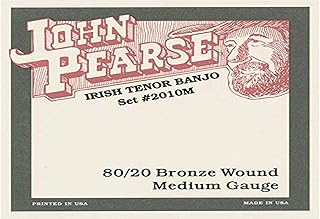
The John Pearse 2010M is a medium Irish tenor banjo string set. The listed winding material is 80/20 bronze, made with 80% copper and 20% zinc. This gives buyers a clearly described alternative to the heavy-gauge pure-nickel set in the same product list.
Best for: Irish-tenor players who want a medium set and prefer the listed 80/20 bronze-wound construction. It was selected because the product description specifies both its intended instrument and its material.
Important limitation: The listing details provided do not specify the individual string gauges or the exact tuning the set is intended to support. Check the package or manufacturer guidance if your banjo uses a particular scale length or tuning.
Choose this if you want the medium-gauge category and bronze winding. It is not the direct match for someone specifically seeking heavy-gauge pure nickel strings.
D’Addario EJ63 Nickel-Plated Steel Strings

The D’Addario EJ63 is a tenor banjo string set with nickel-plated steel construction and a listed 9–30 gauge range. The product description characterizes the tone as warm and bright and notes a smooth feel and loop-end construction. It also states that the loop ends are intended for universal fit.
Best for: Tenor banjo players seeking nickel-plated steel strings in the listed 9–30 range. It was selected as a clearly specified material-and-gauge alternative to the two John Pearse Irish tenor sets.
Important limitation: “Tenor banjo” does not by itself confirm that a set suits every instrument, tuning, or player preference. Check the banjo maker’s recommendations and confirm that the listed gauge range is appropriate for your setup.
Choose this if nickel-plated steel, loop ends, and the stated gauge range suit your requirements. Compare the product’s tuning guidance with your own before ordering, particularly if you play Irish tenor tuning.
Tenor Banjo CGDA Chord Chart

This laminated 11-by-17-inch reference is made for standard four-string tenor banjo in CGDA tuning. According to the listing, it combines common chord shapes with fretboard notes and is intended to support practice, learning, or teaching.
Best for: Players learning or reviewing standard CGDA chord positions and note locations. It was selected because it is a practical learning aid for tenor banjo, but its tuning specification is especially important to check.
Important limitation: The chart is explicitly not designed for Irish tenor banjo tuning. Irish tenor players commonly seek a GDAE reference; this CGDA chart should not be relied on for that tuning.
Choose this if your instrument is tuned CGDA and you want chords and note locations together in one reference. Avoid it if you need an Irish-tenor GDAE chart.
Buying Guide: How to Choose for a 17-Fret Tenor Banjo
How can you verify that a banjo has 17 frets?
Look for a product specification that explicitly states the fret count, then confirm it against the instrument description or manufacturer information. Do not assume that “tenor banjo” means 17 frets. In this selection, the Gold Tone AC-4 is listed as a 19-fret model, so it does not satisfy a strict 17-fret requirement.
If the listing does not provide a fret count, ask the seller to confirm it before purchasing. Also distinguish fret count from scale length and tuning: these are separate specifications, and one does not establish the others.
Should you choose a complete banjo or strings?
Start with what you need to replace or acquire. The Gold Tone AC-4 is a complete instrument; the John Pearse and D’Addario products are string sets. Strings are not substitutes for a banjo, and the string listings do not provide enough information to confirm that every set suits every instrument.
For a replacement set, compare the current strings, the banjo maker’s recommendations, the tuning, and the scale length. If the instrument is new to you, identify its setup before choosing a gauge or material.
What matters when comparing tenor banjo strings?
- Gauge: One John Pearse set is labeled heavy and another medium. The D’Addario EJ63 lists a 9–30 range. These labels and ranges make useful comparisons, but they do not establish suitability for every banjo.
- Winding material: The John Pearse options distinguish pure nickel winding from 80/20 bronze winding. D’Addario lists nickel-plated steel. Material is a useful selection criterion when you already know what you want to try.
- Instrument and tuning: Confirm that a set is intended for your tenor banjo and tuning. “Irish tenor” and “standard tenor” references should not be treated as interchangeable without checking the product details.
- String ends: The D’Addario description specifies loop ends. Check your banjo’s requirements if the end style is a consideration.
Is the chord chart right for Irish tenor banjo?
Not according to its listed use. The chart is made for CGDA standard tenor tuning and expressly differs from Irish tenor charts. If you play Irish tenor banjo, check that a chart covers the tuning you use before relying on its chord diagrams or fretboard notes.
What should beginners prioritize?
First confirm the instrument’s fret count and tuning. Then select learning materials that match that tuning and strings that suit the instrument’s recommendations. Beginners may find a chart useful when it corresponds to their setup; a chart for the wrong tuning can teach chord shapes that do not apply to their playing.
For string replacement, record the existing set’s gauges and construction if available. That gives you a practical reference point when comparing new strings and helps avoid making several setup changes at once.
Frequently Asked Questions
Is the Gold Tone AC-4 a 17-fret tenor banjo?
No. The supplied product information identifies the Gold Tone AC-4 as a 19-fret tenor banjo. Confirm the fret count with the seller if you need a specific configuration.
Which listed product is a complete banjo?
The Gold Tone AC-4 is the only complete banjo among these five products. The other listings are three string sets and one CGDA chord chart.
Which strings are labeled heavy gauge?
The John Pearse Irish Tenor Banjo pure nickel wound set is labeled heavy gauge in its product name. The supplied information does not list its individual string gauges.
Does the CGDA chord chart work for Irish tenor tuning?
No. Its listing says it is designed for standard tenor banjo tuned CGDA and not for Irish tenor banjo charts. Choose a reference that matches your tuning.
What material are the D’Addario EJ63 strings?
The D’Addario EJ63 set is listed as nickel-plated steel, with loop-end construction and a 9–30 gauge range.
Which product should I choose if I need exactly 17 frets?
None of the supplied product information confirms a 17-fret instrument. The listed banjo is described as having 19 frets, so look for a product that explicitly states 17 frets and verify that specification before buying.