
The best long-distance AM/FM radio for most buyers is a portable analog model with a large tuning dial, a built-in antenna, and flexible power options. The Panasonic RF-2400D is a practical choice for battery or AC use, while the DreamSky adds shortwave and tone controls. The PRUNUS J03 is suited to simple indoor and outdoor listening. A Bluetooth-equipped PRUNUS model offers more listening options, while the Aiwa is better for buyers who want a home audio system and do not require AM reception.
| Product | Best suited for | Notable feature |
|---|---|---|
| DreamSky Portable Shortwave Radio | AM/FM/SW listening and simple controls | Large speaker and high/low tone selection |
| Panasonic RF-2400D | Power outages and camping | AC adapter or four AA batteries |
| PRUNUS J03 | Easy portable listening | Foldable handle and battery or AC power |
| PRUNUS J-199 | Buyers seeking extra audio options | AM/FM, shortwave, and Bluetooth in the name |
| Aiwa Exos Home 30W | Home FM and CD listening | CD player and Bluetooth speaker |
DreamSky Portable Shortwave Radio

The DreamSky is best for listeners who want AM, FM, and shortwave bands in a portable radio with straightforward analog controls. Its large speaker is designed to provide loud sound, and its high/low tone selection lets listeners adjust the sound character. The listing also describes a long-range antenna for receiving AM, FM, and shortwave broadcasts.
Large volume and tuning dials make station adjustment simple. An earphone jack supports private listening, which is useful when other people are nearby. The radio is described as battery-powered or usable with a wall plug, so it can serve in more than one setting.
- Best for: People who want shortwave as well as AM/FM, or prefer large physical controls.
- Why it stands out: It combines a large speaker, tone selection, an earphone jack, and three listed broadcast bands.
- Limitation: The supplied details do not specify battery type or runtime, so check the product listing before planning extended battery use.
Choose this model if access to shortwave and simple tuning are priorities. As with any analog radio, actual reception depends on the station, antenna position, terrain, buildings, and interference.
Panasonic RF-2400D AM/FM Radio

The Panasonic RF-2400D is best for buyers who want a basic AM/FM radio that can operate from household AC power or batteries. The product information lists an AC adapter and support for four AA, LR6, or R6 batteries. That combination makes it suitable for everyday indoor listening and situations where outlet power may not be available, such as camping or a power outage.
The large tuning dial has a fluorescent pointer intended to be easier to see in low light. A 3.5-millimeter headphone connection allows private listening with compatible headphones. Its analog tuning design offers a direct way to move across the dial without navigating menus.
- Best for: Buyers who value a recognizable analog layout and two power choices.
- Why it stands out: Battery operation, AC use, a visible dial pointer, and a headphone jack cover practical listening needs.
- Limitation: The supplied features list AM and FM only; it does not identify shortwave reception.
Choose this radio if an uncomplicated AM/FM set is more important than extra bands or digital features. The product details do not provide a reception-distance guarantee, so it should not be treated as a guaranteed long-range receiver in every location.
PRUNUS J03 Portable AM/FM Radio

The PRUNUS J03 is best for listeners who want a portable AM/FM radio that can move between a room and an outdoor setting. It can use an AC cable or four AA batteries, and its foldable handle supports carrying. The manufacturer lists dimensions of 8.2 by 5.2 by 2.4 inches and a weight of 20.8 ounces.
Its large frequency scale and smooth tuning knobs are intended to make station selection accessible. A one-button AM/FM switch keeps band changes simple. The listing describes a large speaker and reception, but does not provide measured reception range or other technical performance figures.
- Best for: Buyers who need a carryable radio with both outlet and AA-battery operation.
- Why it stands out: The handle, clear scale, and uncomplicated band switch suit casual listening at home or on the go.
- Limitation: Four AA batteries are required for battery operation and are not included, according to the listing.
Choose the J03 if portability and simple operation matter more than additional bands. It is an AM/FM model, so buyers seeking shortwave should compare it with a radio that explicitly lists that band.
PRUNUS J-199 Vintage Radio
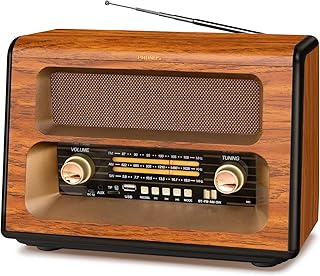
The PRUNUS J-199 is best for buyers attracted to a vintage-style radio that the product name identifies as having Bluetooth, AM, FM, and shortwave. Those named features make it a potentially versatile option for people who want broadcast radio alongside wireless audio playback. However, the supplied product information contains no detailed feature list beyond the name.
That limited information means buyers should verify important specifications directly in the listing before purchasing, including power source, controls, antenna details, and the exact Bluetooth functions. Do not assume that a feature is included simply because it is common on similar-looking radios.
- Best for: Shoppers who want a vintage-style unit and are interested in both broadcast bands and Bluetooth.
- Why it stands out: Its name identifies AM/FM and shortwave reception alongside Bluetooth.
- Limitation: Detailed specifications were not provided here, so its power options and reception features cannot be compared confidently with the other radios.
Choose this model only after confirming that its current listing covers your specific needs. For buyers who prioritize well-described power options or controls, the Panasonic and PRUNUS J03 have clearer supplied feature details.
Aiwa Exos Home Bluetooth CD System

The Aiwa Exos Home is best for home listeners who want a Bluetooth speaker and CD player with FM radio. Its listed name specifies a 30-watt Bluetooth speaker, CD player, and FM radio, making it a broader home audio product than a simple portable radio.
It is included as an adjacent option for buyers comparing radios with home entertainment systems, not as a direct long-distance AM/FM recommendation. The supplied name identifies FM reception but does not identify AM reception or battery operation.
- Best for: People seeking a home setup for CDs, Bluetooth audio, and FM stations.
- Why it stands out: It combines the listed speaker, CD, Bluetooth, and FM functions in one product.
- Limitation: The available product details do not list AM reception, so choose another model if AM listening is essential.
Avoid this option if you specifically need long-distance AM reception or a portable battery-powered radio. The product description provided is not sufficient to assess its radio reception performance.
Buying Guide: How to Choose a Long-Distance AM/FM Radio
What features matter most for distant stations?
There is no single feature that guarantees long-distance reception. Signal strength, station frequency, antenna design and position, terrain, buildings, and electrical interference all affect what a radio can receive. Look for product details that explicitly describe bands and antennas, but treat claims such as “long range” as descriptions rather than a promised distance. None of the supplied product details provides a measured reception range.
AM and FM behave differently. AM signals can travel farther under some conditions, particularly after dark, while local surroundings and interference can affect clarity. FM reception is more dependent on line of sight and can be limited by hills, buildings, and distance. A radio that receives both bands gives you more station choices, but does not ensure that every station will come in clearly.
Should you choose analog tuning or digital controls?
The radios described here use large analog dials or tuning scales. Analog controls are direct and easy to understand, especially for listeners who prefer physical knobs. A large frequency scale and visible pointer can help when tuning, as on the Panasonic RF-2400D and PRUNUS J03. Check whether you are comfortable tuning manually; the supplied descriptions do not list digital station presets.
Which power option suits your use?
For home listening, an AC connection can avoid relying on batteries. For camping, travel, or outages, battery operation adds flexibility. The Panasonic supports AC use and four AA batteries, while the PRUNUS J03 lists an AC cable or four AA batteries; its batteries are not included. DreamSky is described as battery-powered or wall-plug compatible, but the listed details do not specify its battery type.
Before buying, confirm whether the required power accessories are included and how the radio operates when the power is out. A radio that needs an outlet cannot provide backup listening during an outage unless it also supports batteries or another independent power source.
Do you need shortwave, headphones, or Bluetooth?
Shortwave is useful for listeners who want more than ordinary AM and FM broadcasts. The DreamSky lists AM, FM, and shortwave, while the PRUNUS J-199 name also identifies those bands. The J03 and Panasonic descriptions identify AM/FM. Headphone connections are explicitly listed for the DreamSky and Panasonic, which can help with private listening.
Bluetooth is a separate convenience from broadcast reception. The PRUNUS J-199 name includes Bluetooth, and the Aiwa name lists Bluetooth alongside a CD player and FM radio. Bluetooth does not improve the radio’s ability to receive distant AM or FM stations.
How can you improve reception after setup?
- Place the radio near a window or in a more open area, away from large obstructions where practical.
- Try different positions and orientations instead of assuming one location is best for every station.
- Move the radio away from potential sources of electrical noise when reception is weak.
- For FM, test reception at different locations because buildings and terrain can block signals.
- For AM, compare reception during daytime and nighttime; conditions can change.
These steps may help, but they cannot overcome every coverage limitation. If receiving a particular distant station is essential, confirm the radio’s supported bands and antenna information, and consider testing reception in the intended location.
Frequently Asked Questions
What is the best radio here for AM, FM, and shortwave?
The DreamSky is the clearest match based on the supplied details because it explicitly lists AM, FM, and shortwave. The PRUNUS J-199 name also identifies all three bands, but detailed specifications were not provided.
Which radio can use batteries and household power?
The Panasonic RF-2400D and PRUNUS J03 list both AC and battery operation. The Panasonic uses four AA batteries, and the J03 also uses four AA batteries; the J03 listing says batteries are not included.
Does a long-range radio guarantee reception of distant stations?
No. Reception depends on the broadcast signal, terrain, buildings, interference, antenna placement, and other conditions. The supplied descriptions do not provide a guaranteed or measured reception distance.
Which model is designed for private listening?
The DreamSky and Panasonic RF-2400D list an earphone or headphone jack. The Panasonic specifies a 3.5-millimeter connection.
Is the Aiwa Exos a good choice for long-distance AM radio?
The supplied product name lists FM radio, Bluetooth, and a CD player, but does not list AM reception. Choose an AM/FM radio instead if AM listening is required.
Are shortwave and FM the same thing?
No. Shortwave and FM are separate broadcast bands. A radio that receives shortwave may provide additional listening options, but shortwave capability does not guarantee stronger FM reception.