
The best wireless mic for guitar depends on whether you need to capture an acoustic instrument’s body sound or send an electric guitar’s output to an amplifier. The Tangxi is best for flexible clip-on placement, while the KENBAIDIO adds magnetic mounting and a receiver display. The EBJ uses suction cups, and the 2.4G guitar mic emphasizes extended battery life. For electric guitar and bass, the JOYO is a wireless instrument system rather than a microphone.
| Product | Best suited for | Key distinction |
|---|---|---|
| Tangxi 2.4G Instrument Microphone | Flexible clip-on placement | Rotating condenser microphone |
| KENBAIDIO UHF Instrument Microphone | Multiple instruments and mounting options | Magnetic attachment and receiver screen |
| 2.4G Cordless Guitar Microphone | Long practice or performance sessions | Advertised 12-hour battery life |
| EBJ KX-801-1 | Damage-conscious surface mounting | Detachable suction cups |
| JOYO JW-06 | Electric guitar and bass output | 5.8GHz transmitter-and-receiver system |
Tangxi 2.4G Wireless Instrument Microphone

The Tangxi is a clip-on wireless condenser microphone designed for guitar and several other instruments, including saxophone, violin, cello, and accordion. Its central advantage is an adjustable microphone position: the pickup rotates 360 degrees, letting players orient it toward a sound-producing area on the instrument.
The listed features describe a full-directional condenser pickup intended to capture instrument sound while reducing noise. Tangxi also cites high-strength tension wire and double-shielded construction as measures intended to support signal transfer and durability. These are listed design features, not a guarantee of performance in every environment.
- Best for: Guitarists who want an adjustable clip-on microphone and also play other supported instrument types.
- Why it was selected: Its rotating microphone position offers placement flexibility that can help when an instrument’s sound varies by pickup location.
- Limitation: The supplied product information does not specify battery life, operating range, or receiver connector details. Confirm these requirements before choosing it for a particular setup.
Choose this if adjustable positioning matters more than having published details about runtime or range. It is a microphone-based pickup, so it is a different approach from a wireless system that sends an electric guitar’s output directly to an amplifier.
KENBAIDIO UHF Wireless Instrument Microphone

The KENBAIDIO U-750 is a UHF wireless instrument microphone system with a sensitive cardioid condenser pickup. The product description says the pickup is designed to reproduce instrument sound clearly while reducing environmental noise. Guitar, accordion, violin, cello, banjo, and piano are among the listed uses.
Its magnetic clip can attach to an instrument, and the package description also mentions detachable magnetic attachments and stickers for securing the system to a suitable smooth surface. The receiver has a digital screen that displays frequency, battery power, and volume. The receiver plug is 1/4 inch, and a 1/8-inch adapter is included for devices that accept that connection.
- Best for: Musicians who want one microphone system for several instruments and value visible receiver information.
- Why it was selected: Its magnetic and stick-on mounting options, cardioid pickup, and screen distinguish it from simpler clip-on choices.
- Limitation: The listed instructions say transmitter sensitivity or volume may need adjustment for optimal results. Check connector and mounting needs before use.
Choose this if a magnetic attachment and display are useful in your setup. The microphone’s cardioid pattern is a more directional pickup description than an omnidirectional design, which may matter when considering nearby sound sources.
2.4G Cordless Guitar Microphone
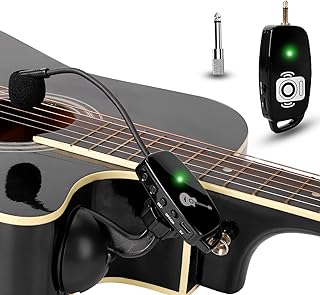
This 2.4G wireless instrument microphone is presented for acoustic and electric guitar, with an omnidirectional condenser mic and a listed open-area range of up to 160 feet. The description also identifies wind instruments as a use. The stated range is a seller-provided maximum; obstacles and the performance space can affect actual wireless distance.
The unit has a 400mAh rechargeable battery, with up to 12 hours of use listed and an estimated active-use range of 8 to 12 hours. A dual-head USB cable is included, and the seller describes a charging time of about two hours. Its 1/4-inch plug and included 1/4-inch-to-1/8-inch adapter are intended for compatible audio inputs.
- Best for: Players who prioritize a long advertised runtime for rehearsals, performances, or practice.
- Why it was selected: Its stated battery duration, 2.4G transmission, and included adapter make it a feature-rich option to compare with other microphone systems.
- Limitation: The product description explicitly says it does not support MacBook, laptop, PC, or mobile devices. Do not assume the adapter makes it suitable for direct computer or phone use.
Choose this if your intended destination is a compatible amplifier, PA, or other supported audio input. Avoid it if direct computer or mobile-device connection is essential, because the listing specifically excludes those uses.
EBJ KX-801-1 Suction-Cup Microphone

The EBJ KX-801-1 is a 2.4G wireless instrument microphone with a detachable suction-cup mounting design. The seller lists guitar, violin, cello, and accordion as example instruments. Two suction cups of different sizes are included, and the description says they attach to smooth surfaces without damaging the instrument’s paint.
The system is described as providing a stable signal within 30 meters, or about 100 feet, and a battery life of six to eight hours. To use it, attach the transmitter to a smooth surface, insert the receiver into the speaker’s microphone input, and turn on the system. The seller says the connection is intended to work without worrying about unwanted vibrations from the attachment.
- Best for: Guitarists who prefer a surface-mounted microphone and want an attachment intended to avoid paint damage.
- Why it was selected: The two suction-cup sizes offer a distinct mounting approach, while the listed range and runtime give buyers concrete points to compare.
- Limitation: Suction cups require a smooth surface. This mounting method may not suit a guitar finish or body shape where the cups cannot hold securely.
Choose this if the instrument has an appropriate smooth mounting area. Check the fit and adhesion before performing, especially if the guitar surface is curved, textured, or otherwise unsuitable for suction cups.
JOYO JW-06 Wireless Guitar System

The JOYO JW-06 is not a microphone pickup. It is a 5.8GHz wireless transmitter-and-receiver system for electric guitar and bass, intended to carry the instrument’s output to compatible equipment. It is included because many shoppers searching for a wireless guitar mic may actually need a cable-free connection for an electric instrument.
JOYO lists 48kHz/24-bit audio, latency under 6 milliseconds, and four channels. The system provides up to six hours of use per charge, with a charging case offering two additional full recharges for up to 18 hours total. The advertised transmission distance is 65 to 100 feet in open areas; with walls or other obstructions, the listing recommends a shorter distance of approximately 30 to 50 feet.
- Best for: Electric guitar and bass players who want a wireless connection to their instrument input, rather than a microphone for acoustic sound.
- Why it was selected: It directly addresses the cable-free needs of electric players and includes a charging case, multiple channels, and stated latency and range details.
- Limitation: It does not function as a microphone for capturing an acoustic guitar’s body sound. Obstacles can also shorten its usable range.
Choose this if your electric guitar or bass has an output connection and you want to send that signal wirelessly. For acoustic microphone capture, compare the clip-on or surface-mounted microphone systems instead.
Buying Guide: How To Choose A Wireless Mic For Guitar
Start by identifying the sound source you need to transmit. A microphone captures sound from the guitar’s body or strings through a mic element. A guitar wireless system such as the JOYO sends an electric instrument’s output from its transmitter to a receiver. These devices serve different purposes, so they should not be treated as interchangeable.
Do you need a microphone or an instrument transmitter?
Choose a microphone system for acoustic guitar sound or for an instrument without an appropriate electrical output. Clip-on, magnetic, and suction-cup designs position a microphone on the instrument. Choose an instrument transmitter-and-receiver system when you want a cable-free connection from an electric guitar or bass to compatible equipment.
Some players may use more than one type of system for different instruments or settings. Before buying, make sure the selected product’s intended role matches the signal path you need.
How should the microphone attach to your guitar?
Mounting affects placement and ease of use. The Tangxi has a 360-degree adjustable clip-on microphone. The KENBAIDIO offers a magnetic clip and detachable magnetic attachments, with stickers also described for smooth surfaces. The EBJ uses suction cups, which depend on a suitable smooth area.
Consider the guitar’s finish, shape, and available attachment area. A mount that is easy to position on one instrument may not fit another. Check that it stays secure and does not interfere with playing before relying on it in a performance.
Which pickup pattern suits your environment?
Microphone pickup patterns describe how the mic responds to sound from different directions. The Tangxi is described as full directional, and the 2.4G guitar microphone is described as omnidirectional. The KENBAIDIO lists a cardioid pickup. Compare these specifications with your stage or rehearsal environment, including nearby instruments, speakers, and room noise.
The product descriptions do not provide matching independent measurements for noise rejection or sound quality. Treat terms such as “clear,” “HiFi,” and “noise reduction” as seller descriptions rather than guaranteed results. If possible, evaluate the microphone in the room and with the amplifier or PA you plan to use.
What wireless range and battery life do you need?
For the listed products, advertised range varies: the EBJ specifies 30 meters, the guitar-focused 2.4G mic lists up to 160 feet in open areas, and the JOYO lists 65 to 100 feet in open areas. These figures come from product descriptions and may not translate to the same distance in a crowded room or venue. Walls and other obstructions are specifically noted as a concern for the JOYO.
Runtime also differs. The EBJ lists six to eight hours, the 2.4G guitar microphone lists up to 12 hours with eight to 12 hours under active use, and the JOYO lists up to 18 hours including case recharges. The Tangxi and KENBAIDIO details provided here do not specify runtime. Compare the stated figures with your session length and charging access.
Will the receiver connect to your amplifier or recording setup?
Check the receiver’s plug and the input on your destination device before ordering. The KENBAIDIO lists a 1/4-inch receiver plug and an included 1/8-inch adapter. The 2.4G guitar microphone also lists a 1/4-inch plug and a 1/4-inch-to-1/8-inch adapter, but its seller says it does not support computers or mobile devices. Connector size alone does not establish device compatibility.
For any wireless microphone, confirm whether your amplifier, PA, mixer, or recording equipment has the input the receiver requires. The supplied information does not give complete connector details for every listed product, so verify the product listing if your setup depends on a particular input.
Does 2.4G, UHF, or 5.8GHz matter?
The products use different wireless bands: 2.4G for Tangxi and EBJ, UHF for KENBAIDIO, and 5.8GHz for JOYO. The band alone does not guarantee better sound or fewer dropouts. Nearby devices, room layout, obstacles, and other wireless equipment can affect performance.
The JOYO description says users can switch channels to reduce noise or dropouts from nearby electronic interference. For any system, test it in the actual space before a performance. If you use several wireless devices, consider their operating bands and channel options together.
Frequently Asked Questions
Can I use a wireless guitar microphone with an acoustic guitar?
Yes, a wireless instrument microphone designed for guitar can capture acoustic guitar sound. The Tangxi, KENBAIDIO, 2.4G cordless guitar microphone, and EBJ list guitar among their intended uses. Check mounting style and receiver connection before choosing one.
Is the JOYO JW-06 a wireless microphone?
No. The JOYO JW-06 is a wireless transmitter-and-receiver system for electric guitar and bass. It sends an instrument’s output wirelessly and is not a microphone for capturing an acoustic guitar’s body sound.
Which option has the longest stated battery life?
The 2.4G cordless guitar microphone lists up to 12 hours of use. The JOYO lists up to 18 hours total when including two recharges from its charging case, while the EBJ lists six to eight hours. These are seller-provided specifications, and actual runtime can vary.
Can I connect these systems directly to a phone or computer?
Do not assume so. The 2.4G cordless guitar microphone specifically says it does not support MacBook, laptop, PC, or mobile devices. For other products, the supplied information does not establish direct phone or computer compatibility. Check the receiver output and device input requirements before purchase.
Which wireless microphone mount is least likely to mark a guitar?
The EBJ description says its suction cups attach without damaging paint, while the KENBAIDIO listing describes detachable magnetic attachments and stickers. Suitability depends on the instrument’s surface and shape. Confirm that the mount holds securely without contacting an unsuitable finish.