
The right 5.1 RCA-to-3.5mm adapter depends on the signal you need to convert. For a passive analog connection, the SPRODIO adapter is the closest match in this list; for digital optical or coaxial audio, choose a PROZOR DAC, which converts supported 5.1 formats to stereo analog. The VPFET is for extracting audio from HDMI. Check your source’s output type before choosing: these products do not all convert the same signals, and the digital converters provide stereo rather than discrete 5.1 analog output.
| Product | Best For | Signal Type |
|---|---|---|
| SPRODIO M5 | Passive analog connections | Stereo RCA and 3.5mm |
| PROZOR Optical/Coaxial DAC | Digital audio to stereo analog | Optical or coaxial to RCA/3.5mm |
| PROZOR DAC With Volume Knob | Digital audio with output adjustment | Optical or coaxial to RCA/3.5mm |
| 3.5mm-to-RCA 5-Pack | Connecting stereo 3.5mm output to RCA input | 3.5mm to RCA |
| VPFET HDMI Audio Extractor | Extracting audio from HDMI | HDMI to optical or 3.5mm |
SPRODIO M5 Passive Audio Adapter

The SPRODIO M5 is the closest match for someone searching for a direct, passive RCA-to-3.5mm adapter. Its listed function converts stereo RCA analog audio to three 3.5mm AUX stereo plugs. The manufacturer also describes reversible use, allowing three 3.5mm input sources to connect toward a speaker.
Best for: Buyers connecting analog stereo equipment to a compatible multimedia speaker arrangement, or routing several 3.5mm sources through the adapter’s supported configuration. It was selected because it is the only listed product that directly describes stereo RCA and multiple 3.5mm connections without requiring digital conversion or HDMI.
- Supports stereo RCA to three 3.5mm connections.
- Listed as bidirectional, with a 3-input-to-1-output use case.
- Described as compatible with 5.1 multimedia speaker systems.
Limitation: The listing describes stereo analog conversion and multiple plugs; it does not establish that this adapter creates separate, discrete 5.1 channels from a stereo RCA source. Confirm the exact input and output arrangement required by your equipment before buying.
PROZOR Optical And Coaxial DAC

This PROZOR converter is for a digital source with optical or coaxial output, not a device that already outputs analog RCA. It converts supported digital audio to left/right RCA or 3.5mm analog output. The listing names Dolby AC-3, DTS, LPCM, and PCM formats, and specifies that 5.1 input is converted to 2.0-channel analog output.
Best for: A buyer whose TV, disc player, or other listed-source type sends audio over optical or coaxial and needs a stereo analog connection for speakers or headphones. It was selected because it explicitly identifies digital inputs, both common analog output styles, and stereo downconversion from supported 5.1 input.
- Optical and coaxial digital inputs.
- Left/right RCA and 3.5mm analog outputs.
- Supports up to 192 kHz sampling, according to the listing.
Limitation: It does not provide six separate analog outputs for a discrete 5.1 speaker system. The listed conversion produces two-channel analog audio, so choose another solution if you need discrete surround channels.
PROZOR DAC With Volume Knob

This PROZOR model converts optical, SPDIF, or coaxial digital signals to stereo RCA and 3.5mm analog outputs. It lists support for Dolby AC-3, DTS 5.1, and PCM 2.0 input formats, with the output described as two-channel analog. A front-panel-style adjustment knob controls the output level for both RCA and 3.5mm connections together.
Best for: Buyers who need digital-to-analog conversion and want a physical control for adjusting the connected output. It is a better fit than a simple passive cable when the source sends digital audio and the receiving device requires analog stereo.
- Converts supported optical or coaxial digital input to RCA and 3.5mm stereo output.
- Lists 192 kHz/24-bit decoding support.
- Volume knob adjusts both output types simultaneously.
Limitation: The knob does not adjust RCA and 3.5mm output independently. The unit is one-way, and it does not convert stereo analog RCA into digital audio or discrete 5.1 analog channels.
3.5mm-To-RCA Stereo Adapter Pack

This five-pack takes a different direction from the main search phrase: each adapter has a 3.5mm stereo male plug and two RCA female connectors. It is intended to connect a stereo 3.5mm output, such as one on a phone or MP3 player, to equipment with RCA inputs. The listing specifies a three-pole TRS plug and gold-plated connectors.
Best for: Buyers who need to send stereo audio from a 3.5mm headphone-style output into an amplifier, receiver, or speaker with left/right RCA inputs. It was included as a useful reverse-direction option for people comparing RCA and 3.5mm adapters.
- Five adapters in the pack.
- 3.5mm TRS male connector to two RCA female jacks.
- Designed for stereo audio connections.
Limitation: It does not convert RCA output to 3.5mm, digitize audio, or carry discrete 5.1 surround sound. Check whether your source has a 3.5mm output and your destination has RCA inputs.
VPFET HDMI Audio Extractor
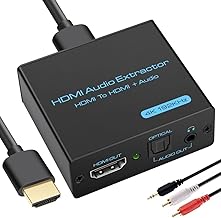
The VPFET is an HDMI audio extractor, rather than a direct RCA-to-3.5mm adapter. It separates audio from an HDMI signal and sends it through optical or 3.5mm output. Its selectable modes are 2.0-channel, 5.1-channel, and pass-through. The listing specifies that 3.5mm output uses 2.0-channel mode, while optical output can support DTS 5.1.
Best for: Buyers whose audio source connects by HDMI and who need a separate analog 3.5mm or optical audio output. It was selected because HDMI sources require a different type of converter from analog RCA connections.
- Extracts audio from HDMI and offers optical or 3.5mm output.
- Provides 2.0, 5.1, and pass-through mode options.
- Supports HDMI 1.4 and listed 4K at 30 Hz video specifications.
Limitation: The listing says the 3.5mm output supports PCM 2.0, not discrete 5.1. It also notes that the device does not support ARC/eARC, that a TV is not supported as the input source, and that certain devices are limited to 1080p with this extractor.
Buying Guide: How To Choose The Right Adapter
What kind of output does your source have?
Start by checking the audio output on the device sending sound. A red-and-white RCA pair carries analog stereo. A 3.5mm headphone-style jack usually carries analog stereo. Optical and coaxial connectors carry digital audio, while HDMI carries combined audio and video. A passive adapter cannot turn a digital signal into analog; that job requires a DAC or an audio extractor designed for the source connection.
Match the converter’s input to the source’s actual output, then match its output to the receiving device. For example, a source with optical audio and a receiver with RCA inputs needs a digital-to-analog converter with optical input and RCA output. A source with 3.5mm output and a receiver with RCA inputs needs a 3.5mm-to-RCA cable or adapter.
Do you need stereo or true discrete 5.1?
The phrase “5.1” can refer to a supported input format, a speaker system, or six separate output channels. These are not interchangeable. The two PROZOR converters list support for 5.1 digital input but convert it to two-channel analog output. The VPFET can pass 5.1 through optical in the listed mode, while its 3.5mm output is specified for PCM stereo.
If you need six discrete analog outputs for a 5.1 speaker system, verify that the product explicitly provides separate front, surround, center, and subwoofer outputs. None of the products in this selection is described as providing six discrete analog output channels.
When is a passive adapter enough?
A passive adapter is appropriate when both devices use compatible analog audio and you only need to change the connector arrangement. It does not decode Dolby or DTS, convert optical audio, or create additional surround channels. The SPRODIO is the closest analog RCA-to-3.5mm option here, but its three-plug arrangement makes it important to confirm the intended connection pattern before ordering.
The five-pack adapter works in the opposite direction: it accepts a 3.5mm stereo male connection and presents two RCA female jacks. It may suit a phone or other analog stereo source connected to RCA inputs, but it is not the correct choice if your source outputs RCA and your destination accepts 3.5mm.
When should you choose a DAC?
Choose a digital-to-analog converter when your source has an optical or coaxial digital output and your destination accepts analog RCA or 3.5mm input. Compare supported audio formats and output channels. Both PROZOR models list supported Dolby or DTS 5.1 input formats and stereo analog output. The model with a knob may be useful when you want to adjust both analog outputs from the converter, but its level control is shared.
What should you check for HDMI audio extraction?
For an HDMI source, confirm that the extractor supports the source’s video resolution, audio format, and required output. The VPFET lists HDMI 1.4, HDCP 1.4, and 4K at 30 Hz, but its product details include limitations for certain devices and formats. Review the product’s mode instructions: its 3.5mm output is associated with 2.0-channel mode, and optical is the listed route for DTS 5.1.
Also check the direction of the signal. An extractor takes HDMI from a source and sends audio onward to an audio device. It is not a general-purpose converter for sending analog RCA into an HDMI connection.
How can you avoid a connection mismatch?
- Write down the source’s audio output and the destination’s audio input before shopping.
- Identify whether the connection is analog RCA, analog 3.5mm, optical, coaxial, or HDMI.
- Check the signal direction; adapters that look similar may work in opposite directions.
- Confirm whether you need stereo output or separate 5.1 channels.
- For digital devices, check which audio formats and output modes the converter lists.
Frequently Asked Questions
Can a 3.5mm adapter convert RCA audio to 5.1 surround?
Not by itself. A basic analog adapter changes connectors but does not create discrete surround channels. The products listed here either handle stereo analog connections or convert supported digital 5.1 input to stereo analog output.
Which product is closest to an RCA-to-3.5mm adapter?
The SPRODIO M5 is the closest match because its listing describes stereo RCA input and three 3.5mm AUX plugs. Confirm the intended plug arrangement with your equipment, since it is not described as a six-channel analog decoder.
Can I connect optical audio directly to RCA?
No. Optical audio is digital, while RCA analog inputs require an analog signal. Use a DAC that accepts optical input and provides RCA output, such as one of the listed PROZOR converters.
Do the PROZOR converters output true 5.1 through RCA?
No. Their listed analog outputs are left/right stereo RCA and 3.5mm. They support specified 5.1 digital input formats but convert those signals to two-channel analog output.
Which adapter should I use for a phone with a 3.5mm output?
If the receiving device has RCA inputs, the five-pack 3.5mm-to-RCA adapter is the directionally appropriate option. If the destination instead has a 3.5mm input, select an adapter with the matching RCA-to-3.5mm direction.