
The best FM radio interference filter depends on what is causing the problem: a dedicated FM bandstop filter is designed to reduce strong 88–108 MHz broadcast signals reaching a receiver, while a ferrite clip can help address high-frequency interference traveling along a cable. The NooElec Flamingo+ FM is best suited to high-signal urban locations; the RTL-SDR Blog filter is a straightforward option for blocking the FM band; and the VSKEY ferrite clip is better for cable-borne noise. Compare the frequency range, connectors, and possible effects on nearby bands before choosing.
| Product | Best for | Key distinction |
|---|---|---|
| NooElec Flamingo+ FM | Strong local FM transmitters | More than 60 dB typical average attenuation |
| RTL-SDR Blog FM Block Filter | Blocking broadcast FM in an SDR setup | Over 50 dB attenuation across 88–108 MHz |
| NooElec Distill:FM Barebones | SDR users needing bias power passed | Bandstop design passes DC |
| NooElec Flamingo FM | Moderate FM overload and adjacent-band use | Approximately 40 dB attenuation |
| VSKEY 7 mm Ferrite Clip | High-frequency noise on larger cables | Clip-on, reusable cable choke |
NooElec Flamingo+ FM Bandstop Filter

Best for: SDR listeners in urban areas or other locations near high-power FM transmitters. This filter is designed to attenuate broadcast FM from 88 to 108 MHz, where strong stations may overload a sensitive radio or SDR.
The listed performance is greater than 60 dB typical average attenuation and greater than 70 dB typical maximum attenuation. NooElec also specifies average insertion loss below 0.25 dB outside the stop band. That low stated loss is relevant when the filter remains in the signal path for frequencies outside the FM broadcast band.
Why it stands out: Compared with the listed Flamingo FM version, the Flamingo+ is the stronger choice when FM signals are particularly intense. Its stated average attenuation in the adjacent 108–137 MHz VHF airband is 8 dB, so it has less effect there than the similar filters described in the product details.
Limitation: The product details say the original Flamingo FM is a better option for locations without strong local FM signals. The Flamingo+ can also affect adjacent airband reception, so it may not suit listeners who need to preserve the full strength of that band.
RTL-SDR Blog FM Block Filter

Best for: SDR users looking for a dedicated filter that blocks the broadcast FM band. The stated stop band is 88–108 MHz, with more than 50 dB of attenuation. This makes it a comparison-friendly option when the main goal is reducing strong FM signals before they reach a receiver.
The filter has SMA female connectors and includes a free SMA male-to-male adapter. Its listed insertion loss is less than 0.5 dB from 0 to 1 GHz and mostly less than 1.5 dB from 1 to 3 GHz. These figures help explain how the filter may affect signals outside the FM band, although actual results depend on the whole receiving setup.
Why it was selected: The specified FM-blocking range and attenuation make this a direct-purpose choice rather than a general cable-noise accessory. It is better suited to a user who wants a clearly defined FM notch and whose receiver connections match the SMA arrangement.
Limitation: The filter attenuates the entire 88–108 MHz broadcast band. Avoid it if receiving stations within that range is the goal. Check connector requirements before ordering, particularly if the antenna or receiver uses a different connector type.
NooElec Distill:FM Barebones Filter

Best for: SDR users who want a broadcast-FM bandstop filter that passes DC, such as when bias-T power needs to continue through the signal path. The product details specifically describe the filter as a bandstop design that passes DC, a useful distinction to check when selecting an RF filter for a powered setup.
Distill:FM is designed to attenuate broadcast FM while minimizing effects on adjacent bands and keeping insertion loss tiny, according to the product description. Its circuitry is fully shielded with an EMI frame, and its front end has an RF application ESD diode. The listed use is with SDR applications, including RTL-SDR devices that can be overloaded by strong broadcast FM.
Why it was selected: This model is a useful alternative when the DC-pass feature matters. Choose it if you need FM rejection but want to retain the ability to pass bias-T power through the filter. Its shielding and ESD protection are additional design features stated by the manufacturer.
Limitation: The supplied product details do not provide a specific attenuation figure or connector specifications. Confirm the exact model’s connections and performance details before buying if those are essential to your installation.
NooElec Flamingo FM Notch Filter

Best for: SDR users who want a dedicated FM notch and do not need the stronger attenuation specified for the Flamingo+ version. The product description gives approximately 40 dB attenuation for broadcast FM, with filter rolloff points at 80 MHz and 115 MHz.
The listed design aims to minimize effects on adjacent bands. The description notes that the VHF airband from 108 to 137 MHz is minimally affected, while also stating that the filter has very low out-of-band insertion loss. The enclosure is EMI-shielded and made from black anodized aluminum. An RF-rated ESD diode is included at the front end, and a male-to-male SMA barrel connector is supplied.
Why it was selected: This is the better comparison point for locations where the strongest available FM rejection may not be necessary. Its stated attenuation is lower than the Flamingo+ specification, making the two models easier to distinguish by signal environment and required filtering strength.
Limitation: The approximately 40 dB attenuation may be insufficient where nearby FM transmitters are especially strong. Consider the Flamingo+ instead if the stated higher attenuation is more appropriate for the location.
VSKEY 7 mm Clip-On Ferrite Filter
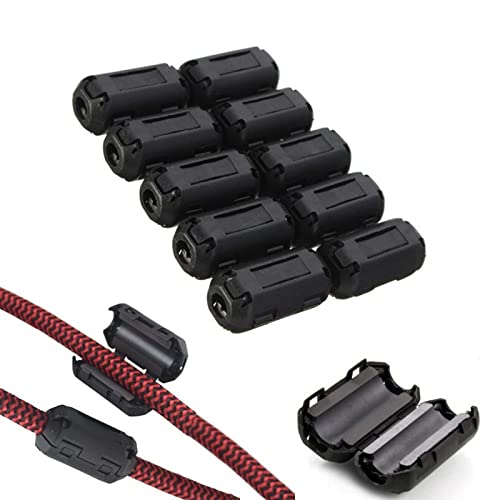
Best for: Troubleshooting high-frequency interference carried along a cable, rather than blocking FM broadcast frequencies at the antenna input. This pack contains 10 clip-on ferrite cores with a 7 mm inner diameter. The listed cable fit is approximately 5–7 mm outside diameter.
The product details describe use on audio and video cords, power lines, HDMI, VGA, AV, DVI, coaxial audio, speaker, and other cables. The cores snap around a cable and can be removed and reused. The description suggests wrapping additional cable turns through a core if the cable is loose or more interference reduction is desired.
Why it was selected: It offers a different approach for listeners whose noise source may be entering through cabling or nearby electronics. Choose it if the cable fits the core and you are investigating high-frequency EMI or RFI. It is not a substitute for a filter designed to reject the 88–108 MHz broadcast band.
Limitation: The 7 mm opening is intended for relatively thick cables. It may not fit a thin receiver lead, and the product details do not specify attenuation across the FM broadcast band.
Buying Guide: How to Choose an FM Interference Filter
Is the interference coming from strong FM stations?
If strong local broadcast stations are overloading an SDR or receiver, start with a dedicated FM bandstop filter. These devices target the 88–108 MHz broadcast band before the signal reaches the radio. A ferrite clip is intended to suppress certain types of cable-borne high-frequency noise and does not provide the same defined FM notch.
Symptoms alone do not always identify the cause. Check whether the problem changes when the antenna, cable routing, or radio location changes. If possible, compare reception with and without a filter. A filter can only help with interference that falls within its intended role and frequency range.
How much FM attenuation do you need?
Compare the specified attenuation rather than treating all FM filters as equivalent. The Flamingo+ listing gives greater than 60 dB typical average attenuation, while the original Flamingo FM lists approximately 40 dB. The RTL-SDR Blog filter specifies more than 50 dB. These are product specifications, not a guarantee of identical results in every receiver installation.
Stronger rejection may be useful near high-wattage transmitters, but a strong notch can be an unnecessary trade-off when FM signals are not causing trouble. The Flamingo+ product details specifically recommend the original Flamingo FM for other locations.
Will the filter affect nearby frequencies?
Every filter has a frequency response, so consider the stations or services you want to keep receiving. A filter that blocks FM can also reduce signals near the stop-band edges. This matters especially if your listening includes frequencies adjacent to 88–108 MHz. The Flamingo+ lists an average 8 dB attenuation in the 108–137 MHz VHF airband; the original Flamingo FM describes that airband as minimally affected.
Review the stated insertion loss outside the stop band as well as attenuation inside it. A low insertion-loss figure indicates less stated signal reduction outside the intended notch, but the overall result still depends on cables, connectors, antenna, and receiver.
Do connectors and power pass-through matter?
Confirm that the filter’s connectors match the antenna and receiver, or identify which adapters are needed. The RTL-SDR Blog model lists SMA female connectors and includes an SMA male-to-male adapter. The original Flamingo FM listing also includes a male-to-male SMA barrel connector. Do not assume that every product uses the same connector configuration.
If your setup sends bias-T power through the RF line, check whether the filter passes DC. The Distill:FM listing explicitly says its bandstop design passes DC. The provided details for the other filters do not establish that feature, so verify it before placing one in a powered signal path.
Should you choose a ferrite clip or a bandstop filter?
Choose a bandstop filter when the target is a known radio-frequency range, such as FM broadcast signals reaching an SDR front end. Choose a ferrite clip when investigating high-frequency noise on a cable, provided the cable diameter matches the core. They address different interference paths and should not be compared by FM attenuation figures.
Ferrite cores are also easy to reposition, which can help during cable-noise troubleshooting. A dedicated RF filter is more appropriate when you need a defined stop band and documented attenuation. If the ferrite does not change the problem, the interference may not be traveling along that cable or may require another remedy.
What should you verify before purchasing?
- Target range: Confirm that the filter covers the frequencies causing the problem.
- Attenuation: Compare the listed FM rejection when strong broadcast signals are the concern.
- Adjacent-band use: Check whether nearby services could be affected.
- Insertion loss: Review stated out-of-band loss if you plan to leave the filter connected.
- Connectors: Match the filter to the antenna and receiver or account for adapters.
- DC pass-through: Verify this requirement if the RF line carries bias-T power.
- Cable diameter: For ferrite clips, measure the cable and compare it with the core opening.
Frequently Asked Questions
What does an FM radio interference filter do?
A dedicated FM bandstop filter attenuates signals in the broadcast FM range, generally 88–108 MHz, before they reach a receiver. It can help reduce overload from strong FM stations but will also suppress desired broadcasts in that same range.
Can an FM notch filter improve SDR reception?
It can help when strong FM signals are overloading an SDR or creating reception problems. The result depends on the interference source, filter response, receiver, antenna, and installation. It will not correct every type of radio noise.
Does a ferrite clip block FM radio stations?
A ferrite clip is not a dedicated 88–108 MHz bandstop filter. It is intended to reduce certain high-frequency interference traveling along a cable. Use a specified FM bandstop filter when the goal is to attenuate broadcast FM signals entering the receiver.
Will an FM filter reduce VHF airband reception?
It may affect nearby frequencies, depending on the filter’s response. The Flamingo+ listing specifies average attenuation in the 108–137 MHz airband, while the original Flamingo FM describes the airband as minimally affected. Check the product’s stated response if airband monitoring matters.
Can I leave an FM filter connected all the time?
That depends on its out-of-band insertion loss, the frequencies you use, connector fit, and whether the signal path needs DC power. Review those specifications first. The Distill:FM listing explicitly states that it passes DC; the supplied details do not confirm that feature for every listed filter.
How do I know whether I need a stronger filter?
Compare the filter specifications and test whether FM overload is the issue. The Flamingo+ lists stronger attenuation than the original Flamingo FM, and its description recommends it for locations with high-wattage FM transmitters nearby. Stronger attenuation is not automatically better if it reduces frequencies you need.