
The best keyboard with synth sounds depends on whether you need built-in sounds, software control, or a beginner-friendly instrument. The Arturia AstroLab Stage Keyboard and Roland JUNO-D6 are the clearest choices for playing sounds directly from the instrument. The Akai MPK Mini MK3 is better for making music with computer software, while the Kartier and Vangoa keyboards emphasize app-based sounds or beginner learning features.
| Product | Best For | Sound Approach |
|---|---|---|
| Arturia AstroLab Stage Keyboard | Live players seeking built-in synth variety | 44 instruments and over 1,800 presets |
| Roland JUNO-D6 | Players wanting a broad onboard sound library | ZEN-Core engine and over 3,800 sounds |
| Akai Professional MPK Mini MK3 | Beat makers using a computer | MIDI controller for software instruments |
| Kartier Piano MIDI Keyboard | App-connected players seeking many presets | 1,000+ sounds through its app offering |
| Vangoa VGK6101 | Beginners who value learning features | Electronic keyboard with light-up keys and teaching modes |
Arturia AstroLab Stage Keyboard
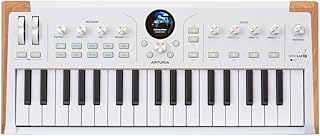
Best for: Live performers and keyboard players who want a dedicated instrument with a large selection of synth and other sounds. The AstroLab has a 37-key format, built-in virtual synthesis, 44 instruments, and more than 1,800 presets. Its product description also highlights iconic synths and modern textures.
The key advantage is that the listed sound engine and presets are built into the keyboard. The product is described as DAW-free for live use, so it suits players who want to perform without making a computer-based music production setup the center of their workflow. It is the better fit than a MIDI controller when independent onboard sound generation is a priority.
Limitation: Its 37-key range is shorter than the 61-note Roland and Vangoa options. Choose another model if a wider keyboard range is more important than the AstroLab’s stated synth library.
Roland JUNO-D6 Synthesizer

Best for: Players who want a full-size, 61-note synthesizer with a broad collection of onboard sounds. Its listed ZEN-Core engine provides access to over 3,800 onboard sounds, a larger stated sound count than the other products in this selection.
The JUNO-D6 is a strong option for keyboardists who need variety across a performance or want one instrument for exploring multiple sound types. The product description also lists creative tools and a USB-C audio/MIDI interface for mobile devices and computers. Those connections can be useful in a hybrid setup, while the onboard sound engine remains the main reason to choose it as a keyboard with synth sounds.
Limitation: The product listing names its sound engine and sound count but does not detail the exact sounds included. Check the current product information if a particular instrument or preset is essential to your setup.
Akai Professional MPK Mini MK3

Best for: Beat makers and home-studio producers who plan to use software instruments. This 25-key USB MIDI controller has velocity-sensitive mini keys, eight MPC pads, eight knobs, and an included software suite. These controls support a compact computer-based workflow for playing and shaping virtual synth sounds.
Unlike the AstroLab and JUNO-D6, the MPK Mini MK3 is a controller, not a listed standalone synthesizer. It sends MIDI performance information to compatible software; the software instrument supplies the sound. Choose this model if portability and hands-on control for production matter more than built-in presets. The pads and knobs also give producers controls beyond the keys.
Limitation: It has only 25 mini keys and depends on a separate sound source for synth audio. Avoid it if you need a keyboard that produces its own sounds without a computer or software instrument.
Kartier Piano MIDI Keyboard

Best for: Buyers looking for a keyboard-and-app approach to exploring a large set of sounds. The product listing advertises more than 1,000 famous sounds or presets, LED light-up keys, Bluetooth and wired connections, and an app for iOS, Android, and desktop.
Its stated app support and connection choices make it a different kind of option from a stage synthesizer with an explicitly described onboard sound engine. It may suit learners or casual players who want to explore presets through a connected device. The light-up keys are also a notable feature for buyers who prefer visual guidance while practicing.
Limitation: The listing does not clarify whether the 1,000+ sounds are stored in the keyboard itself or accessed through the app. Confirm how the sound library works and whether a connected device is needed before choosing it for standalone performance.
Vangoa VGK6101 61-Key Keyboard

Best for: Beginners who want a 61-key keyboard with visual learning support. The listing specifies full-size keys, light-up keys, and three teaching modes. It also mentions a stand and headphones, making it a beginner-oriented package according to the product name.
This model is less directly targeted at synth-sound buyers than the AstroLab or JUNO-D6 because its listed features focus on learning and keyboard practice rather than a named synthesis engine or synth preset library. It may be a better starting point if guided learning and full-size keys matter more than a clearly documented selection of synth tones.
Limitation: The supplied product details do not identify specific synth sounds or describe the sound library. Choose it for its stated beginner features, not on the assumption that it offers a particular synth collection.
Buying Guide: How to Choose a Keyboard With Synth Sounds
Do you need built-in sounds or a MIDI controller?
First decide where the sound will come from. A synthesizer with onboard sounds can produce audio from its own sound engine. In this selection, the AstroLab is described as having built-in virtual synthesis, and the JUNO-D6 lists its ZEN-Core engine and onboard sounds. A MIDI controller, by contrast, sends performance data to another device or software instrument.
The Akai MPK Mini MK3 is explicitly a USB MIDI keyboard controller, so plan on using software or another sound source for its synth tones. The Kartier listing advertises a large preset collection and app support, but does not say clearly whether the sounds are generated inside the keyboard or through the app. Verify that detail if standalone sound is essential.
How many keys do you need?
Key count affects playing range and portability. The Akai’s 25 mini keys make it a compact choice for beat-making and computer-based production, but the short range may be limiting for two-handed parts. The AstroLab has 37 keys, offering a middle ground in the listed options. The Roland and Vangoa each specify 61 keys, which provide more room for playing across registers.
Also consider key size and feel. Only the Akai description specifies mini keys and velocity sensitivity. The Vangoa listing specifies full-size keys. The provided details do not identify key action or touch response for every model, so consult the full specifications if those characteristics are important to your playing.
Which option suits live performance?
For a setup that does not rely on a DAW, the AstroLab is the most directly described fit: its product name highlights built-in virtual synthesis and DAW-free live use. The Roland JUNO-D6 is also a synthesizer with thousands of onboard sounds, making it relevant for players prioritizing a broad sound library and 61-note range.
A controller such as the Akai can work in a computer-based performance setup, but it is not the same as a standalone sound-generating keyboard. Consider the need for a computer, software, and a reliable connection when deciding whether a controller-based arrangement suits your stage workflow.
Are sound count and sound type equally important?
A large preset count can signal variety, but it does not explain which sounds are included or how they are organized. The Roland lists over 3,800 onboard sounds, while the AstroLab lists 44 instruments and over 1,800 presets. The Kartier advertises more than 1,000 sounds or presets, but the listing does not specify where those sounds run.
Look for the sound categories you actually need, such as synth textures or other keyboard tones, and confirm the details in the current product listing. A high preset count alone does not establish that a keyboard includes a particular sound or editing feature.
Will you use a computer or mobile device?
For home production, software instruments can provide synth sounds through a MIDI controller. The Akai includes a software suite, while the Roland listing specifies a USB-C audio/MIDI interface for mobile devices and computers. The Kartier advertises Bluetooth and wired connection options plus an app for iOS, Android, and desktop.
Connection descriptions do not guarantee that every device or application will work in the same way. Check the complete product details for supported connections and software requirements before purchase, especially if your setup depends on a particular phone, computer, or music application.
What matters most for a beginner?
Beginners may prefer clear learning support, accessible sound exploration, or a straightforward way to play. The Vangoa lists three teaching modes and light-up keys. The Kartier also advertises light-up keys and an app with a large sound collection. These features may help make practice or experimentation more approachable, but they do not replace checking the keyboard’s sound source and connection requirements.
If the learner’s main goal is to play synth sounds without relying on an app or computer, prioritize a model with clearly stated onboard sounds. If the goal is learning keys or producing beats with software, a beginner-oriented keyboard or controller may be more suitable.
Frequently Asked Questions
Does a MIDI keyboard make synth sounds by itself?
Not necessarily. A MIDI controller sends playing information to another sound source, such as music software. The Akai MPK Mini MK3 is listed as a MIDI keyboard controller, so its synth audio depends on an appropriate software instrument or other connected source.
Which keyboard in this list has the most stated onboard sounds?
The Roland JUNO-D6 lists over 3,800 onboard sounds and a ZEN-Core engine. The AstroLab lists 44 instruments and over 1,800 presets, while the Kartier advertises 1,000+ sounds or presets without clarifying whether they are onboard or app-based.
Which option is best for a compact home studio?
The Akai MPK Mini MK3 is the most compact option by its listed 25-key layout. It is best suited to a software-based studio workflow, not to someone seeking a standalone synthesizer with its own stated sound engine.
Which models have 61 keys?
The Roland JUNO-D6 and Vangoa VGK6101 both list 61 keys. The Roland is presented as a synthesizer with onboard sounds, while the Vangoa emphasizes beginner learning features.
Can I use the Kartier keyboard without an app?
The provided product details do not establish whether its 1,000+ sounds are stored in the keyboard or require the app. Check the current product specifications to confirm whether a mobile device or computer is needed to access sounds.