
The best toggle switch for speakers depends on whether you need to select speaker zones, switch between amplifiers, or control interior and exterior audio. For a home stereo with two speaker pairs, the TENEALAY P21 is designed for multi-zone selection; the SOLUPEAK P2 is better for reversible amp-or-speaker switching; and the RecPro three-position switch suits RV audio zones. The options below compare connection styles, switching behavior, and practical limitations so you can match the switch to your setup.
| Product | Best for | Key distinction |
|---|---|---|
| TENEALAY P21 | Two speaker pairs from one stereo amplifier | Supports two pairs at the same time or in combination, within listed limits |
| SOLUPEAK P2 | Switching between two amps or two speaker pairs | Passive A/B selector; only one speaker pair works at a time in speaker mode |
| RecPro 3-Position | RV interior and exterior audio | Select interior, exterior, or both speakers |
| SOLUPEAK P3 | Comparing two amplifiers and two speaker pairs | Switches amp and speaker connections; speaker pairs do not play together |
| YGiTK 2-Zone Selector | Basic two-zone or two-amplifier layouts | Passive design with spring-clip terminals |
TENEALAY P21 Two-Pair Speaker Selector

The TENEALAY P21 is a speaker distribution controller for connecting up to two pairs of speakers to a stereo amplifier. Its listed design allows the pairs to be used at the same time or in combination, making it a relevant choice when one stereo system needs to serve more than one speaker location.
- Listed for up to 80 watts maximum per channel.
- Designed for speakers with 8–16 ohm impedance.
- Uses two switches installed in parallel to control two sets of speakers.
Best for: Buyers who want a dedicated home stereo selector for two speaker pairs and whose speakers fall within the stated impedance range. It was selected because the product description directly addresses multi-zone speaker control, rather than merely switching an audio signal.
Limitation: The listed maximum is 80 watts per channel, and the stated speaker impedance range is 8–16 ohms. Check your amplifier and speakers against those specifications before connecting them.
SOLUPEAK P2 Passive A/B Switcher
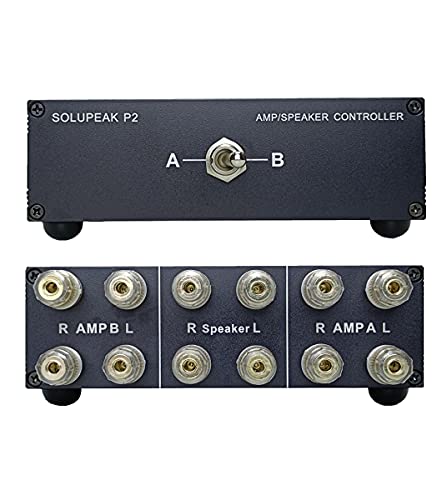
The SOLUPEAK P2 supports two connection arrangements: two amplifiers to one speaker pair, or one amplifier to two speaker pairs. In either direction, its A/B button selects between the connected options. It is a passive, non-powered unit, so its listed operation does not require an external power supply.
- Can be used as a 2-in/1-out amp selector or a 1-in/2-out speaker selector.
- Uses gold-plated banana jacks that accept speaker wire up to 12 gauge.
- Designed for quick A/B comparison without repeatedly changing speaker wires.
Best for: Buyers who need a simple manual selector for comparing two amplifiers or choosing one of two speaker pairs. The reversible configuration makes it more flexible than a switch designed for only one direction.
Limitation: When used with one amplifier and two speaker pairs, the pairs do not operate simultaneously. The product also specifies banana-plug speaker wire, not RCA cable.
RecPro Three-Position RV Speaker Switch

The RecPro switch is intended to manage interior and exterior speakers in an RV. Its three-position control allows a user to select interior audio, exterior audio, or both, which makes it a direct fit for installations where listeners need to choose where sound plays.
- Provides three selections: interior, exterior, or both speaker areas.
- Has a low-profile black surface designed to integrate with existing décor.
- Focuses on convenient switching between RV speaker locations.
Best for: RV owners who want a panel-style control for indoor and outdoor listening. It was selected because its stated purpose and three-position operation closely match common RV zone-switching needs.
Limitation: The provided product details do not specify power handling, speaker impedance, or terminal type. Confirm those details with the product documentation and your audio system before installation.
SOLUPEAK P3 Amp And Speaker Selector

The SOLUPEAK P3 is designed to switch between two amplifiers and two pairs of speakers. Its two toggle switches and banana-jack connections make it a more connection-focused option for users who want to compare amplifier and speaker combinations without unplugging and reconnecting speaker wires.
- Uses two 10A, 250V-contact 4PDT toggle switches with two-position ON/ON operation.
- Provides gold-plated banana jacks that accept wire up to 12 gauge.
- Lists separate switching of positive and ground connections and independent grounds between amplifiers.
- Uses internal UL1007 18 AWG, 600V wire, according to the product details.
Best for: Buyers who want a manual selector for comparing two amplifiers or two speaker pairs and need the listed separate-ground switching arrangement. It is a more specialized choice than a basic one-zone switch.
Limitation: Speaker pair A and speaker pair B do not play at the same time. Check the wiring layout and connection requirements before purchasing.
YGiTK Two-Zone Speaker Selector

The YGiTK selector is described for two basic layouts: one amplifier driving two speakers or two amplifiers driving one speaker. Its passive design requires no external power, and the spring-clip terminals are intended for direct speaker-wire connections.
- Uses independent on/off switches for flexible audio control.
- Supports a one-amplifier/two-speaker or two-amplifier/one-speaker arrangement.
- Uses spring-clip terminals and is described as a plug-and-play device.
Best for: Buyers seeking a straightforward passive selector with spring clips rather than banana jacks. It was included because it covers both amplifier and speaker selection in a compact, no-external-power format.
Limitation: The provided details do not state a power rating, impedance range, or whether the two speaker outputs can play simultaneously. Do not assume concurrent playback or compatibility without checking the product instructions.
Buying Guide: How To Choose A Speaker Switch
Do you need to select speakers or amplifiers?
Start by identifying what you want the switch to route. A speaker selector typically lets one amplifier feed one of several speaker pairs. An amplifier selector instead directs multiple amplifiers to a speaker pair. Some products can be used in either direction, but the input and output arrangement may change how they operate. The SOLUPEAK P2, for example, is described for both layouts, while the TENEALAY P21 focuses on controlling two speaker pairs from a stereo amplifier.
Write down the number of amplifiers, speaker pairs, and listening zones in your setup. Then match those counts to the selector’s listed configuration. Avoid assuming that a product can support a wiring arrangement simply because its name includes “2-way” or “selector.”
Should both speaker zones play at the same time?
Check this point before choosing a switch. Some selectors let users choose only speaker A or speaker B, while others offer a simultaneous option. The SOLUPEAK P2 states that its two speaker pairs do not work at the same time in speaker-selector mode. The SOLUPEAK P3 also specifies that its two pairs do not play together. The TENEALAY P21 is listed for two pairs at the same time or in combination, subject to its stated limits.
If simultaneous playback matters, look for an explicit statement in the product specifications. If the listing is unclear, confirm the operation before wiring the system.
How do impedance and power ratings affect the choice?
Compare the selector’s stated limits with the amplifier output and speaker specifications. The TENEALAY P21 lists support for 8–16 ohm speakers and a maximum of 80 watts per channel. Other products in this selection do not provide those figures in the supplied details, so do not treat their ratings as equal or assume they match your system.
When multiple speaker pairs are connected, the load presented to an amplifier can depend on the selector’s circuitry and how the speakers are used. Follow the manufacturer’s instructions and avoid exceeding any stated ratings.
Which connection type fits your wiring?
Banana jacks offer a plug-in connection for speaker wires fitted with banana plugs. Both SOLUPEAK models list gold-plated banana jacks and support wire up to 12 gauge. The YGiTK selector instead lists spring-clip terminals. Confirm that your speaker wire and installation method suit the terminals provided. The supplied product information does not establish the terminal style for every model.
For an RV or fixed installation, also consider where the control will sit and whether its physical format suits the panel or cabinet. The RecPro product is described as a low-profile control panel, while the other listed units are selector boxes.
Is a passive switch right for your system?
A passive switch does not require an external power supply for its switching function. The SOLUPEAK P2 and YGiTK products are explicitly described as passive. This can simplify placement because there is no separate power connection to plan for. However, passive operation does not by itself confirm compatibility, power handling, impedance support, or simultaneous playback.
Choose based on the full specification—not solely on whether a product is passive. Check its intended routing, connectors, and any listed electrical limits.
What should RV buyers compare?
For an RV, first decide whether you need to switch between indoor and outdoor speakers, or whether you need to route different amplifiers and speaker pairs. The RecPro switch specifically describes interior, exterior, and both-speaker positions. That makes its stated function more directly relevant to RV zone control than a general amplifier-comparison switch.
Before installation, verify wiring, dimensions, and electrical specifications against the documentation for the switch and the RV audio system. Those details are not all provided in the listed product features.
Frequently Asked Questions
Can I use a toggle switch to choose between two speaker pairs?
Yes, if the switch is designed for speaker-level connections and its configuration matches your system. Check whether it selects one pair at a time or supports simultaneous playback.
Can one amplifier power two speaker pairs through a selector?
Some selectors are designed for this arrangement. Confirm the product’s supported speaker count, impedance range, and power limits. The TENEALAY P21 is listed for two pairs and specifies 8–16 ohm speakers and up to 80 watts per channel.
Can I connect two amplifiers to one pair of speakers?
Some products in this list are described for that layout, including the SOLUPEAK P2 and YGiTK selector. Follow the product’s specified connection direction and instructions rather than connecting amplifier outputs together.
Do speaker selector switches need power?
Not always. The SOLUPEAK P2 and YGiTK selector are described as passive and requiring no external power. Check the specific product details because not every switch has the same design.
Will two speaker zones play at the same time?
That depends on the switch. The SOLUPEAK P2 and SOLUPEAK P3 specify that their two speaker pairs do not play simultaneously. The TENEALAY P21 is described as supporting two pairs at the same time or in combination.
Are 3.5 mm audio switches interchangeable with speaker switches?
No. A 3.5 mm switch routes line-level or headphone-style audio connections, while a speaker selector handles speaker wiring. Choose a switch designed for the signal type and connections used by your system.