
The best hi-fi audio system depends on how you listen: the Edifier S3000MKII suits high-output stereo listening, the S355DB adds a wireless subwoofer for stronger bass, and the WiiM Sound Lite is designed for app-based streaming and multi-room use. For compact desks, the Edifier S880DB MKII offers high-resolution inputs, while the Klipsch RP-600M is a passive speaker pair for buyers who already have or plan to add an amplifier.
| System | Best For | Key Distinction |
|---|---|---|
| Edifier S3000MKII | Powerful stereo listening | 256W RMS, EQ presets, aptX HD Bluetooth |
| Edifier S355DB | Music and movies with stronger bass | 2.1 system with wireless subwoofer |
| WiiM Sound Lite | Streaming and multi-room audio | App, casting, and room optimization features |
| Edifier S880DB MKII | Desktop or compact hi-fi setups | USB-C, optical, coaxial, and RCA inputs |
| Klipsch RP-600M | Passive-speaker systems | Horn tweeter and 6.5-inch woofer |
Edifier S3000MKII Hi-Res 2.0 Speakers

The Edifier S3000MKII is a powered stereo system with 256W RMS output, so it does not require a separate external amplifier. Its 6.5-inch aluminum woofers and planar magnetic tweeters are specified for a 38Hz–40kHz frequency range. Four EQ presets—Classic, Monitor, Dynamic, and Vocal—let listeners select a sound profile for different kinds of material.
Best for: Buyers who want substantial stereo output and the convenience of active speakers. The system also suits listeners who want to switch between wired connections and wireless playback. Bluetooth 5.0 with aptX HD is listed for streaming, while a separate 5.8GHz/5.2GHz wireless link connects the two speakers.
Why it stands out: The combination of high stated RMS output, EQ options, and no need for a separate amplifier makes this a flexible choice for a main listening area.
Consider: This is a 2.0 system, not a package with a dedicated subwoofer. Choose another option if a separate subwoofer is a priority.
Edifier S355DB 2.1 Powered Speakers

The Edifier S355DB is a 150W 2.1 powered system designed to combine stereo speakers with a separate bass unit. Its listed components include 3.5-inch aluminum cone mid-bass drivers, 1.5-inch titanium dome tweeters, and an 8-inch wireless subwoofer. Digital signal processing, a tri-amped active crossover, and dynamic range control are specified as part of the system.
Best for: Listeners who want a dedicated subwoofer for music, movies, or a TV and gaming setup. The wireless 5.8GHz connection to the subwoofer can reduce the need to run a speaker cable between it and the main speakers.
Why it stands out: Unlike the 2.0 bookshelf systems here, this setup includes a subwoofer and supports high-resolution audio up to 24-bit/96kHz. It is also listed as certified for Hi-Res Audio and Hi-Res Audio Wireless.
Consider: A subwoofer takes up additional floor space, even when it connects wirelessly. Choose a 2.0 system if you prefer a simpler speaker layout or have limited room for a separate bass unit.
WiiM Sound Lite Smart Speaker

The WiiM Sound Lite is a single smart wireless speaker rather than a conventional stereo pair. Its listed hardware includes a 100W peak amplifier, a 4-inch paper-cone woofer, and two 1-inch silk-dome tweeters. It supports streaming up to 24-bit/192kHz and includes AI RoomFit technology intended to adjust sound for the room and speaker placement.
Best for: Buyers who prioritize streaming convenience, app control, and the option to group speakers around the home. The listed platform options include the WiiM Home App, Google Cast, Alexa Cast, DLNA, and Roon/LMS, along with Spotify, TIDAL, and Qobuz Connect.
Why it stands out: The Sound Lite offers a broad set of streaming and casting options, plus support for joining WiiM, Google Cast, and Alexa multi-room groups. This makes it a fit for a connected home audio setup.
Consider: It is a single-speaker design, so it is not the same as a left-and-right stereo pair. Choose a pair of bookshelf speakers if separate stereo channels are essential to your setup.
Edifier S880DB MKII Hi-Fi Speakers
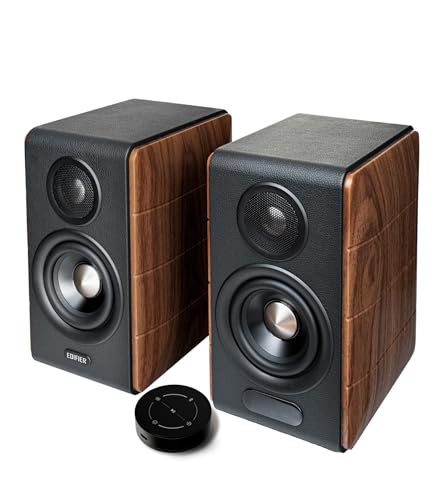
The Edifier S880DB MKII is a powered bookshelf-speaker system with 88W RMS output. Its listed drivers are 1.25-inch titanium-dome tweeters and 3.75-inch aluminum mid-woofers, with a stated frequency range of 20Hz–40kHz. For digital sources, it supports up to 24-bit/192kHz through USB-C, optical, and coaxial inputs. Analog RCA is specified up to 24-bit/96kHz.
Best for: Desktop listeners, creators, and buyers building a compact hi-fi setup with several source types. USB-C can suit computer audio, while optical, coaxial, and RCA inputs provide additional connection choices.
Why it stands out: The input selection and stated high-resolution playback support make this a practical choice for users who connect more than one kind of source. The product also lists an XMOS 16-core processor and dual Class-D amplification.
Consider: The 88W RMS system is less powerful on paper than the 256W RMS S3000MKII. Choose the larger system if its higher stated output is a priority.
Klipsch RP-600M Reference Premiere Speakers

The Klipsch RP-600M is a passive bookshelf-speaker pair with a 1-inch titanium LTS vented tweeter, a Hybrid Tractrix horn, and 6.5-inch spun copper Cerametallic woofers. The cabinet uses a rear-firing Tractrix port. Because the product is a passive speaker pair, buyers need an amplifier or receiver to power it; amplification is not listed as built in.
Best for: Buyers who want to choose their own amplifier or add speakers to an existing stereo or home theater system. The large woofer and horn-loaded tweeter are defining parts of the product’s stated design.
Why it stands out: This is the only selected passive pair, giving system builders more choice over the amplification component. It is a better fit for a modular setup than for someone seeking an all-in-one powered system.
Consider: An amplifier or receiver is required and is not included in the listed product description. Avoid this option if you want speakers that connect directly to a source without separate amplification.
Buying Guide: How To Choose A Hi-Fi Audio System
Do you want a powered system or passive speakers?
Powered speakers have amplification built in, which can simplify setup. The Edifier S3000MKII, S355DB, and S880DB MKII are described as powered or active systems, so they do not need a separate external amplifier. The Klipsch RP-600M is passive and requires an amplifier or receiver. Choose passive speakers if you want to select amplification separately; choose powered speakers if you prefer fewer components.
Is a 2.0, 2.1, or single-speaker setup right for you?
A 2.0 system uses two speakers for stereo playback without a dedicated subwoofer. The S3000MKII and S880DB MKII are 2.0 options. The S355DB is a 2.1 system, adding an 8-inch subwoofer for buyers who want a separate bass unit. The WiiM Sound Lite is a single smart speaker, which prioritizes streaming and room placement over a conventional left-right pair.
Which connections and streaming features matter?
List the sources you plan to use before choosing. The S880DB MKII specifies USB-C, optical, coaxial, and RCA inputs, making it useful when several digital and analog sources are involved. The S3000MKII lists aptX HD Bluetooth and a wireless link between speakers. The WiiM Sound Lite focuses on app, casting, and network-based streaming options. Check the product’s current specifications for the inputs and services you need.
How much output should you compare?
RMS power can help compare the stated output of powered systems, but it does not alone determine how a speaker will sound in a particular room. Among these selections, the S3000MKII lists 256W RMS, the S355DB lists 150W, and the S880DB MKII lists 88W RMS. The WiiM Sound Lite’s 100W figure is peak output, so it should not be treated as directly equivalent to RMS ratings.
Do you need high-resolution playback?
Check both the system’s supported formats and the connection used. The S880DB MKII lists 24-bit/192kHz support through USB-C, optical, and coaxial, while its RCA input is specified up to 24-bit/96kHz. The S355DB lists support up to 24-bit/96kHz. The WiiM Sound Lite lists streaming up to 24-bit/192kHz. Actual playback also depends on the source, connection, and audio material.
Where will the speakers go?
Measure the space for speakers and any separate subwoofer. A 2.1 system needs room for both the main speakers and its bass unit, while a desktop setup may benefit from a more compact pair. Consider where a rear-firing port or a wireless subwoofer will sit, and keep in mind that wireless connections reduce some cabling but do not eliminate the need to place and power components appropriately.
Frequently Asked Questions
What is a hi-fi audio system?
A hi-fi audio system is designed for high-quality music playback. It can include speakers, amplification, and source or streaming equipment. Systems vary: some combine amplification and speakers, while passive-speaker systems need a separate amplifier.
Which selected system is best for a separate subwoofer?
The Edifier S355DB is the selected 2.1 system and includes an 8-inch wireless subwoofer. It is the clearest choice here for buyers who want a dedicated bass unit included in the speaker system.
Which option is best for desktop listening?
The Edifier S880DB MKII is a strong fit for a desktop or compact setup because it is a bookshelf-speaker system with USB-C, optical, coaxial, and RCA inputs. The WiiM Sound Lite is another option for a desk if smart streaming and a single-speaker format are preferred.
Do passive speakers need a separate amplifier?
Yes. Passive speakers such as the Klipsch RP-600M require an amplifier or receiver to power them. Powered speakers have amplification built in and can simplify system setup.
Can a smart speaker provide stereo sound?
A single smart speaker can play audio without a separate stereo pair, but it is not equivalent to a conventional left-and-right speaker setup. The WiiM Sound Lite is described as a single speaker; choose a stereo pair if separate left and right channels are important.
Does a higher wattage rating guarantee better sound?
No. A wattage figure does not by itself establish sound quality. Compare system type, driver design, inputs, room requirements, and whether the rating is RMS or peak. Also consider how much output is appropriate for the listening space.