
A small upright digital piano can bring a full-size, 88-key playing layout to a home without requiring a traditional acoustic upright. The AKLOT is best for players seeking weighted keys and built-in practice extras; the AiJoy is aimed at beginners who want a simpler setup; and the Ktaxon combines a weighted keyboard with a desk-style design. The KAWAI listing is a natural upright-piano option, while the piano light is an accessory rather than an instrument.
| Product | Best suited for | Key distinction |
|---|---|---|
| AKLOT Weighted Upright Digital Piano | Players wanting weighted keys and included practice features | Graded hammer action, triple pedal, sliding lid |
| KAWAI Upright Piano Natural | Shoppers considering a traditional upright | Product listing identifies it as an upright piano |
| AiJoy Home Digital Piano | Beginners and quiet home practice | Semi-weighted keys, headphones, USB-MIDI |
| Ktaxon 88 Key Weighted Digital Piano | Players wanting a desk-style instrument | Fully weighted keys and Bluetooth MIDI |
| LED Piano Light | Piano owners needing music-stand lighting | Lighting accessory, not a piano |
AKLOT Weighted Upright Digital Piano

The AKLOT is best for buyers who want an upright-style digital piano with a more piano-like key action and several practice-oriented features. Its listed specifications include 88 graded hammer-action keys, a sliding piano lid, ambient lighting, four classic piano tones, and a triple pedal.
It also includes dual 25-watt stereo speakers, headphones, and a lesson book. Those bundled items make it a practical option for someone setting up a home practice area and looking for more than a keyboard alone. The graded hammer action is a useful distinction for players prioritizing a weighted response across the keyboard.
- Best for: Home players who want weighted keys, pedals, and included learning accessories.
- Why it stands out: It combines 88 graded hammer-action keys with a sliding lid and built-in speakers.
- Consider: The listing describes a digital piano, not an acoustic instrument. Buyers seeking the sound and mechanics of a traditional upright should compare it with an acoustic model.
Choose this if the key action and included accessories matter more than getting the smallest possible keyboard. Check the dimensions and room layout before ordering, since the supplied product information does not state the piano’s measurements.
KAWAI Upright Piano Natural

The KAWAI listing identifies the product as an upright piano with a natural finish. It is best suited to shoppers specifically exploring an upright-style piano rather than a compact digital keyboard. The name alone, however, does not establish whether the instrument is acoustic or digital, or provide details about its dimensions, key action, pedals, or included accessories.
That limited product information makes it important to verify the listing details before making a purchase. If you are comparing it with a digital piano, confirm the instrument type and the space it requires. A traditional upright can be a different fit for a room than a digital cabinet, but the supplied listing data does not provide measurements or construction details.
- Best for: Buyers who want to investigate a KAWAI upright piano in a natural finish.
- Why it is included: It is the clearest upright-piano-named instrument among the supplied products.
- Consider: The available product information is sparse. Confirm instrument type, dimensions, condition, delivery details, and included components on the listing before deciding.
Choose this if you are open to an upright piano and can confirm the exact product specifications. Avoid assuming it has digital features, a particular action, or a particular footprint based only on the product name.
AiJoy Home Digital Piano

The AiJoy is best for beginners who want a full 88-key layout, onboard speakers, and options for quiet practice. Its 88 semi-weighted keys are intended to provide a piano-like response, while the listed 128-note polyphony supports notes sounding together. Dual 15-watt speakers provide room sound, and a headphone connection offers a way to practice more quietly.
The listed features also include a three-pedal unit and USB-MIDI. The product description highlights a minimalist design without screens, which may suit buyers who prefer a straightforward practice setup. These features make it a beginner-oriented alternative to models that emphasize graded or fully weighted action.
- Best for: New players, families, and adults looking for a home digital piano with headphones and speakers.
- Why it stands out: It combines 88 semi-weighted keys, 128-note polyphony, USB-MIDI, and a three-pedal unit.
- Consider: The keys are described as semi-weighted, not fully weighted or graded hammer action. Buyers who specifically want those actions should compare other models.
Choose this if a beginner-friendly feature set and flexible practice volume are priorities. Compare the key feel carefully if the goal is to reproduce the resistance of a traditional piano action.
Ktaxon 88 Key Weighted Digital Piano

The Ktaxon is best for buyers interested in a weighted digital piano with a desk or vanity-style format. The product name lists fully weighted keys, a three-pedal unit, Bluetooth MIDI, and a wood finish. It is described as a home desk piano and as a setup for beginners.
Compared with the AiJoy, this model is the better fit on paper for a buyer who prioritizes fully weighted keys rather than semi-weighted keys. Bluetooth MIDI is another listed feature that may matter to people planning to connect the instrument to compatible music equipment or software. Confirm connection requirements for your intended setup before buying; the supplied product information does not explain them.
- Best for: Beginners or home players wanting a desk-style digital piano with fully weighted keys.
- Why it stands out: Its listed features include a three-pedal unit and Bluetooth MIDI.
- Consider: The product title uses both “piano” and “vanity desk” language. Review the listing’s dimensions and configuration to confirm it suits your room and use.
Choose this if you want a weighted-key model with a furniture-oriented design. Compare its footprint and setup requirements with a conventional upright-style digital piano before committing to a small room arrangement.
LED Piano Light With Wide Illumination
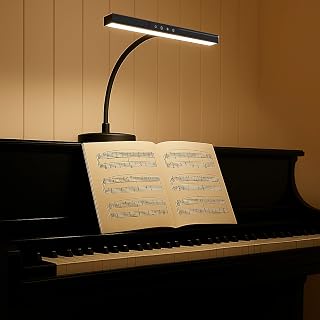
This product is a piano light, not an upright piano. It is best for someone who already owns an instrument and needs lighting for sheet music. The listing describes a wide-illumination LED lamp with three color modes, dimming, a gooseneck, and a timer. It is presented for use with upright, grand, and digital pianos.
As an accessory, it can be considered alongside a piano purchase when the practice area has limited or uneven lighting. Its flexible neck is a listed design feature, while the adjustable brightness and color modes offer lighting choices. The supplied information does not specify power source, clamp design, or exact dimensions, so confirm those details if they affect your music stand or placement.
- Best for: Piano owners who need an adjustable light for sheet music.
- Why it is included: It is relevant to setting up a compact piano practice corner, though it is not an instrument.
- Consider: Do not select it as a substitute for a piano. Check the listing for attachment and power details before purchase.
Choose this only as an add-on if your main need is music-stand lighting. Buyers shopping for a small upright piano should focus first on an instrument and treat this item as optional equipment.
Buying Guide: How To Choose A Small Upright Piano
Should you choose a digital piano or an acoustic upright?
Start by deciding what you mean by “upright.” A digital upright-style piano uses electronic sound and may provide features such as headphones, MIDI connections, or built-in speakers. An acoustic upright produces sound mechanically and is a different type of instrument. The supplied KAWAI name identifies an upright piano, but the provided details do not confirm its type. Verify that distinction before comparing it with digital models.
For a home where quiet practice or electronic connections matter, compare digital models and check their listed headphone and MIDI features. For a buyer seeking a traditional upright, verify the construction and all listing specifications rather than assuming them from the product title.
How much room will the piano take?
“Small” is relative: a piano can still take up substantial floor or desk space. Measure the intended location, including the space needed for a bench, pedal use, and comfortable access to the keys. Compare those measurements with the product’s listed dimensions. The supplied product details do not include measurements for the instruments, so check the individual listings rather than estimating their footprints.
Also consider whether the instrument is intended to stand against a wall, sit at a desk, or function as a furniture-style unit. The Ktaxon product name emphasizes a desk and vanity format, while the AKLOT name describes a sliding lid. Those design descriptions can help guide your comparison, but they do not replace confirmed dimensions.
What kind of key action should you look for?
Key action affects the feel under the fingers. The products here describe three distinct options: the AKLOT has graded hammer action, the Ktaxon has fully weighted keys, and the AiJoy has semi-weighted keys. These descriptions are not interchangeable. Beginners who want a weighted feel may prefer to compare the AKLOT and Ktaxon closely, while the AiJoy may suit someone comfortable with semi-weighted action.
If possible, try the action in person or check the seller’s detailed description. A product title may not explain how the keys respond across the full keyboard, and the supplied information does not provide a direct hands-on comparison.
Do you need pedals, speakers, or headphones?
Pedal configuration matters for players who plan to learn or perform music that uses sustain and other pedal techniques. The AKLOT lists a triple pedal, as do the AiJoy and Ktaxon. Confirm whether the pedal unit is included and how it is configured in the specific listing before purchase.
Built-in speakers support playing without separate audio equipment. The AKLOT lists dual 25-watt stereo speakers, while the AiJoy lists dual 15-watt speakers. The AiJoy also names headphone practice, and the AKLOT product name includes headphones. Compare those details with your room and practice habits rather than treating speaker wattage alone as a measure of overall sound quality.
Which connectivity features matter?
Choose connections based on how you plan to use the piano. The AiJoy lists USB-MIDI, and the Ktaxon lists Bluetooth MIDI. These features may be useful for a digital music workflow, but the supplied details do not specify device requirements or software compatibility. Confirm connection instructions and compatibility with your equipment before buying.
If you only want to play the piano itself, connectivity may be less important than key feel, pedals, and room fit. If you intend to connect to a computer or other device, prioritize a product with the connection type you need and verify the details in the listing.
What should you confirm before placing an order?
- Check the product’s actual dimensions and whether a stand, bench, or pedal unit is included.
- Confirm whether the instrument is acoustic or digital.
- Compare semi-weighted, fully weighted, and graded hammer-action keys according to your playing goals.
- Review speaker, headphone, MIDI, and pedal details for the exact model.
- For a traditional upright, confirm delivery, setup, and any other purchase requirements directly in the listing.
- Separate instrument purchases from accessories: the LED piano light does not include a piano.
Frequently Asked Questions
What is the best small upright piano for beginners?
The AiJoy is a beginner-oriented option with 88 semi-weighted keys, dual speakers, a three-pedal unit, and a headphone connection. The Ktaxon is another option for beginners who prefer fully weighted keys. Compare the action type and dimensions before choosing.
Which product has graded hammer-action keys?
The AKLOT product listing specifies 88 graded hammer-action keys. The Ktaxon lists fully weighted keys, and the AiJoy lists semi-weighted keys.
Can I practice quietly with these digital pianos?
The AiJoy listing specifies headphone support, and the AKLOT product name includes headphones. Confirm the headphone connection and included accessories in the current product listing before purchase.
Is the LED piano light an upright piano?
No. It is a music-stand light accessory described for use with upright, grand, and digital pianos. It does not replace an instrument.
Does “small upright piano” always mean digital?
No. The phrase can refer to an upright-style digital piano or a traditional acoustic upright. Check each product’s instrument type and dimensions because those details are not established by the phrase alone.
Which model includes MIDI?
The AiJoy lists USB-MIDI, and the Ktaxon lists Bluetooth MIDI. Verify the connection requirements and compatibility for your intended setup in the product details.