
The best guitar amp and pedal setup depends on whether you need a portable practice rig, a flexible effects unit, or a dedicated combo amplifier. The JOYO JAM Buddy II is best for players who want an amp and effects in one compact unit, while the MOOER GE100 is better for building and saving a library of tones. The Fender Champion II suits electric guitarists seeking a traditional combo with built-in effects, and the Fishman PRO-LBT-500 is designed for acoustic amplification. A second JOYO listing offers the same feature set in a different color.
| Product | Best suited for | Main distinction |
|---|---|---|
| JOYO JAM Buddy II, Orange | Portable practice and recording | Speakers, amp models, looper, and drums |
| MOOER GE100 | Preset-based effects control | 66 effects and expression pedal |
| JOYO JAM Buddy II, Gray | Portable all-in-one practice | Same listed features as the orange model |
| Fishman PRO-LBT-500 | Acoustic guitar amplification | Two channels, reverb, and chorus |
| Fender Champion II 25 | Electric guitar combo use | 25 watts and built-in effects |
JOYO JAM Buddy II Orange

Best for: Guitarists who want a portable practice amp with effects and basic creative tools built into one device. The JOYO JAM Buddy II combines a 10-watt amplifier, dual 2-inch full-range speakers, a bass radiator, and multiple amp models in a compact unit listed at 940 grams.
Its 14 amp models cover clean, blues, and high-gain sounds. Players can shape tones with a 3-band EQ and gain controls, then choose from nine built-in effects, including modulation, delay, and reverb. Three channels—Clean, Rhythm, and Lead—provide distinct starting points for different styles.
For practice and songwriting, the unit includes 36 drum patterns, a 30-second looper, a tuner, and one-tap memory for saving settings. Bluetooth and OTG recording are included in the product name and features, making this a practical choice for players seeking a self-contained setup rather than separate amp and pedal purchases.
Why it was selected: It combines amplification, tone modeling, effects, rhythm backing, and looping in a single portable product. Limitation: Its 10-watt rating and small speakers make it a practice-focused option; the listed specifications do not establish that it can replace a larger stage amp.
MOOER GE100 Multi-Effects Pedal

Best for: Players who want a broad selection of effects and saved tones from a single pedal unit. The GE100 offers 66 effect types across eight effect modules, giving guitarists options for assembling different sounds without buying individual stompboxes for every effect.
The pedal provides 80 preset patches and 80 user patches. Players can save preferred tones to user locations, which is useful when switching between sounds for practice or songs. Its six assignable expression-pedal parameters allow physical control of selected tone settings.
The GE100 is an effects processor, not a speaker-equipped guitar combo amp. Its adjustable output mode includes a line-out setting intended to retain a suitable tone when playing without an amp, according to the product information. This makes it relevant to buyers comparing an amp-and-pedal setup with an effects-only approach.
Why it was selected: It is the most effects-focused option in this group, with extensive preset storage and expression control. Limitation: Buyers who need sound from a standalone speaker should choose an amp or an amp-and-effects combo instead of relying on this pedal alone.
JOYO JAM Buddy II Gray
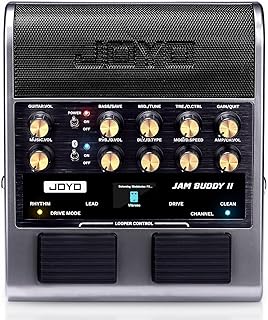
Best for: Buyers who want the JAM Buddy II feature set in the gray color option. The listed specifications match the orange version: a 10-watt portable amp, dual 2-inch speakers, a bass radiator, and a listed weight of 940 grams.
The gray model includes 14 amp models, nine effects, three channels, and a 3-band EQ with gain control. Its built-in practice tools include 36 drum patterns, a 30-second looper, a tuner, and memory for saving tone and drum settings. Bluetooth and OTG recording are also identified in the product listing.
As with the orange model, the main appeal is the combination of an amplifier and effects in one small unit. It can suit beginners who want to explore different tones as well as more experienced players who want a portable practice or idea-capture setup.
Why it was selected: It offers an all-in-one alternative to assembling a separate practice amp and effects pedal. The gray listing gives shoppers a second color choice among the supplied products. Limitation: Its listed 10-watt output and compact speakers are more suited to personal practice than to filling a large room.
Fishman PRO-LBT-500 Acoustic Amp

Best for: Acoustic guitarists looking for a dedicated amplifier with two channels and built-in reverb and chorus. The supplied details list 60 watts, master volume, phase control, and a weight of 21.2 pounds.
The two-channel layout is a distinguishing feature for players who need more than one input channel. Reverb and chorus provide onboard effects without requiring a separate effects pedal for those particular sounds. Phase control and master volume are also listed controls.
This Fishman model is a different kind of choice from the JOYO units and MOOER pedal. It is identified as an acoustic guitar amplifier, while the other products focus on electric guitar tones or multi-effects. Buyers comparing systems should choose based on instrument and intended sound rather than the number of effects alone.
Why it was selected: It fills the acoustic-amplification role in a group otherwise centered on electric guitar practice and effects. Limitation: At 21.2 pounds, it is substantially heavier than the compact JOYO unit, and its listed effects are limited to reverb and chorus.
Fender Champion II 25

Best for: Electric guitarists who want a conventional combo amplifier with a built-in effects suite. The Champion II is rated at 25 watts and has an 8-inch Fender special-design guitar speaker. Its listed dimensions are 16.4 inches deep, 14.1 inches wide, and 10.1 inches high.
The built-in effects include reverb, delay or echo, chorus, tremolo, and Vibratone, among others. A Tap button lets players set delay times and tremolo speeds to match a song’s tempo. That feature can make it easier to coordinate time-based effects without adding a separate pedal for those settings.
Unlike the JAM Buddy II, the Champion II is presented as a speaker-equipped combo amp rather than a palm-sized portable practice device. It may suit players who want a dedicated amp and a range of onboard effects in one cabinet.
Why it was selected: It offers a middle ground between a basic combo and a separate amplifier-plus-pedal rig, with 25 watts and several built-in effects. Limitation: It is larger than the portable JOYO unit, and its listed information does not describe the same looper and drum-machine features.
Buying Guide: How To Choose A Guitar Amp And Pedal
A guitar amp and pedal setup can mean an amplifier paired with one or more effects pedals, a combo amp with effects built in, or a multi-effects unit connected to an amplifier. Decide first whether you need a speaker-equipped product. The MOOER GE100 supplies effects and output modes, while the JOYO JAM Buddy II and the two combo amps include speakers.
Do you need an amp, a pedal, or both?
Choose a combo or amp-and-effects unit if you need a product that produces sound through its own speakers. The JOYO JAM Buddy II combines a compact amp with models, effects, and practice tools. The Fender Champion II and Fishman PRO-LBT-500 are dedicated combo amplifiers. Choose the MOOER GE100 if your main need is effects, presets, and expression control, and you already have a way to hear the signal.
Which product fits your instrument?
The Fishman PRO-LBT-500 is specifically identified as an acoustic guitar amplifier. The JOYO and Fender products are described for electric guitar. Match the amp to the instrument and the sound you want before comparing effects counts. The number of effects alone does not determine whether an amplifier is suitable for a particular guitar or playing situation.
How important is portability?
For a compact practice setup, the JOYO JAM Buddy II is the clearest fit in this selection: it is listed at 940 grams and has built-in speakers. The Fender and Fishman amplifiers are larger combo formats, with the Fishman listed at 21.2 pounds. The GE100 is a pedal rather than a complete speaker-equipped practice rig, so assess what other equipment you would need to use it.
Do you want presets or hands-on effects?
The MOOER GE100 emphasizes stored sounds, with 80 preset patches and 80 user patches, plus six assignable expression-pedal parameters. The JOYO JAM Buddy II offers amp models, effects, three channels, and memory for saving settings. The Fender Champion II includes effects such as delay, chorus, and tremolo, with a Tap button for setting delay time and tremolo speed.
What practice features matter?
If you want to play along with rhythms or build musical ideas, the JOYO JAM Buddy II lists 36 drum patterns and a 30-second looper. Its built-in tuner is another practice convenience. The product information for the other options does not list the same drum-machine and looper combination, so those features may be a deciding factor for solo practice and songwriting.
How should you compare wattage and speaker details?
Wattage and speaker size are useful comparison points, but they do not tell the whole story about perceived loudness or suitability for every room. The listed figures are 10 watts for the JOYO JAM Buddy II, 25 watts with an 8-inch speaker for the Fender Champion II, and 60 watts for the Fishman PRO-LBT-500. Consider where you will play and whether the unit needs to serve as a personal practice amp or a larger combo.
Are built-in effects enough?
Built-in effects can reduce the need for separate pedals when the available sounds meet your needs. The JOYO models list modulation, delay, and reverb among nine effects; the Fender lists reverb, delay or echo, chorus, tremolo, and Vibratone; the Fishman lists reverb and chorus. The MOOER offers 66 effect types. Check whether you prefer a focused onboard selection or a dedicated multi-effects library.
Frequently Asked Questions
Can the MOOER GE100 work as a guitar amp by itself?
The GE100 is listed as a multi-effects pedal, not a speaker-equipped amplifier. Its line-out mode is described as providing a suitable tone when playing without an amp, but the supplied information does not say that the pedal contains a speaker.
Which option includes a looper and drum patterns?
Both JOYO JAM Buddy II listings include a 30-second looper and 36 drum patterns. The orange and gray versions have the same listed feature set.
Which product is intended for acoustic guitar?
The Fishman PRO-LBT-500 is identified as an acoustic guitar amplifier. Its listed features include two channels, reverb, chorus, phase control, and 60 watts.
Do the JOYO orange and gray models have different features?
The supplied feature descriptions are the same for both color listings. They each list 14 amp models, nine effects, three channels, a 3-band EQ, 36 drum patterns, a 30-second looper, a tuner, Bluetooth, and OTG recording.
Which product has the most listed effects?
The MOOER GE100 lists 66 effect types across eight modules. The JOYO JAM Buddy II lists nine built-in effects, while the Fender and Fishman product details name selected onboard effects.