
If you want to use a car charger from a household outlet, choose an AC-to-DC adapter that converts wall power to a 12V car socket. If you want household-style AC outlets in a vehicle, choose a car power inverter instead. The PiSFAU inverter is best for several devices and AC plugs; the 24W converter suits low-power car accessories; and the 500mA adapters are for very low-current devices. Check the direction of conversion and the device’s power requirements before buying.
| Product | Power direction | Best for |
|---|---|---|
| PiSFAU 200W Inverter | Vehicle 12V to AC and USB | Multiple devices in a car |
| 24W AC-to-DC Adapter | Household AC to 12V car socket | Low-power car electronics indoors |
| Universal 500mA Adapter | Household AC to 12V car socket | Very low-current accessories |
| AICEL 500mA Adapter | Household AC to 12V car socket | Small 12V devices with low draw |
| YSOLX 300W Inverter | Vehicle 12V to AC and USB | Travel and outdoor charging |
PiSFAU 200W Car Power Inverter
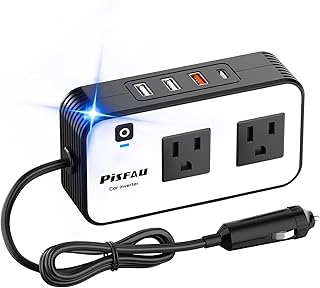
Best for: Drivers who need to run or charge several devices from a vehicle, including devices that use a standard AC plug. This is a vehicle-to-outlet inverter, not an adapter for plugging a car charger into a household wall outlet.
Its listed features include two U.S.-style AC outlets, four USB charging ports, and conversion from 12V DC to 110V AC. The compact body measures 2.7 by 1.4 by 5 inches and weighs 8.5 ounces, according to the product information. The manufacturer also describes its circuit design as efficient and its heat-dissipation design as intended to reduce noise.
Choose this if you want both USB ports and AC outlets in a portable car adapter. Avoid it if your goal is to power a 12V car accessory from a home wall socket: it converts in the opposite direction. Check the power needs of each device before use.
24W AC-to-DC Car Socket Adapter

Best for: People who want to power a low-wattage car accessory indoors from a household outlet. This adapter converts 110–240V AC wall power to a 12V DC car cigarette-lighter socket.
The stated maximum output is 24W, or 2A. The listed examples of suitable low-power accessories include dash cams, FM transmitters, air purifiers, and humidifiers. The product description also lists short-circuit, overheat, and overload protection, and a durable ABS housing.
This is a power supply adapter, not a battery charger. Its 24W ceiling is a key limitation: the listing warns against using it with high-power devices such as car inflators, vacuum cleaners, refrigerators, coolers, or heating pads. Check the accessory’s rated voltage, current, and wattage before connecting it.
Universal 500mA AC-to-Car Adapter

Best for: Users with a small 12V car accessory that draws no more than 500mA. It converts 90–240V AC from a wall outlet into 12V DC and provides a car-style socket.
The product listing names GPS units and dash cams among possible uses, as well as other small 12V car electronics. It has an indicator light to show operating status and is described as easy to use: plug the adapter into a wall outlet, then connect the accessory’s car plug.
The 500mA output is only 6W, so this model is for low-power devices. The listing specifically cautions against high-power equipment such as vacuum cleaners and air compressors. Do not assume that a device is suitable just because its plug fits; confirm that its current draw is within the adapter’s limit.
AICEL 12V 500mA Wall Adapter

Best for: Someone who needs a compact household power source for a very low-current 12V car accessory. This adapter’s stated input is 90–240V AC, and its output is 12V at 500mA, equivalent to 6W.
The listing describes an ABS enclosure and an LED indicator. It names small electronics such as GPS units, MP3 players, and Bluetooth FM transmitters as possible uses. It also mentions air pumps and portable coolers, but the same listing warns that devices requiring more than 6W cannot be used directly. Treat the output limit as the deciding factor.
Choose this if the accessory’s label confirms that it operates at 12V and draws no more than 500mA. Avoid it for a car vacuum, inverter, pump, or other appliance whose power requirement exceeds 6W. The product information’s broad application examples do not override the stated output limit.
YSOLX 300W Portable Car Inverter

Best for: Travelers and campers who want multiple charging connections from a vehicle. The listed outputs include two 110V AC outlets and four USB-C/A charging ports, with USB charging described as 24W.
This is another vehicle-to-household-power inverter. The product description lists phones, cameras, laptops, game consoles, and other devices as examples, and describes use during travel and outdoor activities. It also has an intelligent cooling fan, which the listing says is designed to operate more quietly and steadily during prolonged use.
Choose this if you need several output ports for vehicle or campsite use. It is not the right product for powering a car charger from a household wall outlet because it takes vehicle power as its source. The stated 300W figure does not mean every connected device is suitable; check the inverter’s instructions and each device’s power draw.
Buying Guide: How To Choose The Right Direction
The phrase “car charger into wall outlet” can refer to two different setups. Identify which device supplies power before shopping. An AC-to-DC adapter takes power from a home outlet and supplies a 12V car socket. A car inverter takes 12V power from a vehicle and supplies AC outlets or USB power.
Do you want to use a car charger at home?
Look for an AC-to-DC car socket adapter. Its input should match household AC power, and its output should match the car accessory’s voltage and current requirements. The 24W adapter in this list provides more capacity than either 500mA model, but it still has a firm 24W maximum. The two 500mA adapters are limited to 6W.
These adapters provide power to a car accessory; they do not necessarily charge a vehicle battery. They also do not turn a car plug into a general-purpose USB charger unless the product includes those outputs, which these listed wall adapters do not specify.
Do you want a regular outlet in your car?
Choose a car power inverter. An inverter takes vehicle power and converts it to AC output for devices with household-style plugs. The PiSFAU model lists two AC outlets and four USB ports; the YSOLX model lists two AC outlets and four USB-C/A ports. Both are intended for vehicle power, not for use as wall adapters.
Match the inverter’s stated capacity to the devices you plan to connect. Add the power requirements of devices used at the same time and follow the product’s instructions. A plug that fits an outlet does not guarantee that the inverter can supply enough power.
How do you compare watts, volts, and amps?
Voltage describes the electrical supply a device needs; current describes how much electrical flow it draws; and watts measure power. For a 12V accessory, check its label for the required voltage and current. A rough power calculation is volts multiplied by amps. For example, 12V at 0.5A equals 6W, which matches the stated output of the 500mA adapters.
Do not rely on a product’s broad compatibility list if a specific power limit is also stated. The clearest constraint is the adapter’s maximum output. A car appliance that needs more than that limit may not operate properly and could damage the adapter.
What safety and fit details should you check?
- Conversion direction: Confirm whether the product converts household AC to 12V DC or vehicle 12V DC to AC.
- Output rating: Compare voltage, current, and wattage with the device label or manual.
- Device type: Distinguish a power supply from a battery charger. The 24W model is explicitly described as a power supply, not a charger.
- Use limits: Avoid connecting high-power equipment to low-output adapters.
- Connections: Check whether you need a car socket, USB port, or household AC outlet.
Which option is better for travel?
For charging from a vehicle, consider an inverter with the outputs you need. The PiSFAU listing emphasizes a compact design, while the YSOLX listing emphasizes multiple ports and a cooling fan. For using a low-power car accessory at home, choose an AC-to-DC adapter instead. Its output limit—not its portability—is the more important comparison.
Frequently Asked Questions
Can I plug a car charger into a household wall outlet?
Yes, if you use an AC-to-DC adapter that converts wall power to a 12V car socket. Match the adapter’s voltage and current limits to the car accessory. A car inverter is not the right device for this purpose because it converts power in the opposite direction.
What is the difference between an inverter and an AC-to-DC adapter?
An inverter converts a vehicle’s 12V DC power into AC outlets or other outputs. An AC-to-DC adapter converts household AC power into a 12V car-style socket. Choose based on whether the power source is your vehicle or a wall outlet.
Can a 500mA wall adapter run any 12V car accessory?
No. A 500mA adapter provides 12V at up to 0.5A, or 6W. It is suitable only for a compatible accessory that stays within that output limit. Many pumps, vacuums, and other car appliances need more power.
Is the 24W adapter a battery charger?
No. Its listing describes it as a regulated 12V power supply for car electronics, not a battery charger. Use a dedicated battery charger for charging a battery.
Can I use a car inverter from a wall outlet?
The listed car inverters are designed to receive vehicle power and provide AC or USB outputs. They are not described as household-powered converters. For powering a car accessory from a wall outlet, use an appropriately rated AC-to-DC adapter.
How can I tell whether an adapter has enough power?
Read the accessory’s label or manual for its voltage, current, and wattage. Confirm that the adapter matches the required voltage and can supply at least the required current and power. Do not exceed the adapter’s stated maximum output.